Get Full Government Meeting Transcripts, Videos, & Alerts Forever!
Get email alerts on the Administrative Hearings Rulemaking topic
No spam. Unsubscribe anytime.
Office of Administrative Hearings defends central-panel model, highlights contested-case workload and public hearings
Summary
Chief Administrative Law Judge Jenny Starr told the committee the Office of Administrative Hearings provides independent contested-case hearings, handles large workers' compensation caseloads and uniquely oversees rulemaking public hearings in Minnesota's central-panel model.
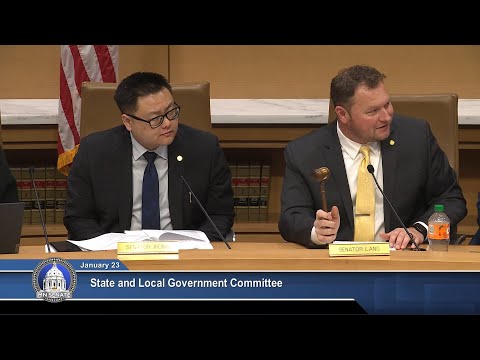
Jenny Starr, chief administrative law judge at the Office of Administrative Hearings (OAH), told the Senate Committee on State and Local Government on Jan. 23 that OAH is Minnesota's centralized administrative judiciary and described the court's contested-case and rulemaking work.
"The office of administrative hearings is the largest of 3 courts that exist inside the executive branch of government," Starr said, describing the 32-judge bench and contested-case workload.
The nut graf: Starr said OAH resolves most workers' compensation cases without a hearing, provides an independent forum for agency rulemaking public hearings, and that the central-panel model preserves impartial adjudication separate from agency decision-making.
Starr said OAH receives nearly 10,000 new workers' compensation filings annually and more than 700 contested cases of other types; she said about 70% of workers' compensation matters are resolved without a hearing, about 30% are decided on their merits and fewer than 1% are appealed. Starr explained that judges at OAH are subject to the code of judicial conduct and that the agency bills other state agencies for contested-case hearings at an hourly rate she cited as $270 per hour.
Starr highlighted a recent public hearing on Baldwin Township incorporation that drew more than 1,000 attendees and described that public comment and judicial oversight as a core value of the central-panel model. She told committee members that 19 states have similar central panels for some areas of administrative law and that 5 states include workers' compensation in their central panels, as Minnesota does.
Committee members asked about areas OAH does and does not cover (for example, Minnesota does not place unemployment benefits or child maltreatment appeals at the central panel) and about rulemaking oversight. Starr said OAH's role in rulemaking is to review whether agencies followed required procedures and to hold public comment hearings; OAH does not set policy itself.
Ending: The committee took no action. Starr said OAH would continue to provide contested-case hearings and public-rulemaking processes and fielded a brief exchange about the court's longstanding public-facing role.