Get Full Government Meeting Transcripts, Videos, & Alerts Forever!
Get email alerts on the Legacy Fund Project Accountability topic
No spam. Unsubscribe anytime.
Bill would require outreach, risk assessments and reimbursement plans for legacy-funded land projects after contested tree removal case
Summary
Senate File 106 would add requirements to projects funded by Outdoor Heritage and Clean Water funds — including risk assessments, notice to adjacent landowners and plans to reimburse damages — after testimony about a disputed tree-removal incident on a private neighbor’s land. The committee laid the bill over for revision.
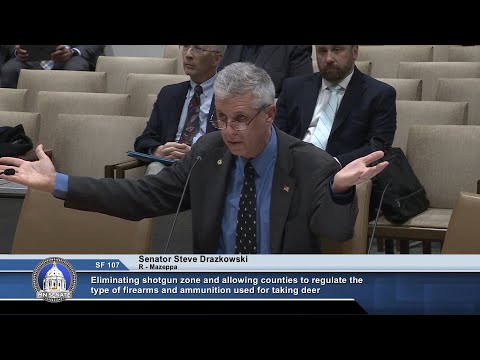
Senate File 106, introduced by Senator Drazkowski, would add bidder/recipient requirements for projects funded by the Outdoor Heritage Fund and Clean Water Fund to address impacts on adjacent private landowners. The bill was discussed in the Senate Environment Committee and laid over for further work.
The author said the bill responds to a constituent dispute in Brown County in which a Pheasants Forever contractor removed trees that an adjacent landowner, Eric Sellner, said were on his mother’s property. Sellner testified to the committee describing a multi-year dispute, sheriff and county attorney involvement that did not result in criminal charges, and civil litigation that he said cost him and his family substantial funds. “They got what they wanted and wouldn’t even compromise with us to regain some of the security that those trees had provided,” Sellner told the committee.
Senator Drazkowski said the proposed language would require project work plans to include an assessment of the risk of damage to adjacent properties, an explanation of how recipients will seek approval from adjacent owners to access adjacent land, notification of a public meeting describing the project and how adjacent owners will be reimbursed for damages sufficient to restore damaged condition from sources other than the Outdoor Heritage Fund.
Representatives of the Department of Natural Resources and the Pollution Control Agency raised concerns about the bill’s current language. Pat Rivers, Deputy Director for the Division of Fish and Wildlife at DNR, said requiring public meetings for Outdoor Heritage Fund restoration and enhancement projects on public lands “would hinder their timely progress” and that the department believes current projects are meeting ecological and community needs effectively. Tom Johnson of the MPCA said Clean Water Fund language on lines 2.20 (as drafted) could be read so broadly that monitoring and sampling activities might be pulled into new requirements, creating unintended burdens.
Mark Johnson, executive director of the Lessard-Sams Outdoor Heritage Council, told the committee staff had reviewed records and found extensive communication and offers to remediate the incident (fencing, trees, prairie restoration) between Pheasants Forever, DNR and the affected landowner. He said many details and offers to remedy were documented and that the council’s administrative review found the removed Siberian elms had “diminutive value” under the court’s finding, but also urged the committee to review the whole record before deciding on a broad statutory change.
Senators who spoke during the discussion expressed sympathy for affected private landowners and said they wanted to avoid future instances where legacy-funded projects impose costs on neighbors. Other senators and some witnesses warned the bill, as drafted, could impose significant time and expense on many smaller grant projects; one senator described potential consultant and meeting costs as burdensome.
The committee laid the bill over for possible inclusion so staff, author and agencies can work on language that balances neighbor protections and administrative burden.
Ending: Author and agency staff agreed to continue drafting and stakeholder outreach; the bill will return for consideration after language revision.