Get Full Government Meeting Transcripts, Videos, & Alerts Forever!
Get email alerts on the Cybersecurity Ai Governance topic
No spam. Unsubscribe anytime.
Minnesota IT Services highlights cybersecurity gains and warns of AI risks; committee asks about recent data breach probe
Summary
MNIT Commissioner Tarek Toombs presented the agency's portfolio and cybersecurity work, said Minnesota earned national recognition for digital government, and described AI governance steps; members asked about a recent public-safety data breach and forensics.
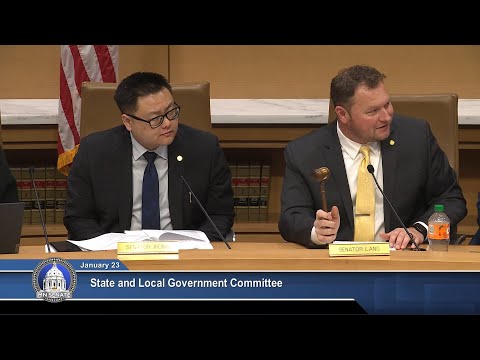
Tarek Toombs, commissioner of Minnesota IT Services (MNIT) and chief information officer for the state, briefed the Senate Committee on State and Local Government on Jan. 23 on MNIT's role supporting agencies, counties, schools and local governments and on cybersecurity and artificial intelligence governance.
"It's my pleasure to provide you with an overview of Minnesota IT Services, or MNIT as it's commonly referred to," Toombs said, summarizing MNIT's portfolio and noting that Minnesota recently received an "A grade for excellence in digital government" from the Center for Digital Government.
The nut graf: Toombs told the committee MNIT manages thousands of agency applications, a substantial project portfolio and tens of thousands of cybersecurity incidents per year; lawmakers pressed the commissioner on AI governance and a recent data breach affecting public-safety officers.
Toombs said MNIT supports about 41,000 executive-branch employees, manages more than 2,700 agency applications and a project portfolio of roughly 500 initiatives. He cited monthly service volumes (about 38,000 tickets per month) and said MNIT detects and resolves approximately 5,300 cybersecurity events annually and supports more than 375 statewide locations, including counties, cities, townships and public education institutions.
On cloud migration, Toombs said MNIT is a "multi cloud" organization and reported an approximately 105% increase in servers running in the cloud and an average 43% cost savings for workloads moved to cloud environments. He thanked the legislature for investments in cybersecurity tools, which he said strengthened statewide defenses.
Committee members pressed Toombs about artificial intelligence. Senator Heather Gustafson and others voiced concerns that third-party generative AI models may ingest state-generated content and raise accuracy, privacy and monopoly questions. Toombs said MNIT has created a classification model for AI risk (comparing it to autonomous-vehicle levels), has a governance structure, and earlier created an executive-branch policy warning employees not to put personally identifiable information into public AI tools and not to use such tools for final decision-making.
The committee also asked about a recent breach involving public-safety officer data. Toombs said MNIT is conducting forensic investigative work and asked the committee to allow that work to conclude; he offered to brief the legislative cybersecurity committee in closed session when appropriate and to return to the committee with public details that can be shared.
Ending: No legislative action was taken. Toombs said MNIT would provide published policies and follow up on requested materials, including the AI policy and more detail on cloud and cybersecurity investments.