Get Full Government Meeting Transcripts, Videos, & Alerts Forever!
Get email alerts on the Wildlife Management Hunting Firearms topic
No spam. Unsubscribe anytime.
Committee considers repeal of southern Minnesota shotgun-only deer zone; bill laid over
Summary
Senate File 107 would repeal an antiquated shotgun-only zone and clarify county authority to limit firearm discharge; supporters argue rifles are safer and simplify enforcement, opponents and county representatives urged careful local process. The bill was laid over for possible inclusion.
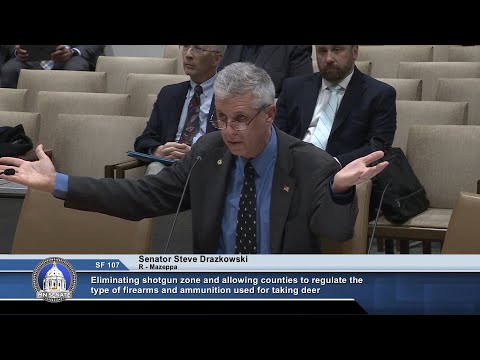
Senate File 107, which would repeal Minnesota’s shotgun-only deer hunting zone in the southern part of the state and clarify county authority to regulate the discharge of firearms, was discussed at length in the Senate Environment Committee and laid over for possible inclusion.
The bill’s author, Senator Drazkowski, told the committee the measure “repeals the antiquated” 97B.318 statute enacted in the 1940s and clarifies that counties retain authority under the state’s firearms preemption statute (Minn. Stat. 471.633) to regulate discharge within their jurisdictions.
The proposal drew testimony from Department of Natural Resources Assistant Commissioner Bob Meyer and multiple hunting and county-interest groups, who described safety, management and regulatory reasons to repeal the shotgun zone or to preserve local control. Meyer said the shotgun zone was originally adopted in the 1940s to limit deer harvest in open agricultural landscapes and that modern deer management emphasizes harvest limits and safety training. “Eliminating the shotgun zone would simplify regulations for hunters,” Meyer said, and could add a tool for reducing deer numbers and chronic wasting disease in parts of southern Minnesota.
Proponents cited data from other states. Senator Drazkowski pointed to a Wisconsin Department of Natural Resources report and a Pennsylvania study reported in committee materials, noting that in the cited data "76% used a rifle, 24% used a shotgun" and that in Wisconsin 42% of hunting incidents involved shotguns. Eric Simonson of the Minnesota Deer Hunters Association said the MDHA “express[s] our full support of this bill” and welcomed language that explicitly reiterates counties’ ability to adopt local ordinances to limit firearms if they choose. Several individual hunters and representatives who testified asked the committee to bring the state into alignment with neighboring states that allow statewide rifle hunting.
County officials and county associations urged care in how local authority would be preserved. Brian Martinson, environment and natural resources policy analyst for the Association of Minnesota Counties, said AMC has no formal position on repeal but criticized the bill’s then-current language that would have required annual re-adoption of county ordinances, calling that requirement burdensome. Martinson said county boards already provide public notice and opportunities for input when adopting ordinances. Senator McEwen offered an amendment (A1) to remove the annual re-adoption language; the author said he prefers citizens have the opportunity to be heard and was open to further language refinement. The A1 amendment was offered then withdrawn after members agreed to lay the bill over to allow additional drafting.
Opponents and skeptical listeners warned against creating a patchwork of county rules. Senator Lang and others said the committee should ensure the Department of Natural Resources and counties coordinate so a patchwork of rules does not cause confusion for hunters and enforcement. Senator Drazkowski and other supporters said the preemption statute already allows local units to regulate discharge and that explicit bill language is intended to reassure counties that want to preserve shotgun-only restrictions.
The committee did not vote to pass the bill; Chair Hur announced Senate File 107 will be laid over for possible inclusion so the author and stakeholders can refine language.
Votes at a glance: No formal recorded roll-call votes were taken in committee on Senate File 107; the committee action was to lay the bill over for possible inclusion.
Ending: Committee members and testifiers said they will continue to work on the bill text to protect local authority while addressing safety, CWD management and enforcement clarity. The author indicated interest in pursuing either a full repeal or clarified language that explicitly preserves county ordinance authority.