Get Full Government Meeting Transcripts, Videos, & Alerts Forever!
Get email alerts on the Mandatory Fraud Reporting topic
No spam. Unsubscribe anytime.
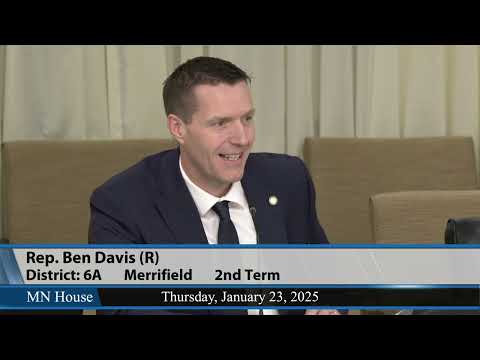
Rep. Davis moves bill to require state employees to report suspected fraud, tighten grant oversight
Summary
Representative Davis moved House File 2 before a House committee, presenting a bill that would require state agency employees to immediately report suspected fraud to law enforcement and to legislative budget committee leaders, the bill’s author said.
Representative Davis moved House File 2 before a House committee, presenting a bill that would require state agency employees to immediately report suspected fraud to law enforcement and to the chairs and ranking minority members of the House and Senate committees with jurisdiction over the agency’s operating budget, the bill’s author said.
The bill, described by Davis as mandatory fraud-reporting and oversight legislation, would also require agency organizational charts and divisional director contact information to be posted online; mandate unannounced, in-person site visits of grant recipients to verify work and financial stability; strengthen grantee obligations; and require each grant agreement to provide that the agreement be immediately suspended if the recipient is charged with a criminal offense and terminated if convicted.
House File 2’s author said the measure is a response to recent fraud scandals and to what she characterized as repeated agency failures to follow legislative auditor recommendations. “There was a time when Minnesota … was known for being a quiet state, responsible in government, accountable in our agencies,” Representative Davis said. “Those days are gone since Governor Walz has come to power,” she said, criticizing the current administration’s handling of prior cases cited during her presentation, including the CCAP fraud from 2017 and the Feeding Our Future scandal.
Davis summarized key provisions by section: Section 1 would require reporting to law enforcement and legislative budget committee leaders; Section 2 would require agency organizational charts and director/divisional contact information to be posted online; Section 34 would mandate unannounced in-person site visits of grant recipients; Section 5 would change current language that “encourages” reporting of grant-process violations to a requirement that state employees report violations to their supervisor, the commissioner or designee and the legislative auditor; and Section 10 would require suspension of grant agreements when a recipient is charged with a criminal offense.
Committee members pressed for clarifications about where employees must report and who is covered. Representative Anderson asked whether an employee must report to law enforcement and the legislative committee leaders, to a supervisor, or to both. Representative Davis said the bill makes clear employees must notify law enforcement and the ranking members of the House and Senate committees with jurisdiction, and also must report violations to a supervisor, commissioner or the commissioner’s designee. Davis added that the legislative auditor is included in reporting requirements.
Representative Collum suggested the bill should explicitly allow reporting to an appropriate inspector general in agencies that have such offices and noted that existing practice sometimes calls for contacting different law-enforcement entities depending on the alleged offense. “I think there could be some inclusion of a appropriate inspector general,” Collum said, adding he was willing to help with wordsmithing to align this bill with other measures.
Committee staff member Mr. Sullivan said he believes existing whistleblower protections apply. “I believe that they would. There's a general whistleblower protection statute, under state labor law. My understanding is that applies to all employees, public and private sector, but if I'm wrong I'll get back to the committee with more information,” he said.
Representative Joy suggested the committee consider language to immediately halt funding to grantees once fraud is reported. “I think it should halt at that moment until we get the investigation,” Joy said. Davis responded that Section 10 already provides for immediate suspension of grant agreements when a recipient is charged with a criminal offense and noted suspension, not termination, is appropriate when a charge (not a conviction) is filed because “you are innocent till proven guilty.”
Representative Sexton asked whether contract employees would be covered by the reporting and whistleblower protections; Davis said she was open to including contract employees and to discussing the detail further.
Chair Nash and committee members agreed to lay the bill over so a fiscal note can be prepared; the committee chair said he would not move bills without a fiscal note. Davis said she hoped additional questions and negotiations would permit refinement of the bill before it returns to committee.
Votes at a glance: The committee moved to lay over House File 2 for future consideration pending a fiscal note; no formal recorded roll-call vote was taken in the hearing record.
Ending: The bill remains under committee consideration, with staff assigned to produce a fiscal note and committee members indicating areas for follow-up language and stakeholder outreach, including to the Minnesota Council of Nonprofits.