Get Full Government Meeting Transcripts, Videos, & Alerts Forever!
Get email alerts on the Education Finance topic
No spam. Unsubscribe anytime.
Minn. school leaders tell committee paid-leave laws are raising substitute costs, straining budgets
Summary
School leaders from large and small districts told the Minnesota House Workforce, Labor, Economic Development, Policy and Finance Committee that changes to the state’s Earned Sick and Safe Time law and the Paid Family Medical Leave Act are raising substitute and payroll costs, adding administrative work and threatening classroom positions
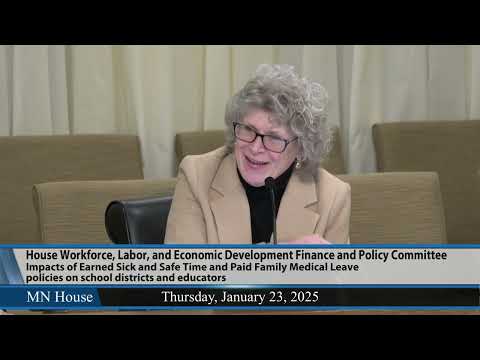
St. Paul — School leaders from large and small districts told the Minnesota House Workforce, Labor, Economic Development, Policy and Finance Committee on Jan. 21 that recent changes to state leave laws are driving higher substitute use, new administrative costs and potential teacher cuts.
“We have a couple that have over 43,000 days,” said Kimberly Lewis, representing the Minnesota School Boards Association, describing large accumulated sick-leave banks that districts are now required to convert or account for under ESST. “Another district has 32,000 days at a monetary value of over $12,000,000.”
Committee members said they convened the hearing to gather concrete examples of how the ESST law adopted in 2023 and changes proposed and enacted in 2024 are affecting districts’ operations and budgets. Testimony from superintendents and human-resources directors emphasized three recurring problems: tracking and administering leave for short-term and substitute employees; increased substitute and vendor costs passed to districts; and uncertainty about how the state’s paid-family medical leave program (PFMLA) will be implemented and funded.
“At STMA, we anticipate an increase of $400,000 in fiscal 2026 to cover additional substitute and payroll costs stemming from the new ESST law and paid leave law,” said Anne Marie Fuqua, superintendent of St. Michael–Albertville Schools. Fuqua and others said many districts already negotiated generous sick-leave banks and that converting those banks to ESST without funding would override locally bargained agreements.
Districts described operational complications that did not exist before ESST. Substitutes and part-time staff who formerly worked only when needed now accrue leave; districts must track accruals for staff who work a few hours or a few days per year. “We now require substitutes for our substitutes,” Fuqua said, describing how a substitute who accepts a job may immediately use ESST, forcing districts to find an additional replacement.
HR directors said the simplest administrative approach has been to front-load leave, but that method conflicts with locally negotiated contracts for some employee groups and can produce apparent inequities. “If you work 3 hours per day or 8 hours per day…there is no consideration of various work schedules,” said Jenny Lorenz, HR director for Becker Public Schools, explaining how ESST’s flat-hour options can give part-time workers a larger percentage of paid days.
Several districts offered district-level cost estimates for PFMLA. Becker Public Schools estimated an annual employer share of about $90,000 at a 0.88% rate; St. Michael–Albertville estimated more than $211,000 if the employer portion were set at 0.44% for its $48 million payroll; Jordan Public Schools estimated an employer share near $69,000 under a 50% split; and ISD 728 (Elk River) projected its employer share could exceed $500,000. Private and small schools warned of similar effects: Central Minnesota Christian School estimated a potential employer share of roughly $79,000 that could force tuition increases or program cuts.
Districts also said vendor fees are rising. Tim Caskey, executive director of human resources for ISD 728, said substitute vendors and transportation contractors have added surcharges to cover ESST costs; in one district the substitute-provider contract rose about 1 percentage point. “In 2023, our substitute costs were $2,200,000,” Caskey said. “That 1% is our estimate as we go into this year.”
Administrators urged the Legislature to allow flexibility for school districts, such as proration of ESST by FTE, exemptions or alternative compliance options for districts with negotiated leave provisions, and clearer rules on how PFMLA interacts with locally bargained sick-leave banks. “We would be grateful if legislators offered flexibility for school districts,” Fuqua said, and asked that districts be allowed to “honor the sick-leave provisions many staff have already earned through collective bargaining agreements.”
Committee chair Rep. Ben Baker ended the hearing saying the panel would continue to seek clarity from state agencies on implementation questions raised by testimony, including whether summer-paid teachers could be paid twice under certain PFMLA scenarios. “They could get paid double. We have to get that clarity,” Baker said.
The committee did not take action on legislation at the Jan. 21 hearing; it hosted the session to collect testimony and cost estimates ahead of further consideration.
Votes at a glance: The committee approved two sets of minutes at the start of the hearing—motion to adopt Jan. 16 minutes and motion to adopt Jan. 21 minutes—both carried by voice vote; specific tallies were not recorded on the transcript.
Many witnesses said the laws’ objectives—to expand paid leave and reduce barriers to time off—are well intentioned, but they asked the Legislature to reconcile statewide rules with the operational realities of K–12 schools and with locally bargained agreements.
Looking ahead, committee members said they plan follow-up hearings and interaction with the state agencies implementing PFMLA to resolve open questions about payroll timing, employer verification, reimbursement procedures and overlapping benefits. Chair Baker said the committee will reconvene to continue the discussion on PFMLA implementation.