Get Full Government Meeting Transcripts, Videos, & Alerts Forever!
Get email alerts on the House File 8 topic
No spam. Unsubscribe anytime.
House File 8 advances from Environment and Natural Resources Committee after debate on permit timelines, EAW petition limits and ombudsman
Summary
Lawmakers heard testimony from agriculture, business and watershed representatives and adopted an amendment clarifying concurrent local and state review. The committee recommended re-referral of House File 8 to Labor and Workforce Development.
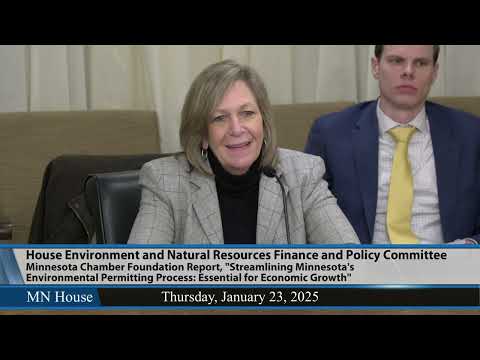
The Environment and Natural Resources Policy and Finance Committee advanced House File 8, a bipartisan permitting reform bill that would change multiple aspects of Minnesota’s environmental and wetland permitting processes, after testimony from industry and watershed groups and brief committee debate.
Representative Heintzeman presented the bill and walked members through the measure section by section. He described the bill as focused on “maintaining standards” while improving predictability and timing for applicants. Heintzeman summarized nine substantive sections that would: limit the number of 60-day Wetland Conservation Act extensions local government can take without applicant agreement; require more frequent MPCA permitting efficiency reports and permit-level tracking; clarify that failure to meet the MPCA’s 150-day tier 2 goal can create a final action eligible for judicial review; require the MPCA to notify applicants immediately if an application is incomplete; allow separate construction and operating permits; expand and better-structure the expedited permitting option; limit who may petition for an Environmental Assessment Worksheet (EAW) to 100 people from the same or adjoining county; create a business permitting ombudsman at DEED; remove scoping EAWs for projects that already require a mandatory Environmental Impact Statement (EIS); and add an intent section saying the bill would not relax environmental standards.
Representative Nelson offered and the committee adopted the A1 amendment, which clarifies that local government review and state review (including EAW processes) may proceed concurrently in applicable cases. Representative Nelson described the amendment as a clarification that avoids confusion about sequencing.
Committee members heard four external witnesses in support of the bill. Lauren Servick, director of public policy strategy and sustainability for the Minnesota Pork Producers Association, told the committee that drawn-out and inconsistent permitting delays raise costs and can halt projects; she said Minnesota’s roughly 3,000 family pig farmers need a predictable process and called the bill a way to unlock agricultural investment.
Andrew Morley, Environmental Policy Director at the Minnesota Chamber of Commerce, testified the bill is “technology neutral” and reiterated findings from the Chamber Foundation report that Minnesota’s air permitting can take far longer than peer states; he said HF 8 would help Minnesota remain competitive without lowering environmental standards. “Obtaining environmental permits does not need to be this difficult,” Morley said.
Robert Sipp, executive director of the Red River Watershed Management Board, described a portfolio of watershed projects with roughly $39 million in current financial commitments and about $70 million in total investment to date; he said permit and review costs already approached $5 million for that portfolio and that projects sometimes require many state and federal permits. Sipp urged greater coordination between agencies and more recognition of regional processes.
Lucas Shostrom, executive director of the Minnesota Milk Producers Association, said permit sequencing and timing have thwarted farm projects for years and said the bill’s changes to align review and streamline sequencing would help dairy operations complete time-sensitive construction.
After questions and discussion, Representative Heintzeman renewed his motion to recommend House File 8 as amended to be re-referred to the Labor and Workforce Development Committee. The committee chair called for voice votes; the committee adopted the A1 amendment and then approved the motion to re-refer HF 8. The record shows the motions prevailed by voice vote; no roll-call tally was provided in the transcript. The committee adjourned after concluding the agenda.
The bill drew letters of support from labor and industry groups (including building trades, mining interests, agri-growth and biofuels), and the record notes at least some organizations opposed the bill and planned to testify. The author said the MPCA was invited to the hearing but declined to attend; the record shows the Minnesota Chamber Foundation and Chamber leaders had previously briefed the governor and MPCA on the underlying permitting study.