Get Full Government Meeting Transcripts, Videos, & Alerts Forever!
Get email alerts on the State Tax Revenue topic
No spam. Unsubscribe anytime.
House Fiscal staff detail Minnesota revenue mix, dedicated funds and property tax relief changes
Summary
House Fiscal analysts told the House Taxes Committee that general fund tax receipts rely heavily on income and sales taxes and that property tax aids and credits are a major, growing portion of general fund spending.
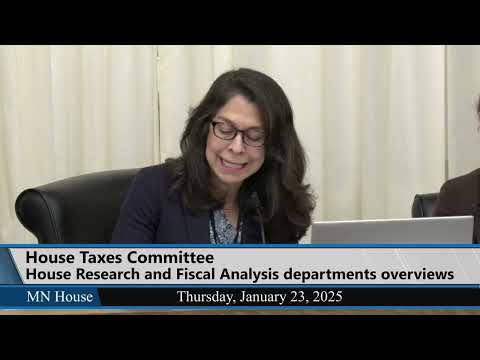
House Fiscal analysts Cynthia Templin and Katrina Highmark told the Minnesota House Taxes Committee that most general fund revenue comes from income and sales taxes and that dedicated receipts and local levies change what the state can spend.
Telling members how tax revenue is collected and used, Templin said state tax collections deposited to the general fund totaled about $28.5 billion in fiscal 2024 and that income and sales taxes together account for roughly three-quarters of general fund tax receipts. “These two tax types are kind of like the anchors of total state tax collections,” Templin said.
Highmark, who leads the committee’s review of property tax aids and credits, said those aids and credits are the third-largest category of general fund spending after education and health and human services. “Property tax aids and credits is the third-largest spender of general fund dollars,” she said, noting total spending grew from about $1.3 billion in fiscal 2014 to roughly $2.8 billion in fiscal 2024.
Why it matters
The presentation framed the committee’s work for the session: because the general fund relies so heavily on income and sales taxes, changes in economic conditions and tax policy can meaningfully affect the state’s ability to fund schools, health care and local aids. The analysts also flagged a variety of dedicated receipts — both constitutional and statutory — that limit how some revenues may be used.
Key details from the presentation
- Aggregate totals: House Fiscal showed three concentric totals for fiscal 2024: state general fund tax collections of about $28.3 billion, all state tax receipts (including dedicated receipts) of about $33.5 billion, and combined state-plus-local tax collections of roughly $46.5 billion. Templin noted that the graphic is “not to scale” but intended to show relationships among collections.
- General fund concentration: About 79% of general fund receipts come from income and sales taxes when looking only at general fund tax receipts (Templin). Statewide, income tax and sales tax generate approximately 73% of all state tax collections.
- Dedicated receipts: Highmark and Templin reviewed constitutional and statutory dedications that divert tax receipts from the general fund to specific purposes. Examples cited include the 3/8 of 1% sales tax dedication to the Legacy Fund (a constitutional dedication that sunsets in 2034) and the motor vehicle sales tax dedication enacted in 2006 that is earmarked for transportation.
- Trends and volatility: Templin showed year‑over‑year volatility in state tax revenues across a 10‑year span, with particularly large swings around the COVID years (fiscal 2020–2022). She said income tax growth projections have slowed because of lower projected average wages and changed assumptions about capital gains realizations; sales tax growth is affected by a long-term shift from goods to services.
- Local taxes and school levies: Highmark noted that local tax collections—chiefly property taxes—have a smoother trend than state taxes. School district levies vary with voter approvals: levies rose 1.95% in fiscal 2022, 0.43% in fiscal 2023 and jumped nearly 10% in fiscal 2024, driven by voter-approved amounts.
- Property tax aids, credits, refunds and a major program change: Highmark reviewed property tax relief mechanisms (refunds, credits and valuation exclusions) and explained a pending technical shift: the renter’s property tax refund will be phased out on the expenditure side and converted into an income tax credit. That change will move the budget effect from an “expenditure” line in the property tax aids and credits budget to a reduction in income tax revenue; Highmark told members that estimates done in 2023 projected the cost would be higher as an income tax credit, in part because eligibility rules changed and because taxpayers will receive the credit automatically rather than via an application.
- Shifts and exclusions: Highmark explained how exclusions (for example, a disabled veteran market value exclusion) reduce taxable value for qualifying parcels and shift the tax burden onto other properties. She cited a 2024 example in which about $44 million in exclusions (from roughly 20,500 parcels) was shifted onto other taxpayers statewide.
- Local government aids and new programs: The analysts summarized major local aids—Local Government Aid (LGA), County Program Aid (CPA), township aid—and newer or one-time programs, including a $300 million one‑time public safety aid in fiscal 2024 and a $35 million ongoing Tribal Nation Aid starting in fiscal 2025. They also explained local cannabis aid (funded from a 10% gross‑receipts tax on retail cannabis sales), local affordable housing aid funded by a metro sales tax, and how the governor’s proposal would move cannabis receipts to the general fund instead of preserving a 20% local share.
Nut graf
The House Fiscal presentation gave the Taxes Committee the numerical basis for the session’s discussions: because the general fund depends heavily on two volatile revenue sources—individual income and sales taxes—policy choices about tax rates, dedications and property tax relief will directly affect how much the state and local governments can spend on services.
Supporting context and questions from members
Committee members pressed staff on several points: whether migration and corporate departures have measurably affected income tax collections (Templin said she would follow up with data), whether year‑to‑year volatility around 2020–2022 reflects COVID‑era fiscal patterns (staff said federal aid and an unusually low base year contributed to the spike), and how shifts and exclusions are modeled and felt unevenly across jurisdictions (Highmark said she can request estimates from the Department of Revenue for specific bills). Members also asked for additional breakdowns—by income cohort and by the fiscal effect of local policy decisions such as local tobacco restrictions—and staff said they would follow up.
Ending
The presentation concluded with staff offering to supply follow‑up analyses and the committee proceeding to the bill calendar. The data packets distributed to members included an FAQ on revenue estimates, a revenue estimate visualization and a spreadsheet showing current‑law expenditures based on the November forecast.