Get Full Government Meeting Transcripts, Videos, & Alerts Forever!
Get email alerts on the Permitting Reform topic
No spam. Unsubscribe anytime.
Committee recommends referral of HF 8 after hearing on permitting reforms
Summary
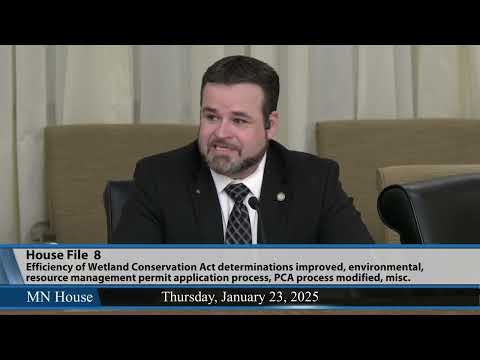
Representative Heintzeman moved that House File 8 be recommended to be re‑referred to the Labor and Workforce Development Committee after outlining nine permitting‑process changes and saying the bill “does not relax any existing standards.”
Representative Heintzeman, the bill author, moved that House File 8 be recommended to be re-referred to the Labor and Workforce Development Committee and presented the measure section by section, saying the bill seeks to speed and clarify state permitting and environmental review processes without relaxing environmental standards.
Heintzeman outlined nine principal provisions in HF 8. He said the bill would reduce the number of 60‑day extensions local units of government can take under the Wetland Conservation Act to one unless applicants agree to more, require the Minnesota Pollution Control Agency (MPCA) to issue a permitting-efficiency report twice a year and break out permit data for municipal versus industrial applicants, and clarify that failure by MPCA to meet a 150‑day goal for issuing a two‑tier permit creates a final action that would allow an applicant to seek judicial review. He also said the bill would require MPCA to immediately inform applicants when an application is incomplete and not restart the 30‑day completeness clock unless more than 30% of required information is missing.
Heintzeman described a separate-construction-and-operation permit option to avoid missing short winter construction windows, noting other states use the approach. He described an expedited permitting option that would allow MPCA to retain fees when it completes work ahead of schedule, a change to limit who may petition for an Environmental Assessment Worksheet (EAW) from 100 people statewide to 100 people who live in the same or an adjoining county, creation of a business permitting ombudsman in the Department of Employment and Economic Development (DEED), removal of a redundant scoping EAW for projects already requiring a mandatory Environmental Impact Statement (EIS), and a technical State Implementation Plan (SIP) revision needed to implement separated permits. He concluded with an intent statement: “This bill does not relax any existing standards,” and said the aim is to make permitting more predictable and timely.
Industry and local government witnesses told the committee they support changes that shorten timelines and reduce duplicative reviews while maintaining standards. Lauren Servick, director of public policy strategy and sustainability for the Minnesota Pork Producers Association, testified in support and said farmers face a “drawn out and inconsistent permitting process” that increases costs and sometimes halts projects. “For Minnesota’s more than 3,000 family pig farmers, a timely and predictable and consistent environmental permitting process is paramount,” Servick said.
Andrew Morley, environmental policy director at the Minnesota Chamber of Commerce, cited a Minnesota Chamber Foundation report that compared Minnesota to peer states and said Minnesota’s air‑permit timelines are much longer. “When issuing an air permit, Minnesota takes up to six times longer than its peers,” Morley said, citing an Illinois average of 110 days versus Minnesota’s 656 days in the study. He said HF 8 “does nothing to lower these rightfully high standards” and described the bill as technology‑neutral.
Robert (Rob) Sipp, executive director of the Red River Watershed Management Board, said watershed projects commonly require many permits and can face long delays and coordination problems across state and federal agencies. Sipp provided figures from his handout: the Red River board currently has projects with roughly $39,000,000 in financial commitments, total project investment around $70,000,000 to date, and about $5,000,000 spent on permitting and environmental review costs for projects currently in the funding process. He told the committee some individual watershed projects required dozens of permits and that federal requirements sometimes add separate reviews that state processes cannot substitute for.
Lucas Shostrom, executive director of the Minnesota Milk Producers Association, also testified in support, urging alignment of review order and timing so construction schedules are not disrupted and noting the amendment under consideration would allow responsible governmental units and applicants to accept applications at the most appropriate time for the project.
Representative Nelson moved the A1 amendment, which the sponsor described as clarifying that local government review and any state review or EAW may proceed concurrently. The committee adopted the A1 amendment by voice vote. The committee then voted by voice to recommend HF 8, as amended, be referred to the Labor and Workforce Development Committee; the chair announced “the motion prevails.”
Discussion in committee repeatedly emphasized that the bill’s changes are process‑focused and are not intended to change substantive environmental standards. Multiple witnesses and the bill author stressed they seek greater permitting efficiency, reduced duplication, better agency coordination and clearer timelines. Questions from members included why other states separate construction and operating permits; witnesses said several states use that approach as an efficiency measure.
Votes at a glance
- A1 amendment (clarify concurrent local/state review): moved by Representative Nelson; adopted by voice vote; outcome: adopted. - Motion to recommend HF 8, as amended, be re‑referred to the Labor and Workforce Development Committee: moved by Representative Heintzeman; voice vote; outcome: recommendation to refer (motion prevailed).
Next steps
The committee recommendation forwards HF 8, as amended, to the Labor and Workforce Development Committee for further consideration and possible subsequent committee action.