Get Full Government Meeting Transcripts, Videos, & Alerts Forever!
Get email alerts on the University Award And Campus Safety topic
No spam. Unsubscribe anytime.
Lawmakers Press University of Minnesota After Award to Communities United Against Police Brutality; safety advocates praise UMPD gains
Summary
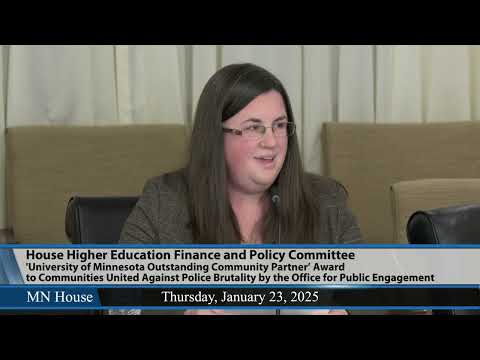
The House Higher Education Finance and Policy Committee heard extended testimony on a University of Minnesota community partner award and campus safety on Jan. 21, 2025, as lawmakers pressed university staff about how the award was vetted and community groups described recent improvements in campus policing.
The House Higher Education Finance and Policy Committee heard extended testimony on a University of Minnesota community partner award and campus safety on Jan. 21, 2025, as lawmakers pressed university staff about how the award was vetted and community groups described recent improvements in campus policing.
Amber Cameron, director of public engagement initiatives in the University of Minnesota's Office for Public Engagement, told the committee the Office facilitates the Outstanding Community Service (Community Partner) Award process and asks selection committees to evaluate nominations "on how has the activity affected society in positive ways that foster long term change," among other criteria. She said the selection committee for the Communities United Against Police Brutality nomination documented long-standing engagement with students through the university's Center for Community Engaged Learning and determined the application met the award criteria.
The award — which Cameron said includes a $5,000 community partner prize that is being processed through university accounting and is paid from operations and maintenance funding — and the university's choice of partners drew criticism from multiple committee members and law enforcement representatives who described social-media posts and public statements by the organization as inflammatory and inaccurate. Brian Peters, executive director of the Minnesota Police and Peace Officers Association, told the committee he and his membership see "misleading and harmful narratives about law enforcement" in the group's public posts and said such messaging harms campus safety efforts.
At the same time, student and parent advocates, including members of a newly formed Campus Safety Coalition, described a series of operational changes they say have improved safety around the Twin Cities campus. Erin Brum, a Campus Safety Coalition board member, said the group has worked with the university, Minneapolis Police Department and University of Minnesota Police Department (UMPD) on a campus safety advisory committee, secure building entrances, an off-campus safety center and increased UMPD jurisdiction and overtime deployments. "We've come a long way in 2 and a half years," Brum said.
UMPD and other campus-safety supporters pointed to a recent state appropriation the committee staff identified as $10 million in the 2023 omnibus higher-education law (with a $2 million base for the 2026–27 biennium) intended in part to enhance public safety on campus. Committee fiscal staff said that appropriation was expected to fund various public-safety measures. Testimony also cited an expanded UMPD jurisdiction along parts of Dinkytown and additional sworn officers and community safety officers assigned to campus shifts.
Several lawmakers said they were alarmed by the university's decision to recognize Communities United Against Police Brutality (CUPB) with the community partner award in 2021 and again in 2024. Representative Robbin Novotny noted a discrepancy between statements by CUPB's leader that the group's work dates back 25 years and the organization's IRS determination letter, which lists an incorporation date of June 25, 2020; Amber Cameron said the award can recognize informal community groups or long-standing collaborations that lack formal tax status and that the nomination materials documented work with the university over a long period.
Cameron told the committee the CUPB nomination packet included documentation that students had worked with the organization on roughly 130 course offerings across about 17 academic departments over two decades and that some student research informed the bipartisan Travis Law, which redirects certain mental-health-related 911 calls to mental-health teams. She said the awards program is being retooled by the university and that 2024 was the last year the Outstanding Community Service Awards were conferred in their historic form; future awards will focus on community-engaged scholarship and be internal to the university.
Law-enforcement representatives objected to CUPB's public messaging and urged the university to reconsider partnerships that they said undermine trust between officers and students. "They create an atmosphere where students are led to believe all police officers are inherently racist, encouraging them to side with criminals instead of supporting law enforcement," Brian Peters told the committee. Peters also read and summarized multiple social-media posts and public statements he said were from CUPB and argued those posts showed a pattern of inflammatory language and false claims.
Speakers also pressed the university for transparency about nomination materials and course vetting. Representative Kristin Scott asked how courses and partnership placements are reviewed; Cameron said her office does not design courses and that she would bring questions about course development and public materials back to the provost's office. Cameron said committee members could request nomination packets and that staff would respond to formal data-practice requests when required.
The hearing elicited strong reactions from committee leaders. Committee Chair Rehrig criticized inflammatory public statements and urged the university to review partnerships and "look hard and deep at themselves and the relationships and the partnerships that they currently have." She closed the meeting saying she prefers to "live in the land of facts and truth, not accusations, inflammatory statements, direct lies, baseless things." The group's leader, Michelle Gross, did not attend the hearing but submitted a letter and — according to public schedules introduced at the hearing — was speaking on campus and holding a press conference the same day.
The committee did not take formal action on the award or on university policy during the hearing. It recorded the approval of committee minutes at the start of the session.
Follow-up requests from legislators at the hearing included: copies of the CUPB nomination packet and related award materials, the university's speaking notes from award events, accounting detail on the O&M line that funds awards, and lists of courses and community-engaged-learning placements that documented student work with outside groups. University staff said they would seek guidance from the provost's office and from university accounting about records requests.
The hearing combined scrutiny of one university award with testimony from students, parents and law-enforcement officials about campus safety improvements. Several panelists urged the university to increase transparency on partnerships and to weigh the safety impacts of campus affiliations going forward; safety advocates urged continued funding and operational support for UMPD and for measures — lighting, secure entrances, additional officers and the off-campus safety center — they said have reduced certain risks seen in prior years.
— Reporting by the House Higher Education Finance and Policy Committee hearing; committee members requested university follow-up on nomination materials, awarding process documentation and budget details.