Get Full Government Meeting Transcripts, Videos, & Alerts Forever!
Get email alerts on the Training Reporting topic
No spam. Unsubscribe anytime.
Working group expands training and reporting recommendations; DPH portal changes and rate incentives remain unresolved
Summary
The group agreed to include hospice agencies in training requirements and to add a requirement that agencies ‘‘establish a system’’ for prompt incident reporting, but state budget and portal‑design questions left the proposed rate enhancement and data-capture details undecided.
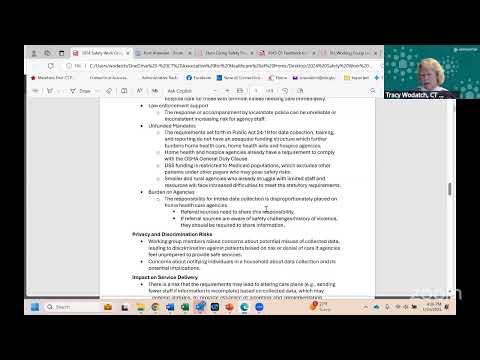
The working group discussed proposed changes to Section 2 of the law to include hospice agencies in workplace-safety training, to preserve training content consistent with federal guidance, and to require an agency-level system for prompt reporting of incidents.
Tracy (Co-chair; head of the Connecticut Association for Health Care at Home) summarized the proposed revisions: add hospice to the training requirement and amend the staff-reporting language to "establish a system for staff to promptly report incidents of violence or potential threats." The recommended curricula cited during the meeting referenced CDC, NIOSH and OSHA materials as model guidance.
Members debated whether the current statutory phrase "monthly staff meetings" should be retained, replaced, or broadened. Several participants said the law’s original legislative‑intent clarification already permitted flexible reporting channels such as phone calls, e-mail or surveys because direct-care staff are rarely co-located for regular in‑person meetings. Steven (work group member) and others cautioned that regular, documented check‑ins support accountability and problem‑solving; he said a "regular meeting can accomplish something that other things can't." Chris (work group member) clarified that the statutory language was intended to create a routine staff check‑in not to mandate convening groups in person.
The group reached a compromise to keep the training expectations (consistent with the OSHA/CDC/NIOSH framework), add language requiring agencies to establish a prompt reporting system, and to flag definitional work for a future committee (for example, defining "safety assessment" and clarifying prompt‑reporting timelines).
DPH confirmed it can modify its reporting portal to capture additional fields (time stamp and payer source) within existing resources. Karen (Department of Public Health representative) said, "We have built the portal" and that adding fields is feasible. DSS (Department of Social Services) staff counselled caution on statutorily requiring a rate enhancement tied to reporting because the Medicaid budget is in deficit: Anna (DSS) said the agency could not support language that would "shall provide" a rate enhancement absent funding. The group discussed replacing "shall" with "may, within available appropriations," or recommending the legislature "consider" funding incentives instead of prescribing them.
Reporting scope: the statute currently requires agencies to report incidents where "an agency client" harms staff; members argued the portal and statutory language should allow agencies to distinguish incidents involving a client, another household member, or community events that occur while staff are on duty. Participants proposed a drop-down in the portal (client / household member / community) so data can be analyzed separately.
Why this matters: training and reporting are the tools that working group members identified as most likely to prevent future injuries and to give policy‑makers data on the scale and nature of incidents. However, budget constraints and data‑definitions will determine whether reporting incentives or expanded data capture are feasible.
Next steps: co-chairs and agency staff will draft revised text incorporating the training language, the reporting‑system requirement, portal field updates requested of DPH, and alternative wording for the rate incentive (for example, "may within available appropriations" or "legislature should consider").