Get Full Government Meeting Transcripts, Videos, & Alerts Forever!
Get email alerts on the Intake Screening topic
No spam. Unsubscribe anytime.
Working group pauses push to repeal intake screening mandates, seeks consensus on OSHA-based best practices
Summary
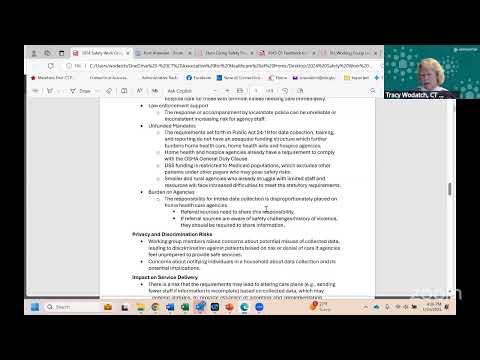
Members of the Connecticut working group on home health and hospice worker safety declined to advance a repeal of Section 1 of recent legislation, instead discussing a package of OSHA-aligned best practices and a process for unresolved items to receive further review.
Tracy (Co-chair; head of the Connecticut Association for Health Care at Home) and Sasha (Co-chair) opened the meeting by urging the working group to find consensus on recommendations while preserving voices that disagreed.
The group debated whether to recommend repealing Section 1 of recent legislation (the intake-screening provisions enacted in Public Act 24-19). Some provider representatives urged retaining the statutory language because removing it could reintroduce risk or leave vulnerable populations without care. Others, including several hospice providers, said the statutory intake requirements are burdensome and could reduce access to services.
Barbara (work group member; hospice provider representative) told the group she had sat through legislative testimony and warned that the cost estimate cited on the Senate floor—"$3,000,000 a year"—would put many hospices out of business. "$3,000,000 a year would put us out of business," she said, and added that in her agency "40% of our people die within 1 week," arguing that lengthy intake steps could prevent timely hospice admission.
Sasha urged that the group’s recommendations honor the intent of the legislature to improve worker safety and said the working group should not remove parts of the conversation simply because a majority prefers that change. "If we are going to dedicate the report and the recommendations, we submit to the legacy of Joyce Grayson... then it should contain things that shows that they were worthy," Sasha said.
After extended discussion, group leadership proposed to "skip over number 1 right now" and focus on reaching consensus on other sections, leaving Section 1 for further consideration. Members also discussed a process for documenting minority opinions and continuing the work if consensus is not possible.
Why this matters: the intake-screening language in Public Act 24-19 is the meeting’s central flash point because it balances worker safety (by encouraging more background and intake checks) against the risk that stricter intake requirements could delay or prevent hospice and home-care access for patients at the end of life.
The working group did not vote to repeal Section 1 during this meeting; instead, members agreed to postpone that decision and to record outstanding concerns for future deliberation and for the legislative sponsors to review.
Remaining steps: co-chairs said they will circulate revised drafts reflecting today’s discussion and noted that, if necessary, the working group could reconvene to resolve outstanding disputes or append minority views to the report.