Get Full Government Meeting Transcripts, Videos, & Alerts Forever!
Get email alerts on the Medicaid Rates Study Phase 2 topic
No spam. Unsubscribe anytime.
DSS presents Phase 2 Medicaid rate study; recommends regular review, Medicare benchmarking and targeted investments
Summary
The Connecticut Department of Social Services briefed the Human Services and Appropriations committees on phase 2 of a Medicaid rate study and recommended a scheduled review process, greater use of Medicare as a benchmark where comparable codes exist, consolidation of fee schedules and targeted investment in primary care, specialists and behavioral health.
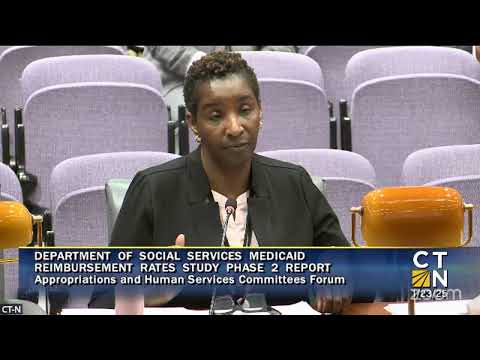
The joint Human Services and Appropriations committees heard a presentation from the Connecticut Department of Social Services (DSS) on phase 2 of a Medicaid rate study, with agency leaders and consultants outlining methodology, gaps in available benchmarks, and next steps for rate review and targeted investments.
The study was presented by Andrea Barton Reeves, commissioner of the Department of Social Services, and Nicole Godburn, DSS fiscal manager for reimbursement and certificate of need. Jennifer Myers & Stauffer consultants (presented by Julia Kachiva) summarized how phase 2 compared Connecticut fee schedules to Medicare and a five‑state peer group and identified areas where benchmarking was not possible.
The study covered fee‑schedule codes representing roughly 81% of codes in scope and used Medicare where possible and a five‑state comparison (New York, New Jersey, Maine, Massachusetts and Oregon) as a secondary benchmark. Julia Kachiva said the consultants “looked at the current Connecticut Medicaid methodologies, as well as the basis and components of those rates,” and compared those rates to Medicare and peer states where meaningful comparisons existed.
Why it matters: committee chairs said rate setting affects access to care, provider workforce decisions and the state budget. Senator Lesser opened the hearing noting the state is examining Medicaid rates “for the first time in almost 20 years.” Committee members pressed DSS on where disparities are largest and on how the state should phase and prioritize changes so access is not disrupted.
Key findings and recommendations
- Benchmark approach and scope: The consultants recommended using Medicare as the primary benchmark where comparable codes exist and a five‑state average where Medicare comparators are not available, but they cautioned that benchmarking is a diagnostic tool, not an automatic instruction to raise or lower rates. As Julia Kachiva put it, the report “is a data‑driven review of Medicaid rate parity.”
- Coverage of the study: DSS and consultants said phase 1 plus phase 2 together analyzed a large share of codes in use but did not capture all Medicaid spend. The presentation reported that many codes could be benchmarked and that the study produced an estimate of potential cost changes using a conservative 50% federal match assumption for state share calculations.
- Fee schedule consolidation and code maintenance: The study recommends consolidating multiple fee schedules (for example, many separate practitioner fee schedules) into a single master physician/clinic schedule to avoid “orphaned” codes that are updated in one schedule but not others.
- Provider groups and priorities: DSS highlighted primary care, specialty physician fees (radiology, oncology, certain surgeons) and behavioral health as priority areas for potential investment where access concerns were reported. The report also flagged FQHCs, hospitals and waiver services (HCBS/DD waivers) as areas that need tailored analysis because of differences in state policies and cost‑based rate methods.
- Alternative payment models: The study encourages expanding existing value‑based or alternative payment methods (DSS referenced PCMH Plus as an existing example) to align incentives for prevention and care coordination.
Gaps, limitations and issues raised by legislators
Committee members and the commissioner discussed limitations in comparability and scope. Representative Joe and others asked about the portion of spend and codes with no usable comparators; DSS staff said the teams prioritized codes expected to be most impactful to members and that not every code or service could be reviewed within the study timeframe. The presentation noted some $300 million in expenditures lacked comparable benchmarks (as highlighted by a committee question), and that roughly 81% of codes in scope were benchmarked (the percentage of total spend covered was lower).
Legislators raised additional concerns and requested follow up in these areas:
- Home health and medication administration: several members asked whether the study examined home‑based med‑administration rates and care‑coordination line items. DSS said waiver‑related med‑administration was evaluated in the waiver analysis but some fee‑schedule home‑health comparisons are limited by lack of Medicare comparators; DSS agreed to re‑examine specific med‑admin codes on request.
- Behavioral health transition “cliff”: the consultants identified instances where practitioners receive enhanced child rates that stop when a patient ages into adult services; members asked DSS to review those cliffs because they can create access problems when youth age out of pediatric rates.
- Nursing home reimbursement: Senators asked why Connecticut nursing‑home reimbursement appears lower than peer states in the five‑state comparison; DSS said the drivers are complex and requested time to return with deeper analysis.
- Provider access versus encounter rates: legislators asked how rate changes would account for non‑rate access barriers (transportation, travel time, workforce shortages). DSS said the current analysis measures encounter rates and benchmarking but recommended that rate adjustments be evaluated alongside access monitoring (geo‑mapping, complaint resolution) and, where appropriate, alternative payments that could incorporate access considerations.
Next steps and department direction
DSS said it will coordinate with sister agencies that administer waiver services, develop a schedule for regular fee‑schedule reviews so providers and the state have predictability, and prioritize deeper dives where the study shows likely access problems. Commissioner Reeves said the department aims to complete the work "this year" and will convene the relevant state agencies and providers to design a phased approach to implementing recommendations. The department also said it will share work Maine and others have done on scheduled rate reviews and will provide follow‑up analysis on nursing homes and med‑admin codes at members’ request.
Quotations from the hearing
- "I think this is 1 of the most important issues that we're looking at this year, which is addressing...Medicaid rates for the first time in almost 20 years," Senator Lesser said in opening the hearing.
- Commissioner Andrea Barton Reeves introduced DSS staff and the consultants: "I am Andrea Barton Reeves, the commissioner for the Department of Social Services. I'm here today with Nicole Godburn, who is our fiscal manager at DSS..." (DSS also referenced Nicole in slides).
- Consultant Julia Kachiva summarized methodology: "To provide, an overview of what we did in the study is we looked at the current, Connecticut Medicaid methodologies, as well as the basis and components of those rates. We reviewed the codes in the fee schedule...in order to create a development of benchmarks, comparing them to Medicare and to other states." (consultant remarks quoted verbatim from presentation.)
Ending
Committee members said they will expect follow‑up data and prioritized recommendations from DSS on timing, fiscal implications and suggested statutory or policy changes to create a routine rate‑review cadence. DSS committed to further analysis this calendar year and to share examples (including Maine’s public cadence) and targeted follow‑ups on nursing‑home reimbursement, home‑health med‑admin codes, the behavioral‑health transition cliff and potential value‑based payment expansions.
(End of report)