Get Full Government Meeting Transcripts, Videos, & Alerts Forever!
Get email alerts on the Insurance Fund Assessments topic
No spam. Unsubscribe anytime.
Insurance Fund working group finalizes edits, sets quick deadline to publish report; recommends legislative approval process and keeping current assessment mix
Summary
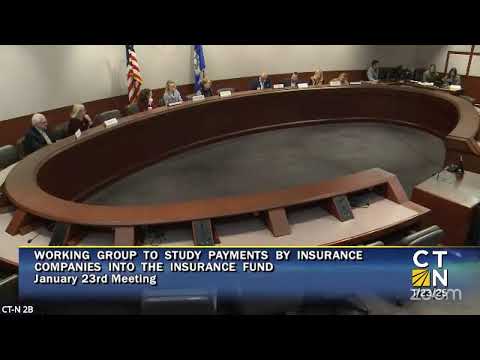
The Insurance Fund Working Group convened Thursday, Jan. 23, 2025, reviewed a draft report on the state’s insurance fund assessments and agreed on revisions and a tight schedule to publish a final document by the end of the following week.
The Insurance Fund Working Group convened Thursday, Jan. 23, 2025, reviewed a draft report on the state’s insurance fund assessments and agreed on revisions and a tight schedule to publish a final document by the end of the following week.
The group agreed to add a glossary and an index of supporting materials, include the Office of Legislative Research report in full, and expand the report’s numerical detail (insured lives and recent budget figures). Sen. Aslett pushed for a rapid turnaround, saying, “I would like to get this done, no later than the middle of next week.”
Why it matters: the report will be used by the Appropriations Committee and executive branch staff as lawmakers consider whether to shift or remove fees currently paid into the insurance fund. The working group’s recommendations—particularly to preserve the current assessment and funding structure for the Department of Insurance and to create a formal legislative approval process for any future assessments—are intended to shape upcoming budget and statutory decisions.
The chair opened by thanking members for their work and noted that the draft report already includes a mission statement from Special Act 24-15 and background material gathered over several meetings. Committee members repeatedly asked for the report to be a standalone document so that readers would not need to consult meeting packets or other materials to understand findings.
Jane, a working group member, and Sue, a working group member, were assigned specific drafting tasks. The group directed that the end of the report include an index of submitted materials and that Sue prepare a glossary of terms. The working group asked Jane to develop clearer definitions for the three assessments discussed in the report so readers can distinguish the general assessment (sometimes referred to in industry as the assessment of apportionment), the immunization/public health fee, and the health-and-welfare/behavioral-health–related assessments.
Chris, a working group member, asked that a recommendation be separated out to “implement a legislative process for the approval of any future assessments.” The chair agreed to make that a distinct recommendation rather than folding it into a public-transparency bullet. Another substantive recommendation that members agreed to add—at the suggestion of Sue and with Eric’s concurrence—was an explicit statement to “maintain the current assessment and funding structure for the Department of Insurance.”
Members also asked staff to include high-level budget numbers in the findings so the fiscal impact is clearer. Participants cited recent budget figures discussed in the meeting: the public health fee at about $8.7 million and the Office of Health Services figure cited at $32.7 million (figures referenced as “as of last budget” and to be verified in the annex). The group discussed presenting a possible rollout or phased transfer of costs over a five-year period as an illustrative example while noting that final budget action depends on the governor’s budget and legislative decisions.
There was debate over language related to the Behavioral Health Advocate’s funding. One member warned that recommending transfer of that office’s funding from the insurance fund to the general fund would be controversial and would require legislative action; the group removed any explicit recommendation to close that office and agreed not to adopt language that would preempt legislative decisions.
The group set a schedule to complete the draft: staff will circulate an updated draft to members by end of day Monday for review; committee members will provide edits over the next few days; the working group will aim to finalize and publish the report by the end of day Wednesday and transmit it to legislative leadership and the governor’s office. The chair characterized the timeline as expedited and said the document should be ready “for leadership and for the governor’s office.”
The meeting closed without formal votes. Members expressed broad agreement on the tasks, the content changes requested and the publication schedule, but no formal motion or roll-call vote was recorded.
The working group plans to use the completed report as background for Appropriations Committee deliberations and to inform any legislative proposals about assessments or fund transfers in the 2025 session.