Get Full Government Meeting Transcripts, Videos, & Alerts Forever!
Get email alerts on the Prepackaged Medication Dispensing topic
No spam. Unsubscribe anytime.
Senate hears bill to let hospitals and clinics give manufacturer-packaged medications at discharge
Summary
S.B. 5019 would clarify and expand when hospitals and licensed healthcare entities may dispense prepackaged medications (for example, inhalers or insulin pens) at discharge when community pharmacies are not reasonably available. Hospital and pharmacy associations supported the bill and proposed technical clarifying language.
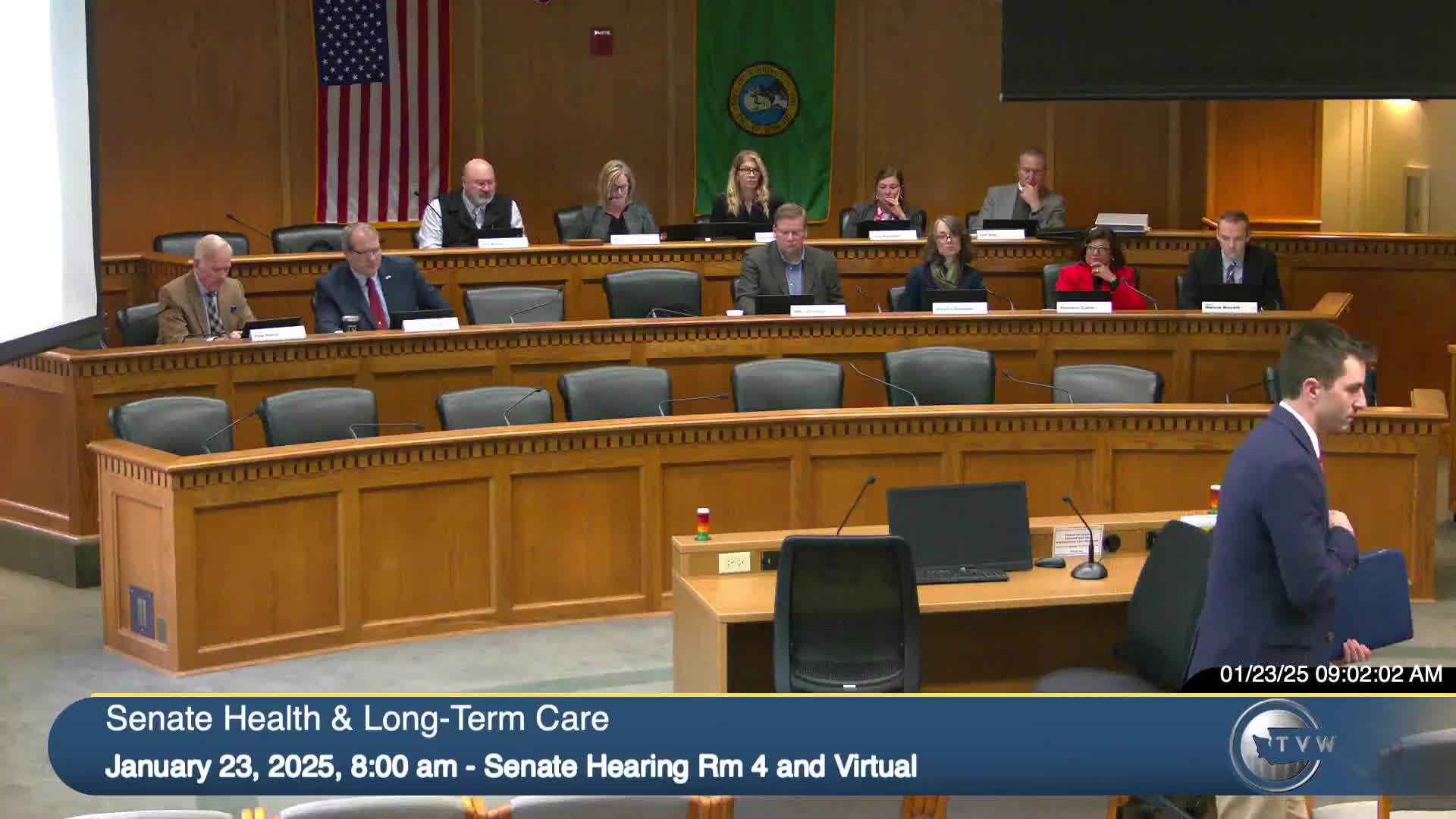
The Senate Health & Long Term Care Committee heard S.B. 5019 Jan. 23, a bill that would modify when hospitals and other licensed health care entities may dispense prepackaged medications at patient discharge. Senator Mike Chapman sponsored the bill and supporters told the committee the measure removes waste and improves immediate patient access to needed medications when community pharmacies are not available.
What the bill changes: Under current law hospitals may dispense a limited supply (48 hours in most cases) of prepackaged drugs in specific circumstances (for example, when no outpatient pharmacy is available within 15 miles by road, or when HIV post‑exposure prophylaxis is required). The bill clarifies that hospitals may dispense manufacturer‑packaged medications that cannot safely be divided into a smaller 48‑hour portion and extends similar logic for other licensed health care entities (72‑hour limit when appropriate).
Support and rationale
- Washington State Hospital Association: Katie Colon told the committee hospitals sometimes must discard partially used manufacturer packaging (for example, inhalers, insulin pens, eye drops or topical ointments) when only a small dose is needed at discharge. Colon said allowing hospitals to dispense intact manufacturer packages avoids waste and helps patients who otherwise lack timely access to a pharmacy; she gave an example of a patient in a remote community who needed immediate access to Lasix.
- Washington State Pharmacy Association: Dr. Jenny Arnold, a pharmacist and CEO of the state pharmacy association, supported the bill and proposed a clarifying amendment to make explicit that the exemption applies to medications “packaged by the manufacturer in quantities that cannot be manipulated to limit to a 48‑hour supply.” Arnold said common examples are inhalers and certain topical preparations and noted the statute already allows full courses of anti‑infectives when clinically necessary to prevent resistance.
Billing and reimbursement: Committee members asked whether dispensing manufacturer packages at discharge would generate separate hospital charges. Colon said the bill is silent on reimbursement; hospitals generally would not bill patients for the additional manufacturer package when dispensing the unused remainder — hospitals prefer to provide the intact package at no extra patient charge rather than waste the medication.
Action: Testimony was taken; there was no vote during the hearing. The bill had broad stakeholder support during testimony with 96 people signed in favor.
Bottom line: Supporters characterized S.B. 5019 as a practical fix to reduce waste and improve safe access to needed medications at discharge, and pharmacy stakeholders offered narrow clarifying language to reflect everyday dispensing practice.