Get Full Government Meeting Transcripts, Videos, & Alerts Forever!
Get email alerts on the Rare Disease Advisory Council topic
No spam. Unsubscribe anytime.
Senate hears bill to create Rare Disease Advisory Council; patients, clinicians urge state support
Summary
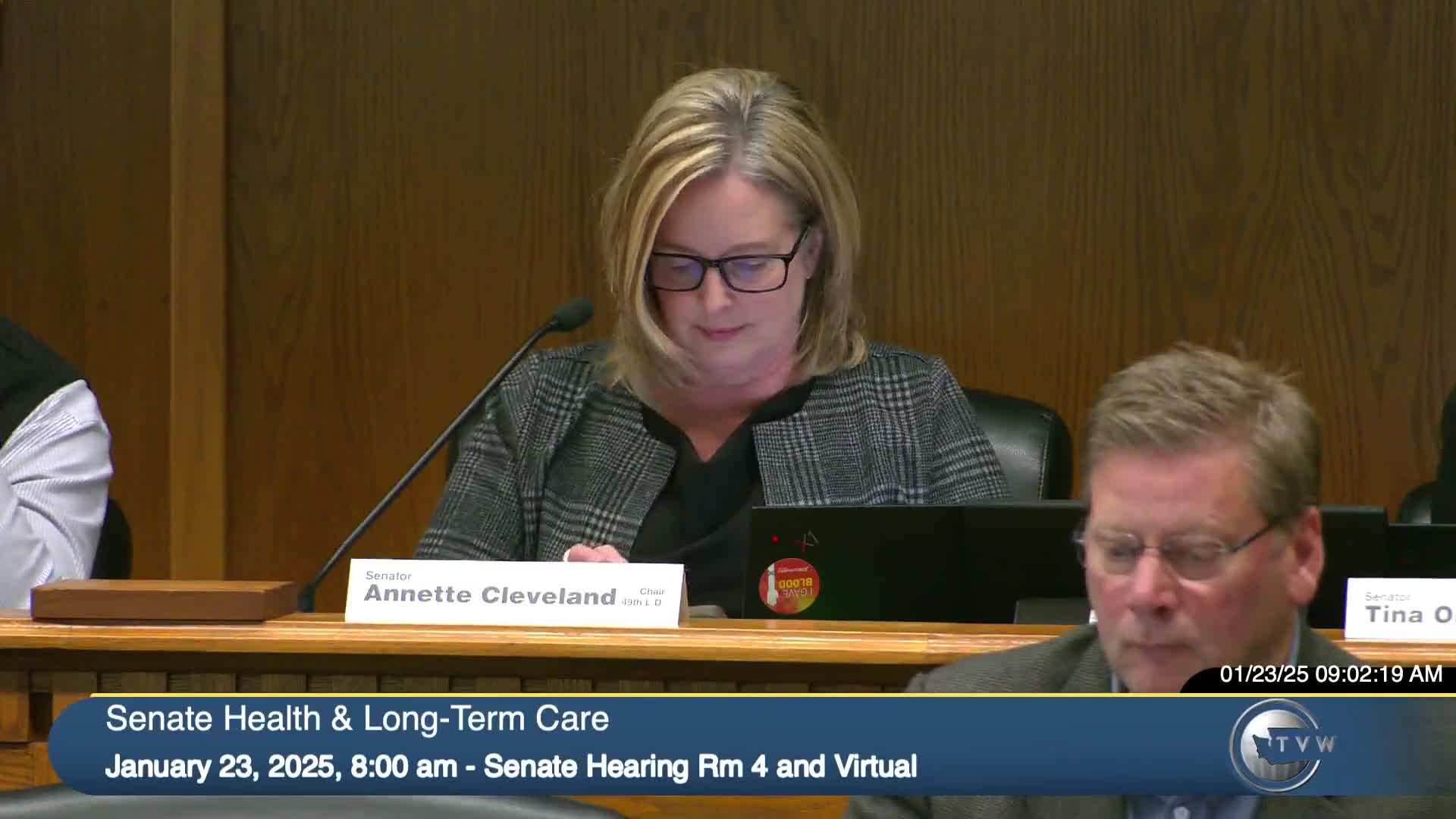
The Senate Health & Long Term Care Committee held a Jan. 23 hearing on S.B. 5064 to create a 12‑member Rare Disease Advisory Council housed at the University of Washington School of Medicine.
The Senate Health & Long Term Care Committee held a public hearing Jan. 23 on S.B. 5064, a bill to create a 12‑member advisory council on rare diseases hosted at the University of Washington School of Medicine. Committee staff, the bill sponsor and nearly four dozen witnesses made the case that a state council would give people with rare diseases a centralized forum for advising the governor and Legislature.
What the bill would do: Committee staff explained that the bill would establish a 12‑member voting advisory council on rare diseases within the University of Washington School of Medicine to advise the secretary of health on research, diagnosis, treatment and education for rare conditions. The council would submit annual reports beginning Dec. 1, 2026.
Why advocates testified in favor
- Diagnostic delay and access to testing: Patients and family members described long “diagnostic odysseys.” Sarah Tompkins, a Bellevue patient living with a variant of Ehlers‑Danlos syndrome, recounted nine years between first symptoms and a definitive diagnosis; she said genetic testing allowed her to reach appropriate specialists and treatments and to obtain coverage for services. Whitney Storer, a parent of a child with multiple rare conditions, said an early diagnosis had allowed her family to access immediate care and supports.
- Patient voice and coordination: The National Organization for Rare Disorders (NORD) and other advocates asked the committee to approve S.B. 5064 so Washington joins more than 30 states with rare‑disease advisory structures. Lindsey Viscara of NORD said the councils give rare‑disease patients a permanent voice in state government and can produce practical recommendations for state agencies.
- Clinical and research capacity: Dr. Gail Jarvik, head of medical genetics at the University of Washington Medical Center and director of related clinical and undiagnosed disease programs, told the committee UW is prepared to host the council and cited the university’s existing clinical and training programs. She also said insurance coverage and reimbursement constraints remain barriers for many adult patients seeking genomic testing.
Questions and suggested refinements
- Cost and scope: Sponsor comments and witnesses acknowledged cost concerns and said they were working to keep the council’s scope and fiscal footprint manageable. Stephanie Simpson of the Bleeding Disorder Foundation recommended specifying that patient representatives be Washington residents to ensure authentic local representation and suggested the council explicitly address access and funding solutions for high‑cost therapies (for example, gene and cell therapies). The sponsor indicated willingness to work with advocates on cost‑and‑scope language.
- Overlap with other boards: Committee members explored whether cost or payment issues might be handled by existing entities; supporters said this council would center patient experience, shorten diagnostic timelines, and coordinate research and education rather than substitute for payer or procurement policy work.
Action: The committee received testimony; no formal vote was held during the hearing.
Bottom line: Patients, clinicians and national advocates urged the Legislature to create a state advisory council to improve diagnosis, care coordination and research for people with rare conditions; supporters said the council would be patient‑centered and would complement, not duplicate, existing agency work.