Get Full Government Meeting Transcripts, Videos, & Alerts Forever!
Get email alerts on the Healthcare Affordability topic
No spam. Unsubscribe anytime.
State insurance office presents five options to tackle health care costs; transparency and drug boards outline next steps
Summary
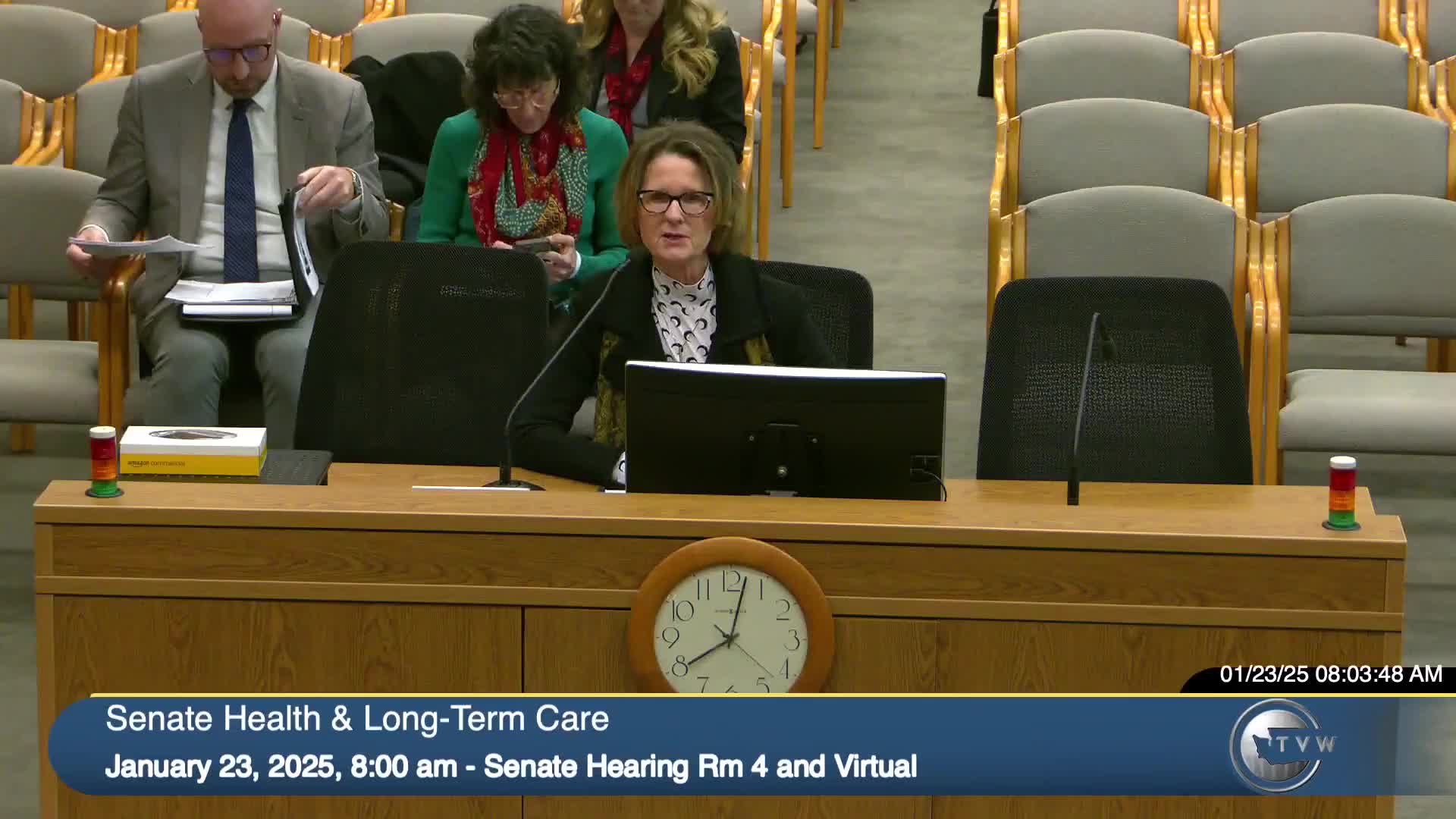
The Senate Health & Long Term Care Committee heard a work session Jan. 23 on state efforts to address health care affordability, including a detailed Office of the Insurance Commissioner (OIC) report and updates from the Healthcare Cost Transparency Board, the Prescription Drug Affordability Board and the Universal Health Care Commission.
The Senate Health & Long Term Care Committee heard a work session Jan. 23 on state efforts to address health care affordability, including a detailed Office of the Insurance Commissioner (OIC) report and updates from the Healthcare Cost Transparency Board, the Prescription Drug Affordability Board and the Universal Health Care Commission.
The OIC presentation, led by Nico Janssen, senior health policy analyst, and Jane Beyer, senior health policy advisor, summarized a legislative-directed report that used Washington-specific data to model five policy options aimed at lowering prices and premiums. Janssen told the committee that “we published this report in August of last year” and framed the analysis around Washington’s payer mix.
Why it matters: The report models interventions that affect different parts of the state health system—individual and small-group markets, insurers and hospitals—and provides numeric estimates Washington policymakers can use when weighing tradeoffs between consumer savings and state or provider costs.
Major findings and options analyzed
- Reinsurance: The OIC modeled a reinsurance program designed to reduce premiums by about 10% in affected markets but cautioned that the program could carry substantial annual state costs — the presentation estimated up to $84,000,000 for the individual market and up to $294,000,000 for the small-group market, depending on design and funding sources.
- Medical loss ratio (MLR): Under federal law insurers must spend a minimum share of premiums on claims and quality (80% for individual/small group; 85% for large group). The OIC modeled raising the standard to 88% and found a modest estimated premium reduction (about 0.9% to 2.5% annually) because many Washington carriers already approach that level.
- Reference-based pricing: The OIC and its contractors analyzed setting maximum payments as a percentage of Medicare for services; modeling found potential spending reductions ranging roughly 3% to 19%, depending on the cap. The analysis showed commercial payments vary widely by service category (e.g., behavioral health near 88% of Medicare; some hospital outpatient payments well above Medicare), and noted implementation costs and potential impacts on provider finances.
- Hospital global budgeting: A prospective budget for hospitals would likely require federal waivers to include Medicare and Medicaid and would be complex to implement. Maryland was identified as the longstanding U.S. example; Washington’s prior hospital rate-setting law (repealed in 1989) shows pitfalls of over‑complexity.
- Meeting the state cost‑growth benchmark: The Healthcare Cost Transparency Board’s benchmark is intended to cap per‑person growth in health spending. The OIC estimated that meeting that target could reduce statewide health spending by roughly $1.4 billion to $2.0 billion annually compared with recent trends.
Committee discussion and concerns
Insurance Commissioner Patty Kuderer (introduced to the committee by Chair Cleveland) framed consumer protection and outreach as the OIC’s top priorities and said “healthcare is a fundamental human right.” Committee members pressed presenters on links between price-focused policies and clinical outcomes. Senator Slatter asked whether affordability steps would increase primary care access and reduce emergency department use; presenters said lower prices and rebalanced payments could improve primary care compensation and access but emphasized those links require additional monitoring and policy work.
Several senators raised concerns about smaller and public hospitals. Senator Mazal (representing districts with public hospitals) asked how budget reductions to hospital payments would avoid forcing service cuts at financially fragile public hospitals; presenters noted carve-outs already used in some states (for critical access and sole community hospitals) and said any design must protect rural and public hospital capacity.
Updates from related state boards
- Healthcare Cost Transparency Board: Michelle Needham, chief policy officer at the Health Care Authority, described the board’s work to set and measure the state’s cost‑growth benchmark (first benchmark set at 3.2% in 2022) and to build the analytic base using the all‑payer claims database (APCD). The board’s December 2024 performance report found commercial and Medicare markets contributed most to recent per‑member spending growth and highlighted hospital outpatient growth and prescription drug increases in some payer streams.
- Prescription Drug Affordability Board (PDAB): Evan Klein (Health Care Authority) briefed the committee on the PDAB’s statutory authority (established by the Legislature in 2022, S.B. 5532) to compile an eligible drug list and to conduct affordability reviews. The PDAB may recommend upper payment limits on a subset of drugs (criteria and methods are subject to rules); the board was preparing its first affordability reviews and could set payment limits beginning in 2027 under the current statute.
- Universal Health Care Commission: The commission continues design work on options to expand coverage and administrative simplification, including examining benefit design and provider participation, but commissioners emphasized many major designs would require federal waivers to implement.
What the committee asked staff to follow up on
Committee members requested additional monitoring and follow‑up on (1) the experience of Maryland on hospital global budgets and how that state tracks quality and outcomes, (2) evidence linking reference‑based pricing and primary care supply/outcomes, and (3) whether PDAB activity has produced measurable changes in prescription spending yet (the PDAB is early in its work).
Bottom line: The OIC report gave the Legislature Washington‑specific estimates and tradeoffs for five affordability levers. Committee members welcomed the data but repeatedly warned that price containment must be balanced against risks to rural and public hospitals, and they asked agencies to return with outcome measures and more workforce and access impact analysis.