Get Full Government Meeting Transcripts, Videos, & Alerts Forever!
Get email alerts on the Fleet Management topic
No spam. Unsubscribe anytime.
Sweetwater Authority approves amended green fleet schedule, orders three replacement vehicles and authorizes fleet optimization study
Summary
Board authorized staff to amend the Green Fleet Plan to align with CARB mandates, directed an RFP for a fleet optimization study, and approved purchase of three replacement vehicles (up to $1,013,145) with a $13,200 contingency; vote was unanimous.
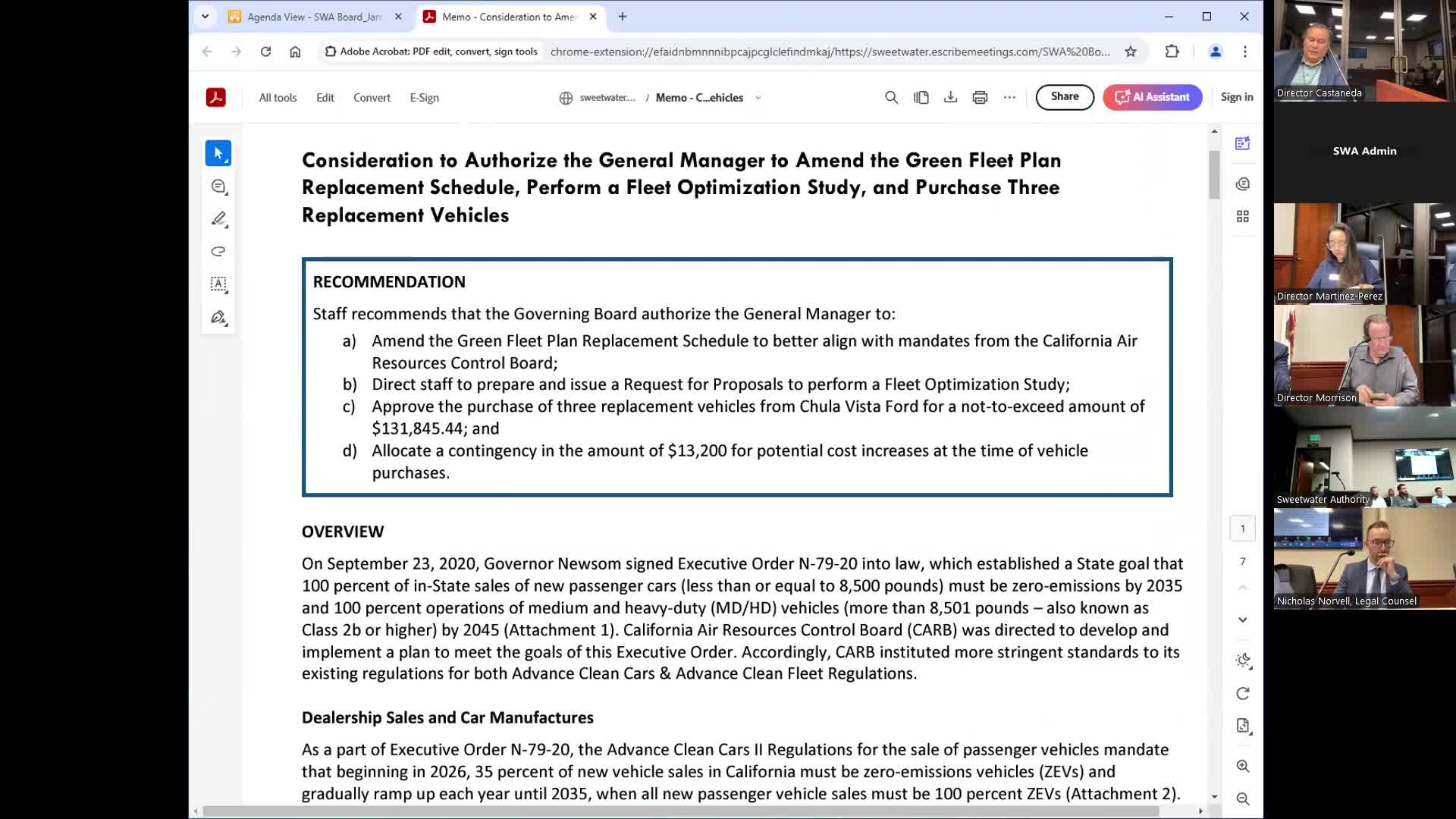
The Sweetwater Authority Board of Directors unanimously approved a multi-part staff recommendation Jan. 8 to amend its Green Fleet Plan, commission a fleet optimization study, and purchase three replacement vehicles.
Staff told the board the 2021 Green Fleet Plan predated California Air Resources Board (CARB) rules that took effect in 2023 and 2024. Under the CARB Advanced Clean Fleet regulation staff described, 45 of the Authority’s 93 vehicles exceed the 8,501-pound threshold and must follow phased zero-emission milestones; about 10% of those vehicles (five vehicles under current counts) must be zero-emission by 2027 under the milestone option staff has followed. Staff recommended revising the replacement schedule to align with CARB mandates while retaining flexibility to consider hybrids or internal-combustion options for vehicles under the weight threshold.
The board authorized four actions: (1) direct the general manager to amend the Green Fleet Plan replacement schedule to align with CARB mandates; (2) direct staff to prepare and issue a request for proposals for a fleet optimization study; (3) approve the purchase of three replacement vehicles from Chula Vista Ford not to exceed $1,013,145; and (4) allocate a contingency of $13,200 for potential cost increases at purchase. The motion passed on a unanimous roll call.
Director of Engineering and Operations Eric Loboska presented the technical background, noting the Authority’s fleet of 93 vehicles (45 above the weight threshold), the CARB milestone groups, and the operational reasons for vehicle choices — for example, higher-ground-clearance needs for reservoir biologist vehicles. Staff recommended replacing three specific vehicles now for reliability reasons; the packet included vendor quotes and a proposed 10 percent contingency because market prices can shift.
Financial context: staff reported a vehicle replacement fund balance of $1,270,000 before accounting for EV-charging station allocations and recent expenditures. After the recommended purchases and contingency, staff said roughly $1.0 million would remain in the replacement fund.
Next steps: staff will issue the RFP, return to the board with consultant proposals for the fleet optimization study, and proceed with vehicle procurement consistent with the approved budget cap and contingency. Directors also asked staff to ensure purchase recommendations reflect 2025 model-year availability.
Speakers and attribution: Eric Loboska (Director of Engineering and Operations) led the staff presentation; Assistant General Manager Lehi Yano and other staff answered technical and funding questions. The final roll call recorded “aye” from Directors Castaneda, Cox, Delgado, Martinez, Martinez Perez, Morrison and Yamani.