Get Full Government Meeting Transcripts, Videos, & Alerts Forever!
Get email alerts on the Mortgage Fraud Prosecution Fund topic
No spam. Unsubscribe anytime.
Bill would raise mortgage-fraud surcharge to bolster prosecutions, prosecutors say
Summary
Senate Bill 5109 would increase the deed-related surcharge funding the Mortgage Lending Fraud Prosecution Account from $1 to $5 and remove its sunset; King County prosecutors told the committee the increase is needed to restore investigative capacity.
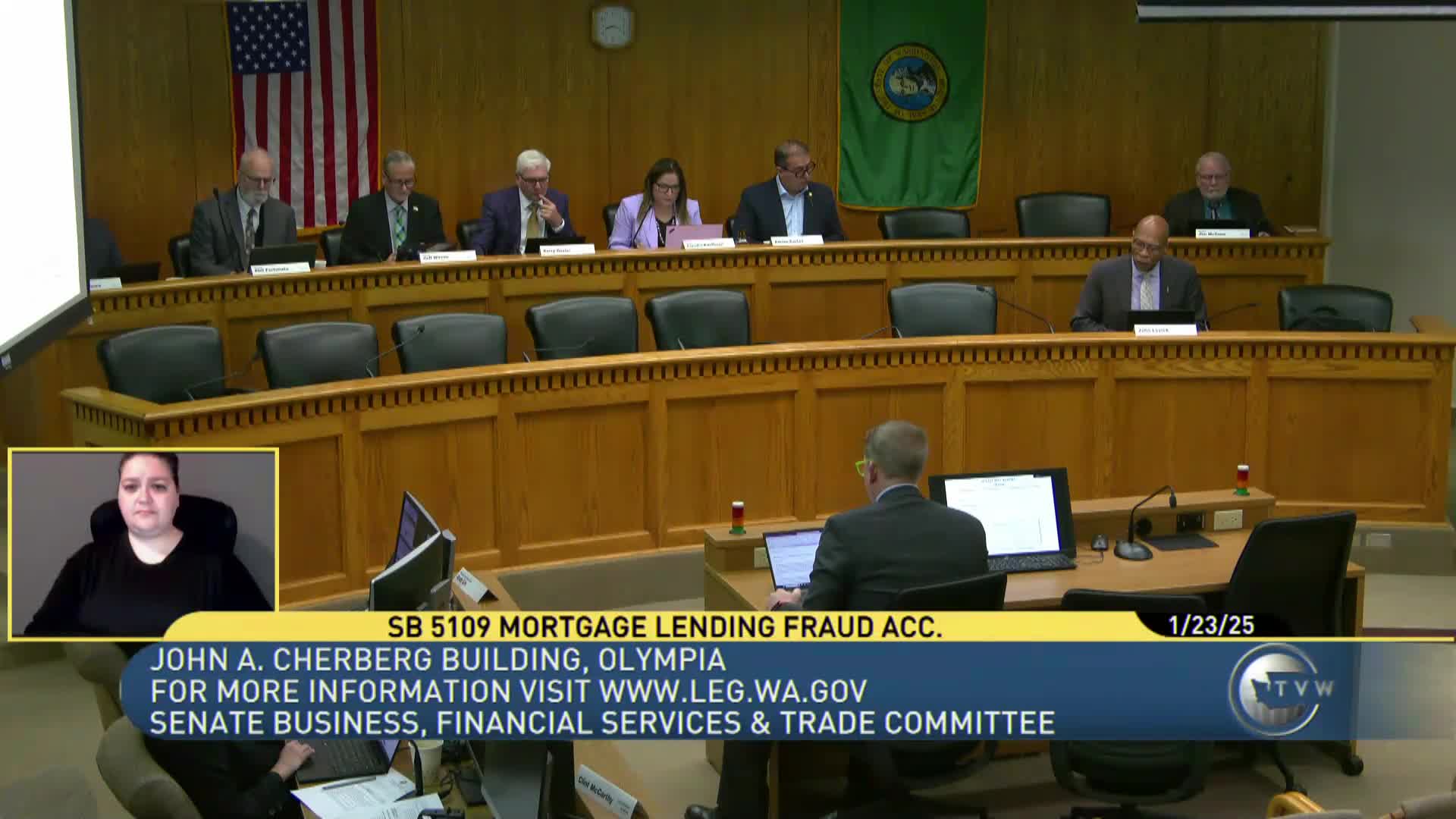
The committee heard testimony on Senate Bill 5109, which would raise the surcharge assessed at recording of each deed of trust from $1 to $5 and remove the account’s sunset provision. The surcharge funds the mortgage lending fraud prosecution account (MLFPA), which supports investigations and prosecutions of mortgage-related crimes.
Senator Claudia Kauffman, prime sponsor, said the surcharge had not changed since the account’s creation and that the proposed increase would go “directly to the prosecutors in the mortgage fraud prosecution unit” to help identify and pursue mortgage fraud schemes, including those exploiting artificial-intelligence tools. Staff said the fee increase would generate an estimated $2.4 million in additional revenue for the 2025–27 biennium and $3.7 million for 2027–29; a fiscal note is available.
King County prosecutors described local impacts of the fund. Patrick Hines, chief deputy in the Economic Crimes and Wage Theft Division, said the fund “works” and that reductions in real funding have eroded capacity: “In 2011, the fund was sufficient to support two prosecutors and an investigator... As of January of this year, the funding we receive only covers half of an investigator and less than half of a prosecutor.” Hines said the change in surcharge would be “virtually imperceptible” in typical mortgage transactions but materially improve the ability to pursue complex fraud.
Hugo Torres, mortgage fraud prosecutor for King County, gave examples of schemes pursued with MLFPA support, including a loan-modification scam targeting Spanish-speaking homeowners and a scheme by an escrow officer inserting false settlement statements. Torres said recent trends include criminals using digital closings to impersonate homeowners and sell property without owners’ knowledge; increasing the fund and removing the sunset would help prosecutors keep pace with such schemes.
No committee action or vote was recorded at the hearing. Committee members asked follow-up questions about outcomes for affected victims and about the program’s history; prosecutors said some victims could not be restored because cases are identified too late, but that statute changes now permit prosecutors to seek title corrections as a sentencing remedy in some successful prosecutions.