Get Full Government Meeting Transcripts, Videos, & Alerts Forever!
Get email alerts on the Eminent Domain School Land topic
No spam. Unsubscribe anytime.
Bill would require school districts to offer to sell condemned property back to prior owners before changing its use
Summary
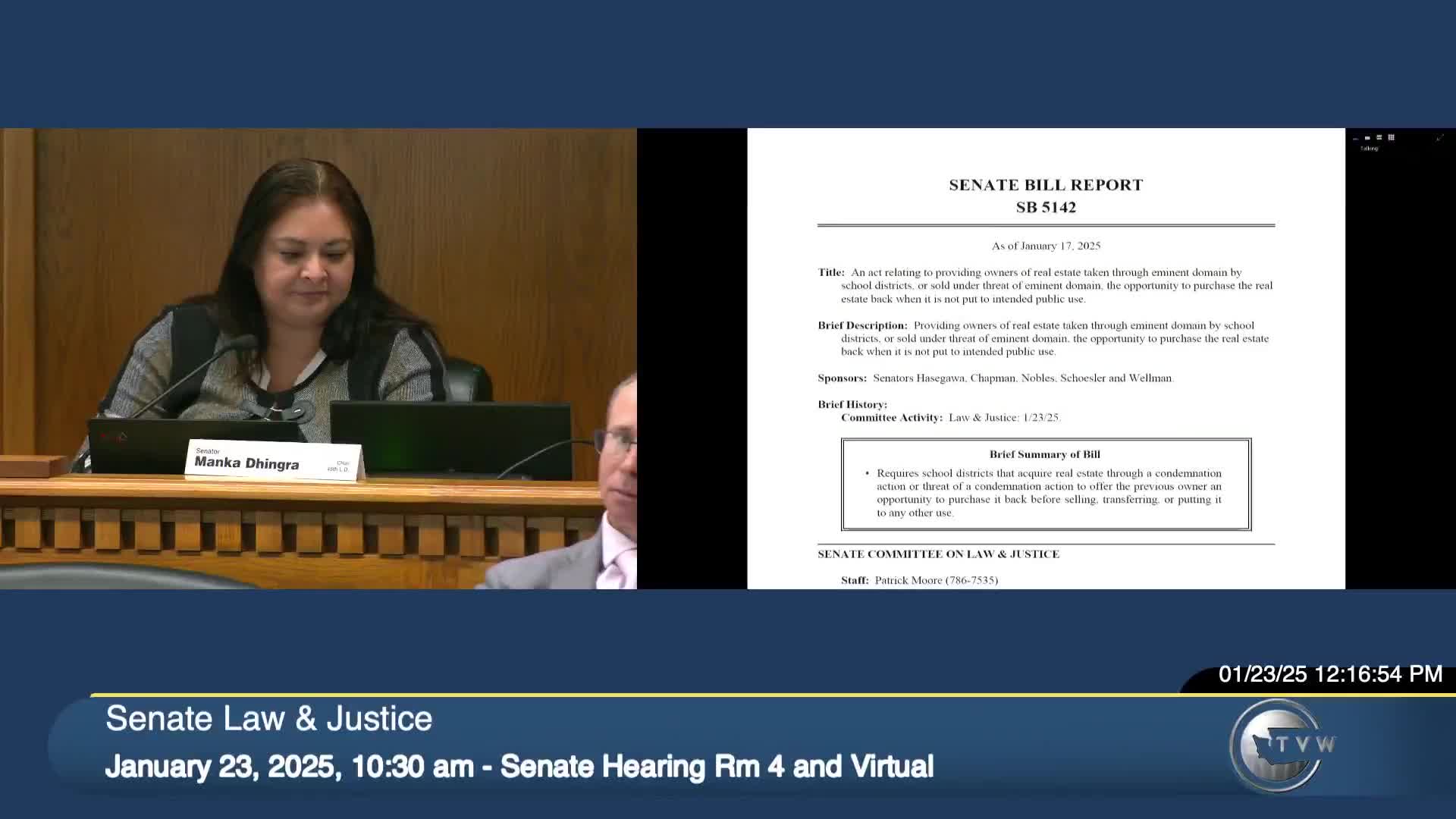
Senate Bill 5142 would require school districts that acquire property by condemnation or under threat of condemnation to offer the prior owner the opportunity to repurchase the parcel at the purchase or condemnation price before selling or using it for another purpose.
Sen. Bob Hasegawa told the Law & Justice Committee on Jan. 23 that Senate Bill 5142 would require school districts that acquire privately owned real estate through condemnation (eminent domain) or under threat of condemnation to provide the prior owner a written offer to repurchase the property at the original purchase or condemnation compensation amount before selling or repurposing the land for any other use.
"When real property is acquired through a condemnation action or under threat of one, the school district must provide the previous property owner a written statement that identifies the use for which the property is being acquired," staff counsel Patrick Moore told the committee during the staff briefing. If the school district later decides not to use the land for the school or additional school grounds, it must offer to sell the property back to the prior owner at the same amount the district paid.
Nut graf: Sponsor and witnesses described historical and present-day cases in which families lost property to condemnation and later saw the land used for different, often more lucrative private development. Supporters framed the bill as a limited corrective measure to protect homeowners and small-property holders, not a general limit on eminent domain.
Testimony and examples
John Houston, whose family previously lost land after a condemnation-related process in Renton, told the committee the family home and acreage were taken and later sold for development. Houston recounted fires and other harm he says occurred while the property was in dispute, and he described the long-term economic and personal losses his family experienced. He told senators the bill is designed to prevent future families from suffering similar outcomes.
Sen. Hasegawa and supporters said the measure was intentionally limited to school districts for this session because the sponsor wanted to act quickly and because school districts use public dollars for property acquisition.
Committee reaction and next steps
Several senators expressed support for the bill on the floor of the committee, describing other local examples where property taken for public projects was later sold or used differently. Sen. Fortunato said he would have signed on to the bill had he known about it earlier and recounted a case in which a municipality acquired land for a reservoir and later sold it to a developer.
The committee held a public hearing with multiple witnesses supporting the bill; testimony included family members of the Houston property and community advocates describing land‑loss history and reparative approaches. Committee staff noted a fiscal note had been requested. The bill was scheduled for further consideration on the committee’s upcoming agenda.
Ending
Committee members closed the public hearing after wide-ranging testimony and indicated the bill would appear on the committee’s agenda the following week for further action.