Get Full Government Meeting Transcripts, Videos, & Alerts Forever!
Get email alerts on the Salmon Recovery Accelerator topic
No spam. Unsubscribe anytime.
Senate committee hears bill to create regulator ‘accelerator’ for salmon recovery; advocates support, some warn of broad waiver authority
Summary
Senate Bill 5305 would establish an environmental accelerator within the Office of Regulatory Innovation and Assistance to identify regulatory barriers and provide time-limited regulatory relief for salmon-recovery and resiliency projects funded with Climate Commitment Act auction revenue.
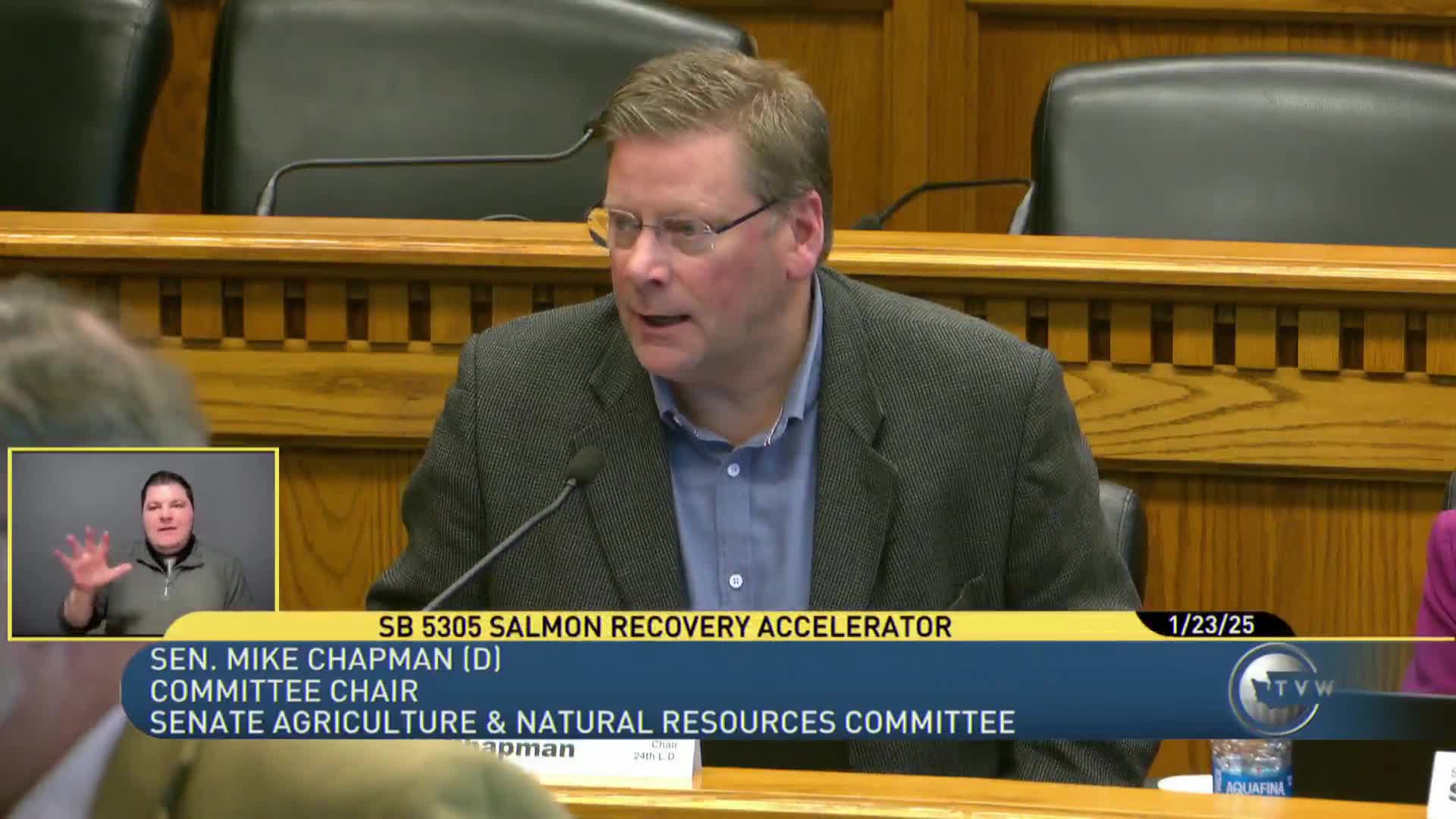
The Senate Agriculture and Natural Resources Committee took testimony on Senate Bill 5305, which would establish an environmental accelerator within the Office of Regulatory Innovation and Assistance (ORIA) to help salmon recovery and ecological-resiliency projects funded with Climate Commitment Act (CCA) auction revenue.
Committee staff described the bill as authorizing ORIA’s director to appoint an administrator and staff for the accelerator, which would identify regulatory barriers to CCA-funded salmon-recovery projects, help applicants request regulatory relief, and work with relevant agencies to grant temporary regulatory adjustments. Testimony from committee staff noted that relief could include a time-limited waiver of state law for trial periods of up to five years and that the administrator or the relevant regulatory agency could rescind relief if it became contrary to the public interest or if a project ended. The bill would require an annual report to the Legislature and a JLARC evaluation by December 1, 2029.
Supporters told the committee the accelerator would reduce delays that have stalled habitat-restoration work. Todd Myers of the Washington Policy Center said the measure would identify permit and non-permit regulatory barriers and provide a monitored pathway to temporary relief, noting ORIA has a track record of assisting with regulatory streamlining. Kelsey Hulse of the Washington State Association of Counties endorsed the bill, saying salmon and resiliency projects are structurally complex and “tough to schedule.” Several individuals and conservation groups that have worked on permitting reform also registered support.
Opponents and cautious witnesses urged narrow drafting and safeguards. Mindy Roberts of Washington Conservation Action said the Legislature’s priority should be funding projects already vetted by local and regional salmon recovery plans; she called the bill duplicative of prior efforts in some respects and warned that an undetermined entity being able to waive state law risks unintended consequences. Roberts asked how government-to-government tribal consultation would be ensured if timeline language limited agency review time.
Remote testifier John Worthington said in his experience local, rigorous watershed plans can produce clear solutions and warned against creating a sliding scale that undermines established local standards. Committee staff and the sponsor said the bill seeks to collect a clear list of barriers, create temporary accommodations where warranted, and hand those lessons back to the Legislature for permanent statutory changes where appropriate.
The committee heard detailed questions about what kinds of regulations might be adjusted, who has statutory authority to grant relief, the scope of waivers and their duration, and whether ORIA has the statutory authority to issue relief or whether relief must come from the underlying regulatory agencies. The sponsor and staff said the bill is intended to be targeted to projects funded with CCA revenue, that relief is time limited and monitored, and that ORIA would coordinate with relevant agencies. No formal committee vote took place during the hearing.