Get Full Government Meeting Transcripts, Videos, & Alerts Forever!
Get email alerts on the Wdfw Governance Review topic
No spam. Unsubscribe anytime.
Ruckelshaus Center tells Senate committee WDFW review found governance confusion, recommends options including major reforms
Summary
The William D. Ruckelshaus Center on June 30 presented a legislative review of the Washington Department of Fish and Wildlife that found broad agreement on a future vision but identified substantial confusion about the commission’s role, funding, tribal coordination and public engagement.
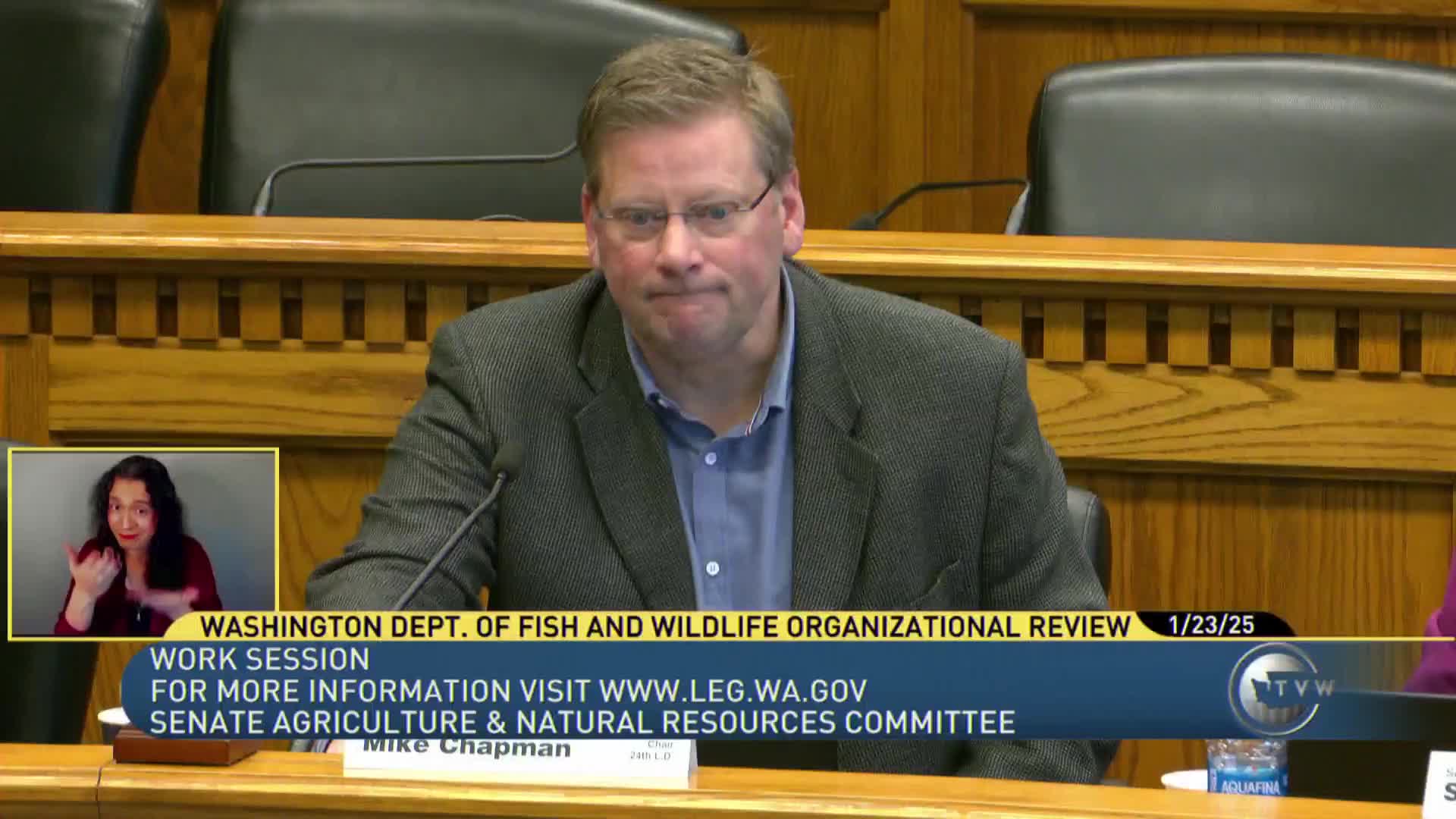
The William D. Ruckelshaus Center presented its year-long organizational review of the Washington Department of Fish and Wildlife to the Senate Agriculture and Natural Resources Committee on June 30, summarizing findings from more than 100 interviews with stakeholders across the state.
Dr. Julia Carboni, director of the Ruckelshaus Center, said the center’s review – directed by the Legislature in 2023 – examined WDFW’s governance, funding model, adherence to state law, decision-making processes and outreach to marginalized communities. The center’s report identifies a shared vision for the agency’s future but also numerous structural and process problems that stakeholders said are hindering WDFW’s ability to manage fish, wildlife and habitat under changing conditions.
Senior facilitators Chris Page and Amanda Murphy described the center’s process of confidential interviews and appreciative inquiry, which began each conversation by asking stakeholders to envision WDFW operating at its best in 10, 20 or 50 years. Murphy said interviewers spoke with 113 individuals and intentionally included tribal governments because tribes have treaty rights and co-management relationships under cases such as U.S. v. Washington and U.S. v. Oregon.
Key findings cited by the presenters included: - Broad agreement on a future vision emphasizing healthy habitat and collaboration across agencies, landowners and tribes to address climate change and biodiversity loss. - Confusion about the role, appointment process and duties of the WDFW Commission; stakeholders generally favored retaining a commission but identified structural problems in appointments, accountability and workload. - Lack of clarity about the agency’s funding structure and widespread misunderstanding about the balance between license fees, general fund and recent biodiversity appropriations; interviewees praised the Budget Policy Advisory Group but asked for clearer public communications about funding sources. - Gaps in tribal coordination and questions about how the commission engages with federally recognized tribes and the co-management framework in U.S. v. Washington and U.S. v. Oregon. - Concerns about science-in-decision-making protocols and public engagement formats; stakeholders wanted agreed protocols for use of science and more dialogic engagement rather than only three-minute public comments.
Phyllis Shulman, a senior facilitator, summarized the center’s recommendations and said three governance options emerged from the review: maintain the status quo; convert WDFW to a cabinet-level agency; or keep a commission but implement comprehensive and simultaneous reforms addressing appointment processes, scope of commission duties, staffing, accountability and tribe-related roles. Shulman said the center recommends building collaborative capacity before attempting changes to the agency’s statutory mandate and suggested consulting tribes directly on any mandate revision.
Other recommendations included updating and clarifying long-term funding plans, diversifying funding sources, increasing tribal liaisons, completing and adopting a “use of science” decision policy, strengthening accountability and transparency, and expanding public engagement practices such as regional workshops and facilitated dialogues. Presenters emphasized that many reforms are interconnected and that partial fixes could leave systemic problems intact.
Committee members asked about trade-offs between governance options, the commission’s role relative to departmental staff scientists, appointment and accountability processes, public comment structure, and whether the agency has shifted from a harvest-focused model to a conservation-first approach. Presenters said there were trade-offs with every option, that many stakeholders favored keeping a representative commission if structural reforms were implemented, and that interviewees generally agreed the department is moving toward a conservation-first approach but needs continued investment and cross-boundary collaboration.
Presenters urged the committee to review the full report, consult tribes, and consider tasking a facilitated stakeholder process to develop concrete reforms if the Legislature wants to maintain a commission and make the simultaneous structural changes the report describes.