Get Full Government Meeting Transcripts, Videos, & Alerts Forever!
Get email alerts on the Committee Executive Session Votes topic
No spam. Unsubscribe anytime.
Executive session: committee advances two bills — tribal‑elder tuition waiver and student‑athlete insurance authorization
Summary
In executive session the committee gave due‑pass recommendations to Senate Bill 5110 (tuition waivers for tribal elders at community and technical colleges) and Senate Bill 5158 (permitting governing boards to pay student‑athlete insurance costs). Both measures were advanced by voice vote without roll call tallies recorded in the transcript.
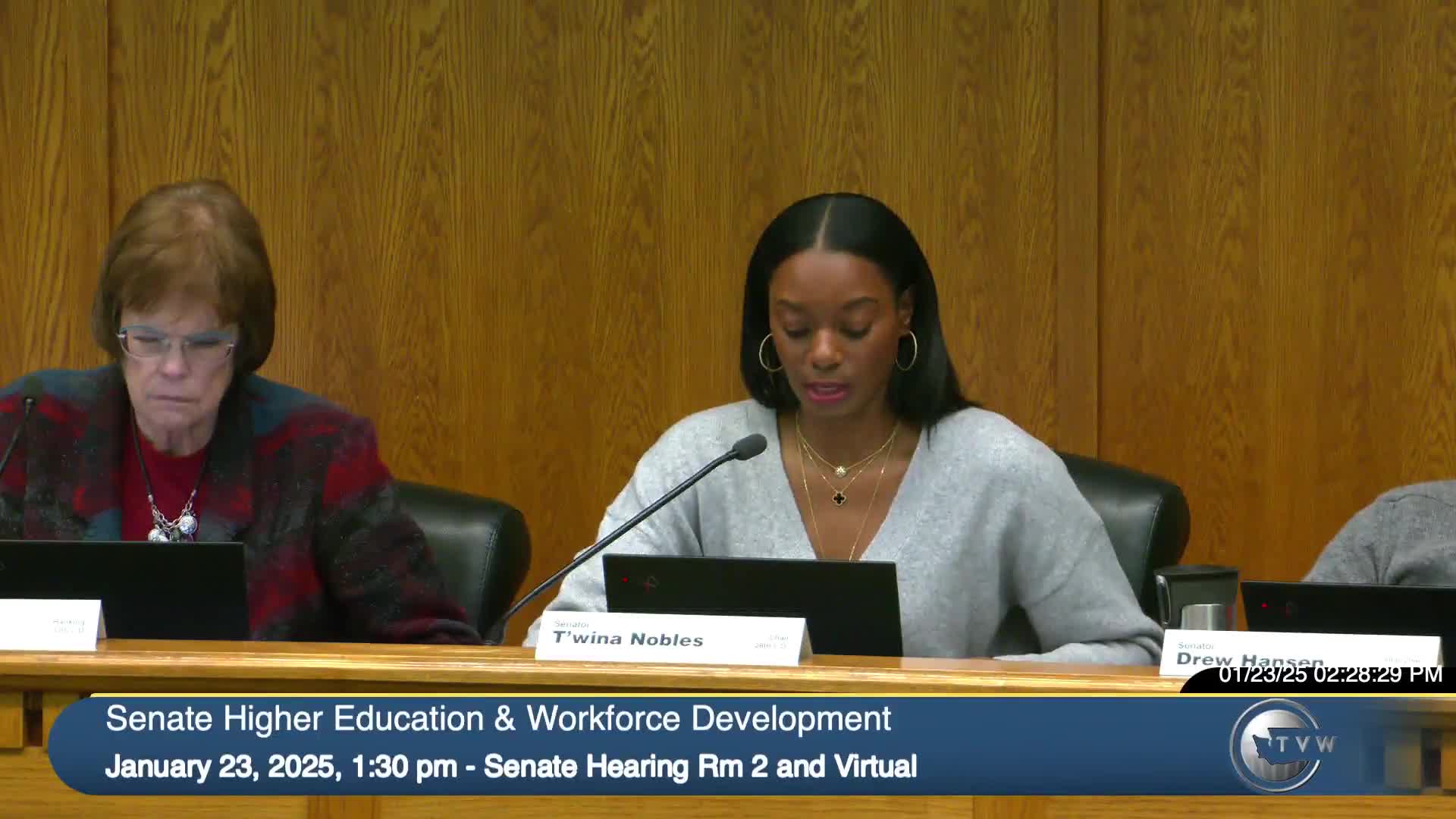
In executive session the Senate Higher Education & Workforce Development Committee advanced two bills by voice votes and sent recommendations to subsequent committees.
Senate Bill 5110: A staff briefing described SB 5110 as creating a tuition waiver for tribal elders (those over age 55) at Washington’s community and technical colleges. The committee took a motion from Senator Slaughter to "receive a due pass recommendation to be sent to the Ways and Means Committee." The motion passed by voice vote; committee chair recorded the motion’s passage and asked members to remain to sign the paperwork. The staff fiscal note in the committee packet showed an assumed revenue loss of $868,000 based on the total number of tribal elders in the state, though the staff briefing noted the estimate is not necessarily the number who would use the program.
Senate Bill 5158: Staff briefed SB 5158 as allowing the governing board of a public four‑year institution to make and pay the costs of insurance for intercollegiate student athletes, including coverage during post‑eligibility health care periods for athletics‑related injuries and conditions. Senator Slatter moved that the bill "receive a due pass recommendation be sent to the Rules Committee;" the motion passed by voice vote. The fiscal note indicated no estimated fiscal cost.
The nut graf: Both measures received due‑pass recommendations in executive session without roll‑call tallies recorded in the transcript; the committee proceeded by voice vote and the bills will move to the next fiscal or rules stage as indicated.
Ending: The committee adjourned after the executive session and members were asked to sign the committee paperwork for the recommended actions.