Get Full Government Meeting Transcripts, Videos, & Alerts Forever!
Get email alerts on the Transportation topic
No spam. Unsubscribe anytime.
Regional planners ask for increased RTPO funding, highlight role in cross‑jurisdiction projects
Summary
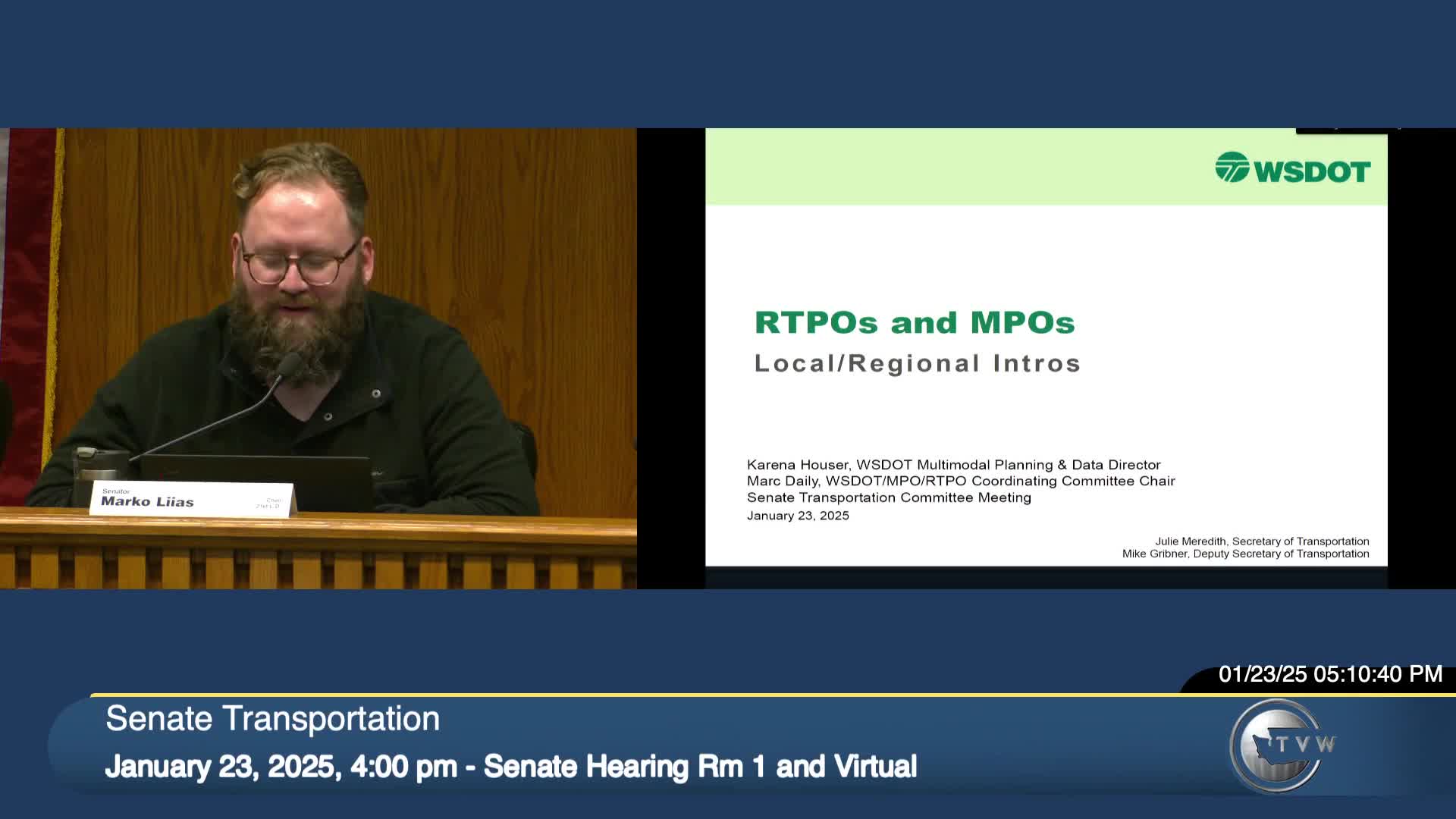
Corina Hauser of WSDOT and Mark Daley of the Thurston Regional Planning Council told the Senate Transportation Committee that MPOs and RTPOs provide essential regional planning functions and need greater biennial funding to meet expanding responsibilities.
Corina Hauser, director of the Multimodal Planning and Data Division at the Washington State Department of Transportation, and Mark Daley, executive director of the Thurston Regional Planning Council and chair of the statewide MPO/RTPO coordinating committee, briefed the Senate Transportation Committee on the role and funding needs of regional planners.
"How do you chart the best course forward through so much complexity and uncertainty?" Hauser asked, telling senators that MPOs and RTPOs help build consensus on long‑term regional transportation visions grounded in state and federal policy.
Hauser said WSDOT administers MPO and RTPO programs and passes through about $26 million in federal funds and $5 million in state funds — $31 million total — to support regional planning over a biennium. She noted the statutory framework: the regional transportation planning program was established as part of the Growth Management Act in 1994 and that there are 17 RTPOs and 12 MPOs in Washington.
Daley described how regional organizations coordinate counties, cities, ports, transit agencies, tribes and state agencies to produce 20‑year regional transportation plans and rolling six‑year Transportation Improvement Programs that align projects with funding. He gave a regional example from the Thurston area where RTPO modeling helped identify future I‑5 bottlenecks and flood/estuary risks at the Nisqually River and informed early investments and coordination with Joint Base Lewis‑McChord and tribal partners.
Both speakers said RTPOs have received additional responsibilities over time while funding levels have not kept pace. Daley and Hauser recommended the legislature consider increasing RTPO biennial funding (they cited a requested increase of roughly $6.8 million per biennium) to support planning, public engagement, multimodal level‑of‑service work and compliance tasks that are especially difficult for rural regions working with small staffs.
Ending: Hauser and Daley invited senators to consult with their local MPOs and RTPOs on project ideas and stressed that early regional planning helps identify fatal flaws, coordinate environmental review and prioritize investments that maximize the effectiveness of limited state dollars.