Get Full Government Meeting Transcripts, Videos, & Alerts Forever!
Get email alerts on the Sentencing Reform topic
No spam. Unsubscribe anytime.
Judicial Discretion Act hearing draws survivors, judges and formerly incarcerated witnesses; committee to continue testimony
Summary
House Bill 1125, a 'second-look'/judicial-discretion proposal, drew survivor and victim testimony, judicial support, and incarcerated-person accounts; the hearing was opened Jan. 23 and will be continued Jan. 30.
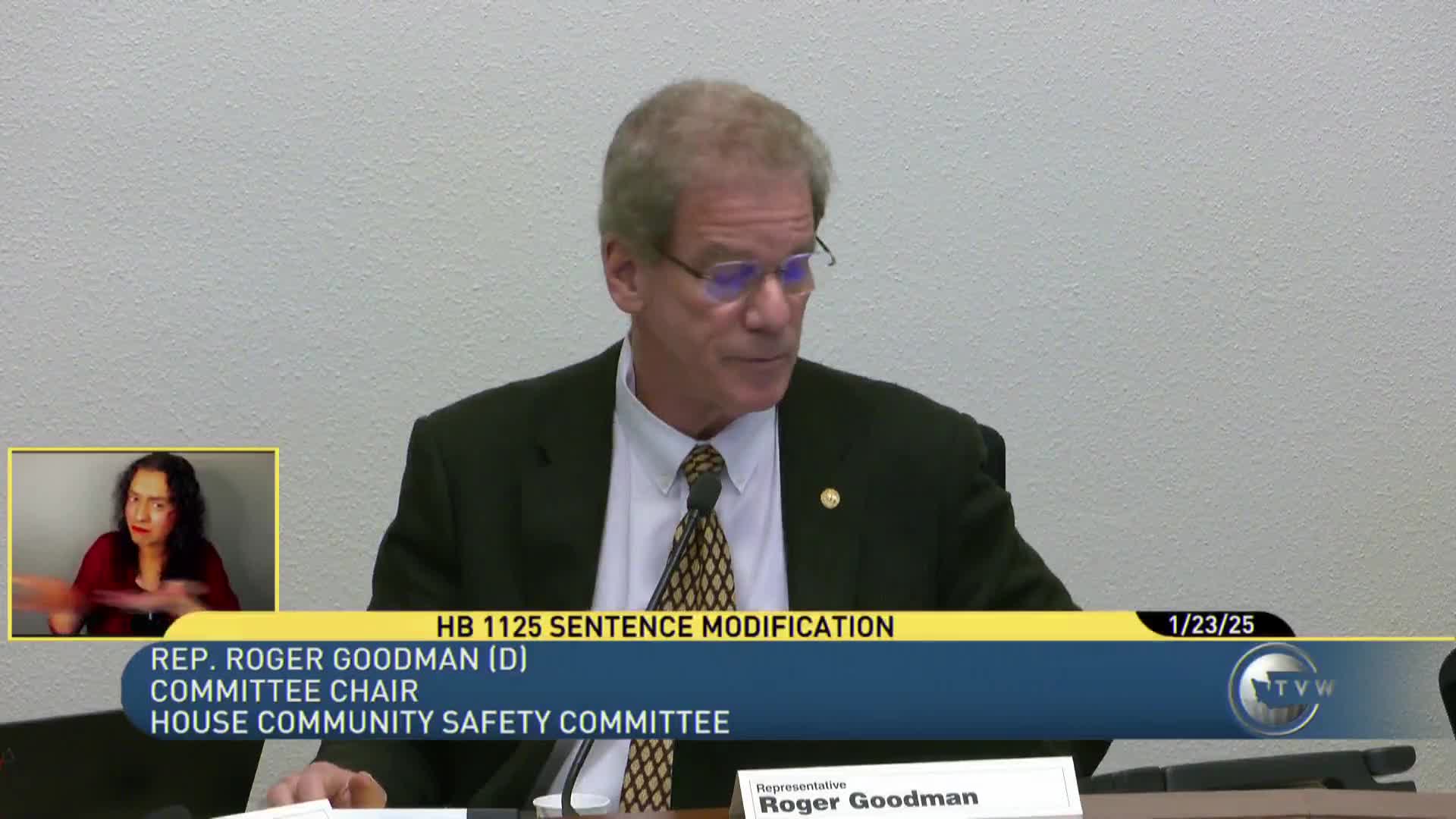
House Bill 1125, a multi-year phased process creating a path for certain people convicted of felonies to petition courts for modification of their sentences “in the interest of justice,” was the subject of a lengthy public hearing Jan. 23 before the Community Safety Committee. Committee staff outlined a six-year eligibility rollout beginning July 1, 2026, and excluding certain persistent-offender designations and first-degree aggravated murder.
The bill would allow people meeting eligibility criteria to petition the original sentencing court to consider post-conviction behavior, rehabilitation and medical frailty; if the court finds eligibility by a preponderance standard it must hold a hearing within 120 days and may reduce a sentence to one no greater than the original. The bill requires DOC assistance compiling records, victim notification and offers for appointed counsel for indigent petitioners, and it creates a flexible fund for victim services.
Several people with lived experience spoke in favor. Azias Ross, incarcerated and serving a sentence he described as the product of consecutive weapon enhancements, said his sentencing judge told him the court lacked meaningful discretion at the time of sentencing and that review mechanisms are necessary. Ross quoted the judge as saying the court’s current sentence was “significantly disproportionate to the crimes committed when evaluating Ross as he is today.” He asked for judicial tools that would allow resentencing when appropriate.
Amanda Knight, who identified herself as incarcerated at Washington Correction Center for Women and described a long sentence for her role in a robbery that ended in a death, testified in support: “My worst choice has defined my life,” Knight said, and urged courts be able to account for rehabilitation and life context.
Victims and family members voiced opposition. Krista Stogner testified on behalf of a brother who was murdered and said the bill risks re-traumatizing victims and could jeopardize public safety. Anthony Mixer, speaking for a campus chapter of a conservative student group, described the bill as undermining consequences for crime.
Judge Veronica Galvan, co-chair of the Minority and Justice Commission, supported second-look policies and urged the committee to consider data showing disproportionate impacts of long sentences. She said, “We know better and we are obligated to do better,” and pointed to research showing low recidivism among people granted similar resentencings in other contexts.
Committee members asked detailed questions about eligibility, carve-outs for persistent-offender designations and how victim notification and funding would work. Because demand for testimony exceeded available time the committee recessed public testimony and set a continuation for Jan. 30; priority will be given to those who traveled to Olympia. The hearing remains open and the bill will be considered at a later date.