Get Full Government Meeting Transcripts, Videos, & Alerts Forever!
Get email alerts on the Prison Labor topic
No spam. Unsubscribe anytime.
Public hearing on prison work programs: sponsors, incarcerated workers and DOC debate wages and voluntariness
Summary
A public hearing on House Bill 1233 drew testimony from incarcerated workers, advocates and Department of Corrections officials about making correctional industries participation voluntary and raising wages.
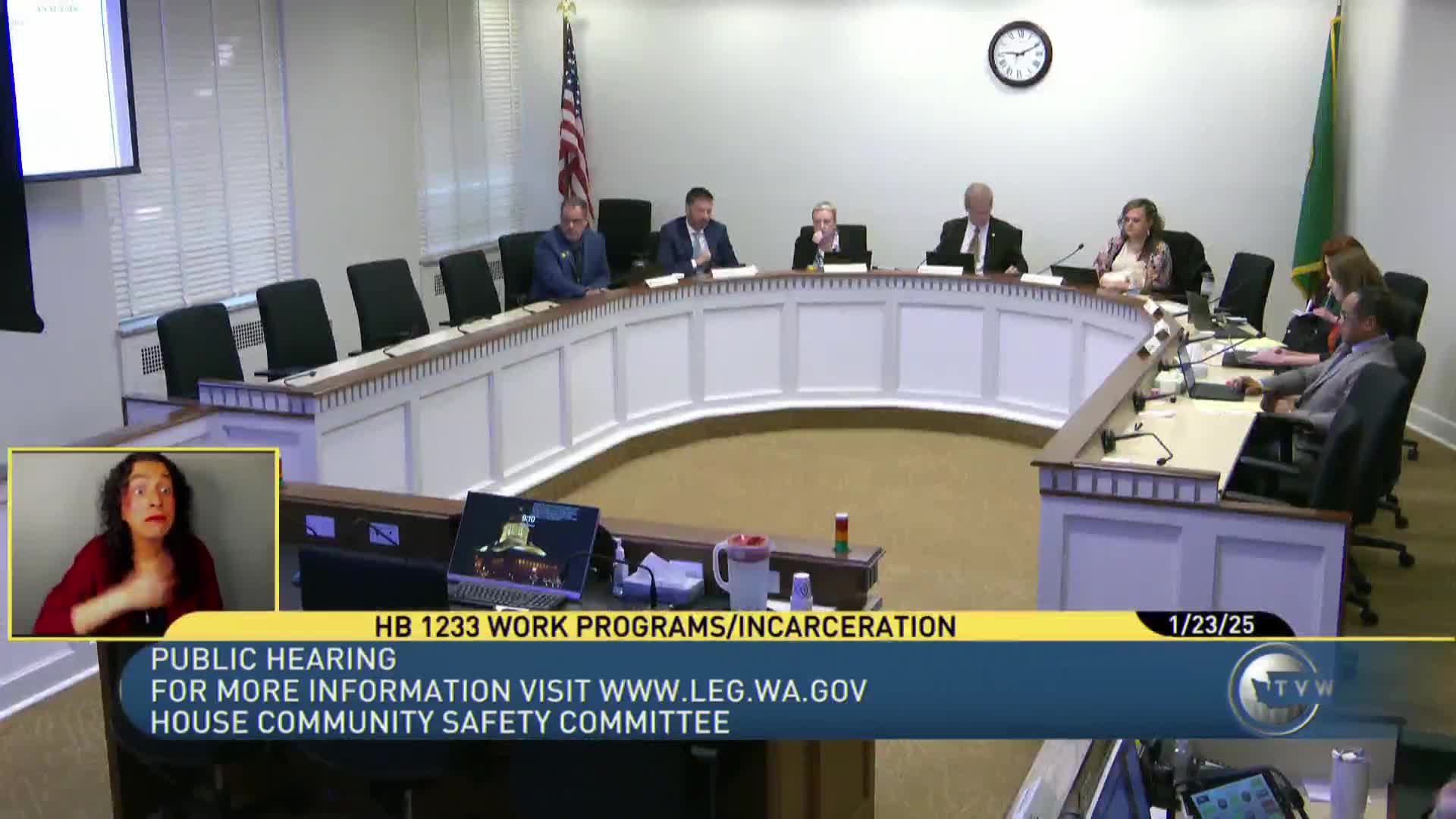
The Community Safety Committee on Jan. 23 heard public testimony on House Bill 1233, which would make participation in most correctional industries work programs voluntary, forbid punitive discipline for refusing to work, and set a minimum wage/gratuity of at least $1 per hour for class 2 and class 3 work and a monthly maximum no less than $200 for class 3 payments.
The bill would not affect court-ordered community restitution work (class 5) but would end DOC’s ability to reduce earned early release or other privileges, issue infractions, or take punitive action solely because a person refuses to participate in a correctional industry program.
Carlos Bernardes, incarcerated at Washington Correction Center and a lead organizer for Look to Justice, told the committee that increased wages helped him support his family. "Having the ability to receive a sustainable wage while incarcerated has alleviated the financial load for my family members and loved ones," Bernardes said, adding that higher pay made it possible to send money home for essentials.
Several formerly incarcerated or currently incarcerated witnesses described a lack of meaningful choice. Jermaine Williams said that once people are assigned to certain programs they cannot quit without suffering infractions and loss of good conduct time; he said, "No, ma'am. Respectfully, and you can verify this, you do not have a choice. Once you have been chose to program, you absolutely must."
Hannah Warner, an attorney with Columbia Legal Services, testified in strong support, describing prison labor as rooted in an exception to the 13th Amendment and saying the $1 hourly floor adopted in recent budget language was vital for basic needs and reentry. "Our state should not backslide on the progress we have made in the past two years," Warner told the committee.
Department of Corrections Assistant Secretary Danielle Armbruster said DOC supports policy that encourages programming but warned the department that making participation optional for facility-maintenance jobs would require hiring additional staff or contracting out essential operations, imposing substantial costs. Armbruster said Correctional Industries must be financially self-sustaining and that higher gratuities would increase operating costs that are passed to customers.
Committee members asked whether custody-related maintenance roles (class 3) differ from correctional industries (class 2) and whether existing law already requires individuals to participate in programs. DOC staff said class 2 (Correctional Industries) has been legally voluntary though individuals must give notice to quit, and class 3 includes custodial and maintenance work that is currently required in many circumstances.
Testimony reflected sharply different views: advocates and several incarcerated witnesses described coerced labor and urged a voluntary model and wage protections; DOC emphasized operational continuity and fiscal consequences. The committee did not take action on the bill and will consider it later in the legislative process.
Ending: Sponsors and witnesses asked the committee to keep the recent $1 per hour wage floor and to enshrine voluntariness and protection from punitive infractions for refusal to work. DOC requested further fiscal analysis.