Get Full Government Meeting Transcripts, Videos, & Alerts Forever!
Get email alerts on the Committee Briefings topic
No spam. Unsubscribe anytime.
Staff briefed committee on amendments to HB 1024 and HB 1154; no votes taken
Summary
Committee staff summarized proposed amendments: HB 1024 would restore a limitation on St. Edward State Park leases while HB 1154’s substitute would adjust timing, civil penalty amounts and appeals paths for solid waste facility enforcement. Members asked clarifying questions; no committee action recorded.
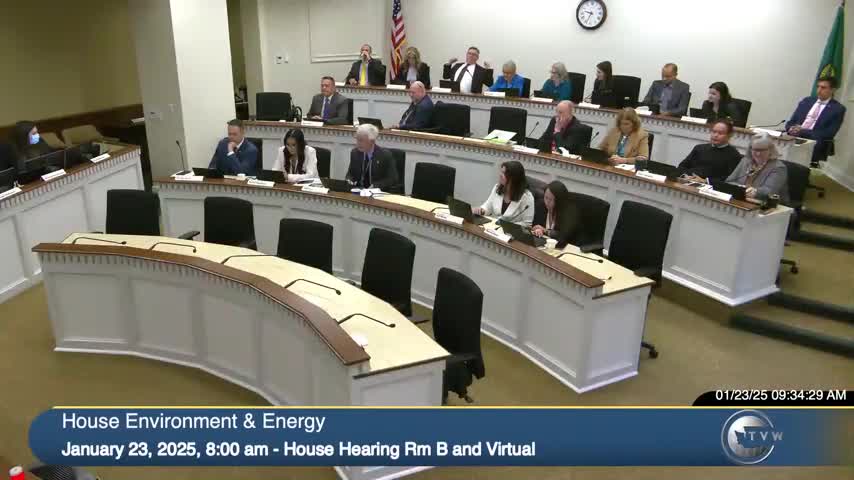
Committee staff provided briefings on amendments to two bills during the Environment & Energy hearing.
An intern for the committee, Srinandan Ramachandran, summarized a proposed amendment to House Bill 1024. The underlying bill would increase the maximum lease length for St. Edward State Park from 62 years to 80 years; the amendment would restore a requirement limiting long leases at the park to specific structures and adjacent property (the main seminary building, pool building, gymnasium, adjacent parking lots and associated nearby property).
Matt Sterling, committee staff, then summarized House Bill 1154 and a proposed substitute (EHB H-0785.1). The bill would authorize the Department of Ecology to suspend permits and impose civil penalties on solid waste handling facilities operating in violation of requirements, and would require jurisdictional health departments (JHDs) to provide Ecology with a list of facility violations. The proposed substitute makes multiple changes: it delays a validation date for land‑filling permits to August 1, 2027; limits a JHD’s initial penalty authority to $5,000 per day for the first 14 days (rising to $10,000 per day thereafter if violations persist); directs where penalties are deposited (local treasuries for JHD penalties; the Model Toxics Control Operating Account for Ecology penalties); requires JHDs to attempt education and outreach before penalties and allows JHDs to defer enforcement to Ecology; allows Ecology to assume enforcement if a JHD’s response is inadequate; and sets appeal paths (local health officer for JHD penalties, Pollution Control Hearings Board for Ecology penalties).
Staff said the substitute seeks to harmonize relationships between local health departments and Ecology and to create clearer procedures and appeal routes. Committee members discussed the changes briefly; staff offered to provide any additional technical details in writing. No amendment votes or final committee action were taken during the briefing segment.