Get Full Government Meeting Transcripts, Videos, & Alerts Forever!
Get email alerts on the Student Survey topic
No spam. Unsubscribe anytime.
Committee hears bill to create voluntary exit survey for transferring or withdrawing students
Summary
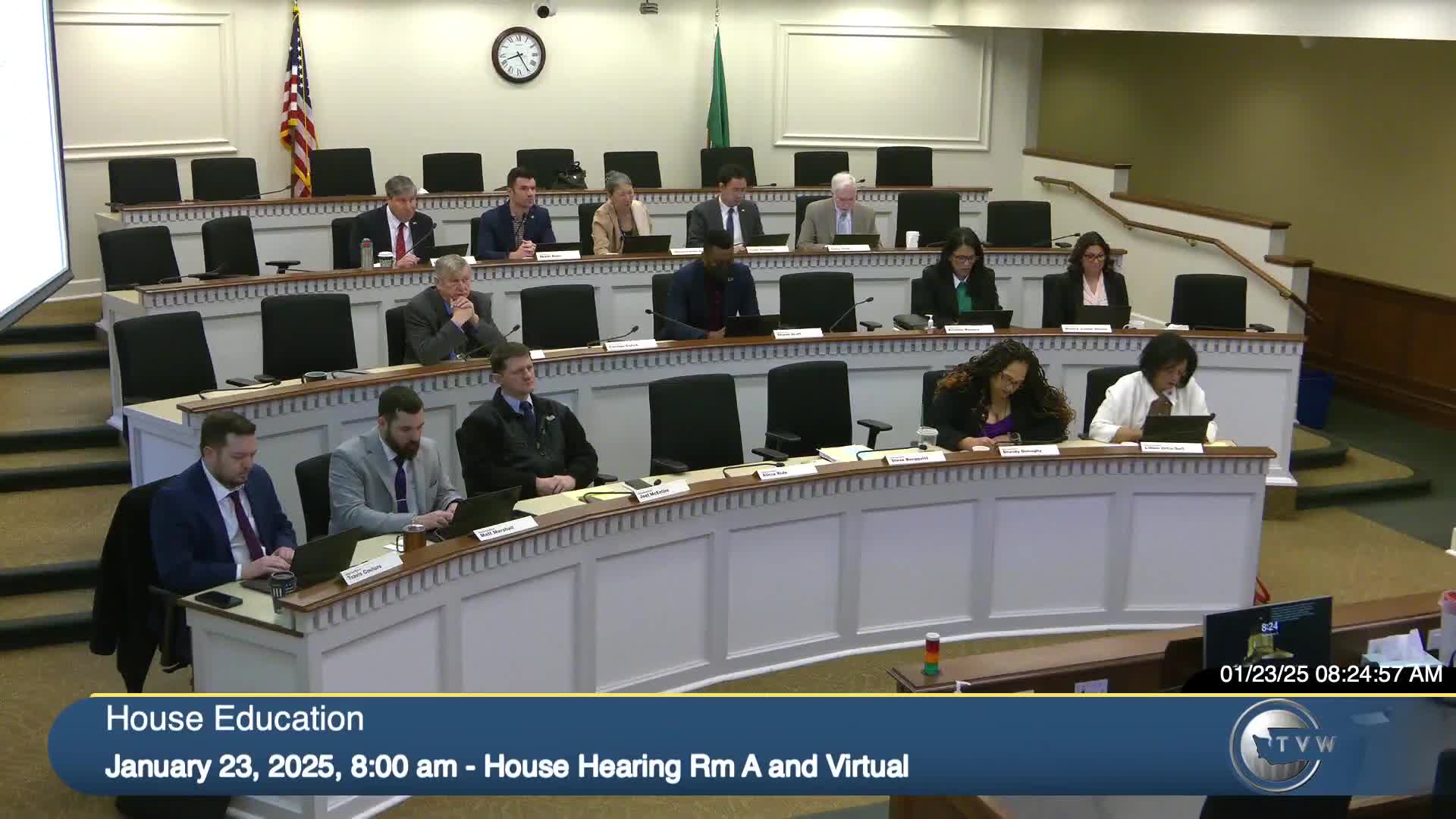
House Bill 1289, which would direct the Washington School Information Processing Cooperative to create a confidential, voluntary online survey for parents or guardians of students who transfer or withdraw from public schools, received a public hearing before the House Education Committee.
House Bill 1289, which would direct the Washington School Information Processing Cooperative (WSIPC) to create a confidential, voluntary online survey for parents or guardians of students who transfer or withdraw from Washington public schools, received a public hearing before the House Education Committee.
Damian Morton Snipper, a graduate intern with the Office of Program Research, summarized the bill for the panel, saying the survey’s stated purpose is to collect data about why students transfer or withdraw and to provide annual summaries of responses to the districts where the transfers occurred and to legislative committees. The bill would encourage districts to notify parents about the survey, require the cooperative to make an aggregate summary public annually, and set an operational date of Sept. 1, 2025.
Damian told the committee the cooperative provides data and technology services to districts through an interlocal agreement among nine educational service districts. Dr. Dana Anderson, chief executive officer of WSIPC, said the cooperative supports the bill’s timeline if the scope is limited. "If it's a closed survey, that's relatively simple to deploy," Anderson said, and added that WSIPC has begun initial design work and conducts regular cybersecurity audits. She also flagged language around equitable access — including multilingual options and accessibility — as drivers of scope and cost.
Several testifiers supported the idea but urged broader or clarified measures. Former Representative McClintock, the bill’s prime sponsor, said an exit survey can provide information districts can use to retain students and offered that expanding to a broader engagement survey could be discussed. The Washington Education Association supported the concept but suggested including families who keep their students in public schools to create a larger, more informative data set. The Washington Coalition for Gifted Education asked for amendments to ensure public, disaggregated reporting (for example by originating district, destination school type and student demographics) and proposed mandatory district delivery of the survey at unenrollment events even though parent response would remain voluntary.
Committee members asked about cost: staff said the fiscal note indicated no cost to districts. Representative Ortiz‑Self asked whether the survey would be offered in multiple languages; WSIPC said language‑access provisions would need to be specified and could affect deployment. The cooperative and other witnesses noted FERPA and federal privacy obligations apply; WSIPC said it is subject to annual audits and serves data for roughly 700,000 students and 3.2 million active users.
At the close of the public hearing the committee recorded 31 pro, 505 con, and 1 other written sign‑ins. No committee vote occurred during the hearing; the bill was presented for testimony and potential amendment.
— Ending —