Get Full Government Meeting Transcripts, Videos, & Alerts Forever!
Get email alerts on the Environmental Justice topic
No spam. Unsubscribe anytime.
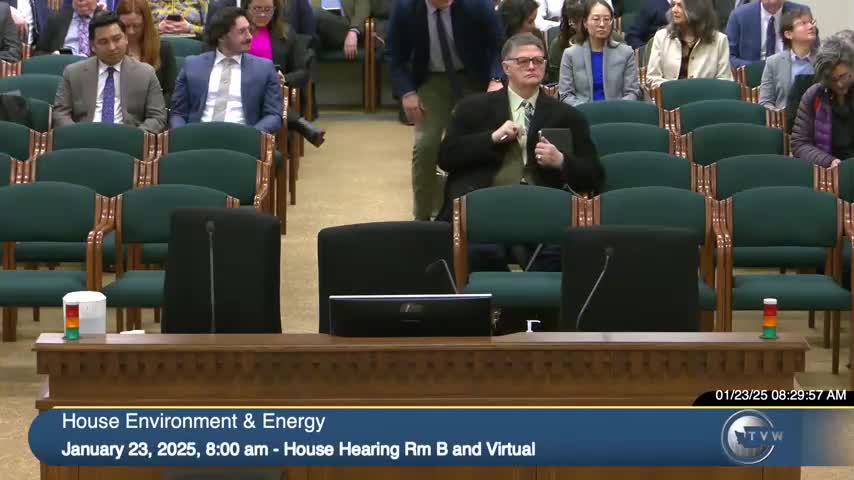
Committee hears HB 1303 (CURB Act) to add environmental justice review to SEPA and restrict some permits in overburdened areas
Summary
The House Environment & Energy Committee heard House Bill 1303, the Curb Pollution Act, which would add environmental justice requirements to SEPA, require environmental justice impact statements for certain projects in pollution‑burdened communities, and bar specified large air permits in the most polluted census tracts.
The House Environment & Energy Committee heard House Bill 1303, the Curb Pollution Act (sponsored by Rep. Charlotte Mena), which would add environmental justice requirements to Washington’s State Environmental Policy Act and restrict certain Clean Air Act permits in the state’s most pollution‑burdened communities.
Under the bill’s three main components, the Department of Ecology would be required to adopt rules to explicitly include environmental justice among SEPA’s elements; certain covered projects in communities ranked 7 or higher on the state’s environmental health disparities map (or adjacent to them) would require an environmental justice impact statement (EJIS) before a SEPA threshold determination; and construction orders or approvals for certain large air sources in census tracts ranked 9 or 10 would be prohibited for specified types of facilities, including major sources and incinerators.
Sponsor Representative Charlotte Mena (29th Legislative District) framed the bill as a response to long‑standing disparities: “In the 29th district, the vast majority of the census tracts are ranked 9 and 10,” she said, and noted local health outcomes including a reported 10‑year shorter life expectancy in parts of her district. She described the EJIS as a tool to assess cumulative impacts, take public input, and require mitigation or allow denial of projects when identified harms cannot be mitigated.
Proponents from community and advocacy groups said the bill would make cumulative impacts visible and give frontline communities a formal role in permitting. Mia Ayala Marshall, with the Duwamish River Community Coalition, said the Duwamish Valley faces “cumulative health disparities” including an estimated eight‑year shorter life expectancy than the Seattle average and high rates of childhood asthma hospitalizations. Front and Centered representatives and Earthjustice urged passage and pointed to similar policies enacted in other states.
Local governments, ports, business groups and some developers expressed concerns about scope, timing and cost. Carly Michaels of the Washington Public Ports Association said the underlying policy goal is important but warned the bill “is duplicative and burdensome” for port projects and asked that economic benefits and community investments be considered. Peter Godlowski of the Association of Washington Business cautioned the bill’s definitions could reach a broad set of permits across large geographic areas. Kelsey Hulse of the Washington Association of Counties urged more stakeholder work to integrate EJ into SEPA without creating extensive new layers that could delay projects.
State agencies and technical witnesses flagged implementation and legal conflicts. Carrie Sessions of the Department of Ecology said some timelines in the draft EJIS could conflict with SEPA threshold determination timelines, and the department raised concerns that a statutory prohibition on issuing certain air permits in 9‑ and 10‑ranked areas could jeopardize federal delegated permitting obligations if it prevents legally required upgrades or modifications. Other witnesses urged clarification on how the bill interacts with the Climate Commitment Act and the HEAL Act (Senate Bill 5141).
Committee members asked detailed questions about scope and tradeoffs. Staff said the Clean Air Act‑type prohibition in the bill applies only in 9 and 10 areas, while the EJIS requirement applies to communities ranked 7 and above. The committee also discussed an explicit Department of Transportation exclusion for smaller‑value DOT projects (the transcript referenced a $15,000,000 threshold consistent with HEAL Act exclusions).
The hearing included dozens of community, industry, local government and technical witnesses. No committee vote or final action occurred; proponents and opponents said they expect further negotiations between the sponsor, state agencies and stakeholders on definitions, SEPA timing and specific exemptions.