Get Full Government Meeting Transcripts, Videos, & Alerts Forever!
Get email alerts on the Housing Manufactured Home Sharing topic
No spam. Unsubscribe anytime.
Committee hears testimony on bill to let seniors in manufactured-home communities take roommates
Summary
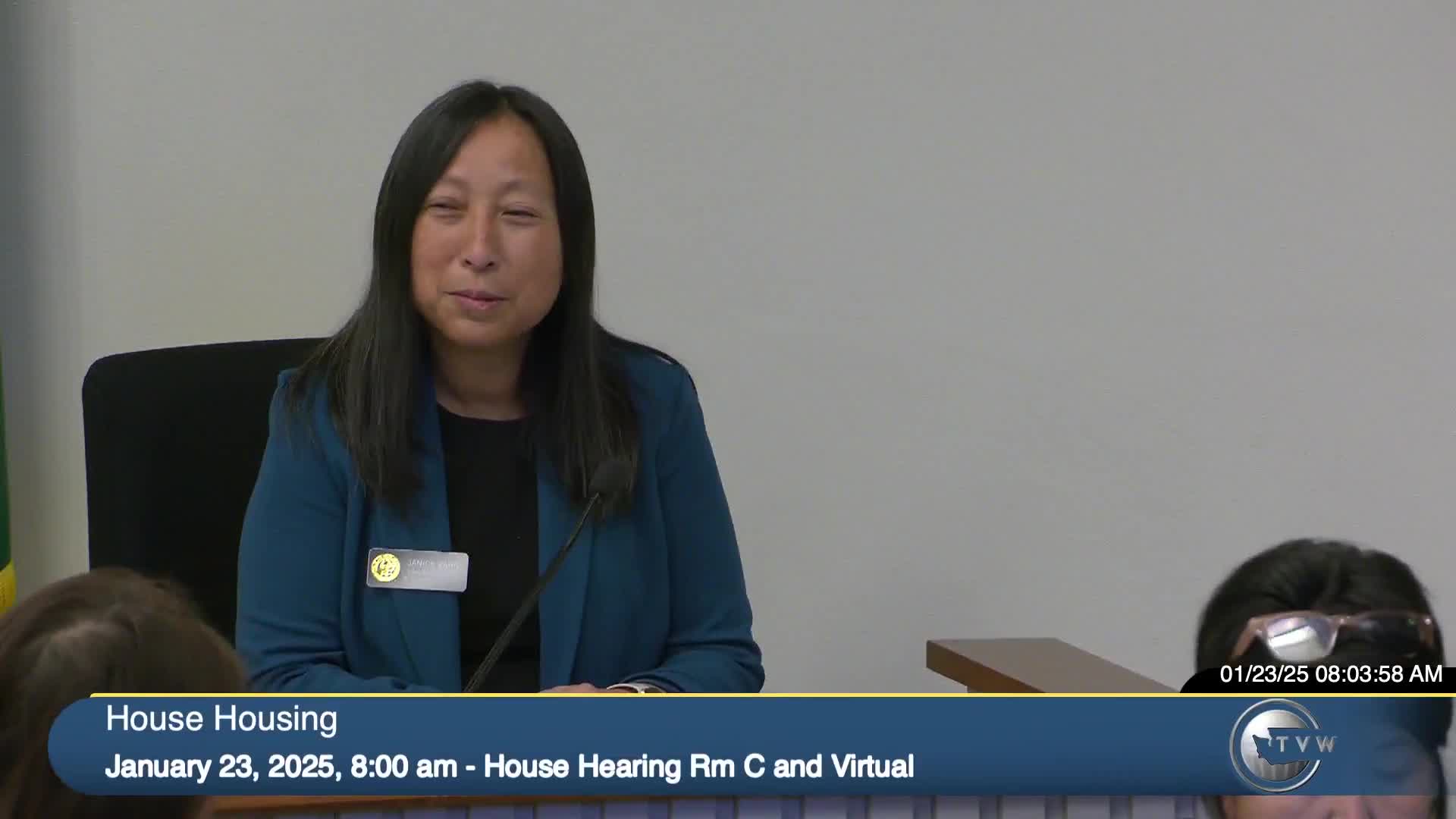
OLYMPIA, Wash. — The House Committee on Housing on Jan. 23 opened a public hearing on House Bill 1204, which would allow manufactured-mobile-home tenants who are age 55 or older to have at least one roommate so long as the roommate’s presence does not violate the community’s age restrictions.
OLYMPIA, Wash. — The House Committee on Housing on Jan. 23 opened a public hearing on House Bill 1204, which would allow manufactured-mobile-home tenants who are age 55 or older to have at least one roommate so long as the roommate’s presence does not violate the community’s age restrictions. Representative Carolyn Eslic (D), who represents the 39th Legislative District, introduced the measure and said it is intended to help seniors on fixed incomes remain in their homes amid rising lot rents and corporate purchases of parks.
Audrey Vasek, staff to the committee, summarized the bill and the statutory background. "House Bill 1204 allows a manufactured mobile home tenant who is age 55 or older to have at least one roommate as long as the roommate's residence in the community does not violate any applicable age restrictions," Vasek said, noting that the Manufactured Mobile Home Landlord-Tenant Act (RCW 59.20) governs rental agreements where a homeowner rents the land under their home and that the caregiver statute, RCW 59.20.145, already permits some occupants to live with homeowners.
Supporters from manufactured-home communities described financial and social reasons seniors need the option to share homes. "I urge your support of House Bill 1204," said Ishbelle Dickens, a volunteer with the Association of Manufactured Homeowners (AMMO). Dickens urged the committee to consider expanding the bill to allow any person living alone in a manufactured-housing community to home-share, not only those 55 and older.
Resident witnesses recounted personal experiences. "Jim found a lovely roommate ... but her application was rejected without reason by the park management," said Christine Walker of Parkwood Manufactured Home Community in Sequim, referring to an 82-year-old neighbor denied a prospective roommate. Walker told the committee that roughly half of the 210 homes in her 55-and-older community are occupied by single residents and that companionship and shared expenses can keep seniors in place longer.
Karen Erickson, who lives in Glenwood Mobile Estates in Marysville, described steep lot-rent increases she said affected people in her 231-home community. "I was told my lease was gonna be $708, and then when I signed the lease ... it went to $1,350," Erickson said. She said a subsequent notice raised leases again to about $1,415 and that being able to share land-lease costs with a roommate would help her avoid displacement.
Industry and park-operator witnesses supported the bill's intent but asked for amendments to address safety and operations. Brad Tower of Commonwealth Real Estate Services asked that the bill explicitly authorize background checks for prospective roommates and clarify that roommates do not acquire tenancy rights unless they are on the lease. "It is for the benefit of the entire park and all of the tenants that we have established background checks," Tower said. Christie Mays, a local manufactured-housing provider, said existing statute already allows caregivers and occupants and warned the bill's new language could conflict with the Manufactured Mobile Home Landlord-Tenant Act and create confusion.
Several legislators pressed on protections against "bad actors." Representative Chris Dafoe asked whether the bill would allow someone on a sex-offender registry or a person who has harmed seniors to move in. Witnesses pointed to eviction remedies and existing statute, but also acknowledged eviction proceedings can be time-consuming. "We sometimes have residents ... who now wish to remove [an occupant] and the tools we have are very limited," Mays said.
No vote was taken. Committee staff said they will follow up with answers to questions raised during testimony. The committee closed the public hearing on HB 1204 with no action recorded.
Why it matters: Manufactured-home communities often house low- and fixed-income seniors who own homes but rent the land; rising lot rents and corporate purchases of parks have prompted testimony that new options to share housing could forestall displacement for some residents while raising operational and safety questions for park operators.
What’s next: Committee staff will provide follow-up information requested during the hearing; no amendment or vote was taken on HB 1204 at the Jan. 23 meeting.