Get Full Government Meeting Transcripts, Videos, & Alerts Forever!
Get email alerts on the Veterans Parking Service Animals topic
No spam. Unsubscribe anytime.
Committee hears bill to extend disabled parking privileges to veterans who use service animals
Summary
House Bill 1371 would allow veterans with a qualifying discharge and a 70% or higher disability rating who use a federally defined service animal to apply for special parking privileges (placard or plates). Supporters, including veterans and trainers, said wider parking spaces and shorter walks reduce injury risk to veterans and service animals.
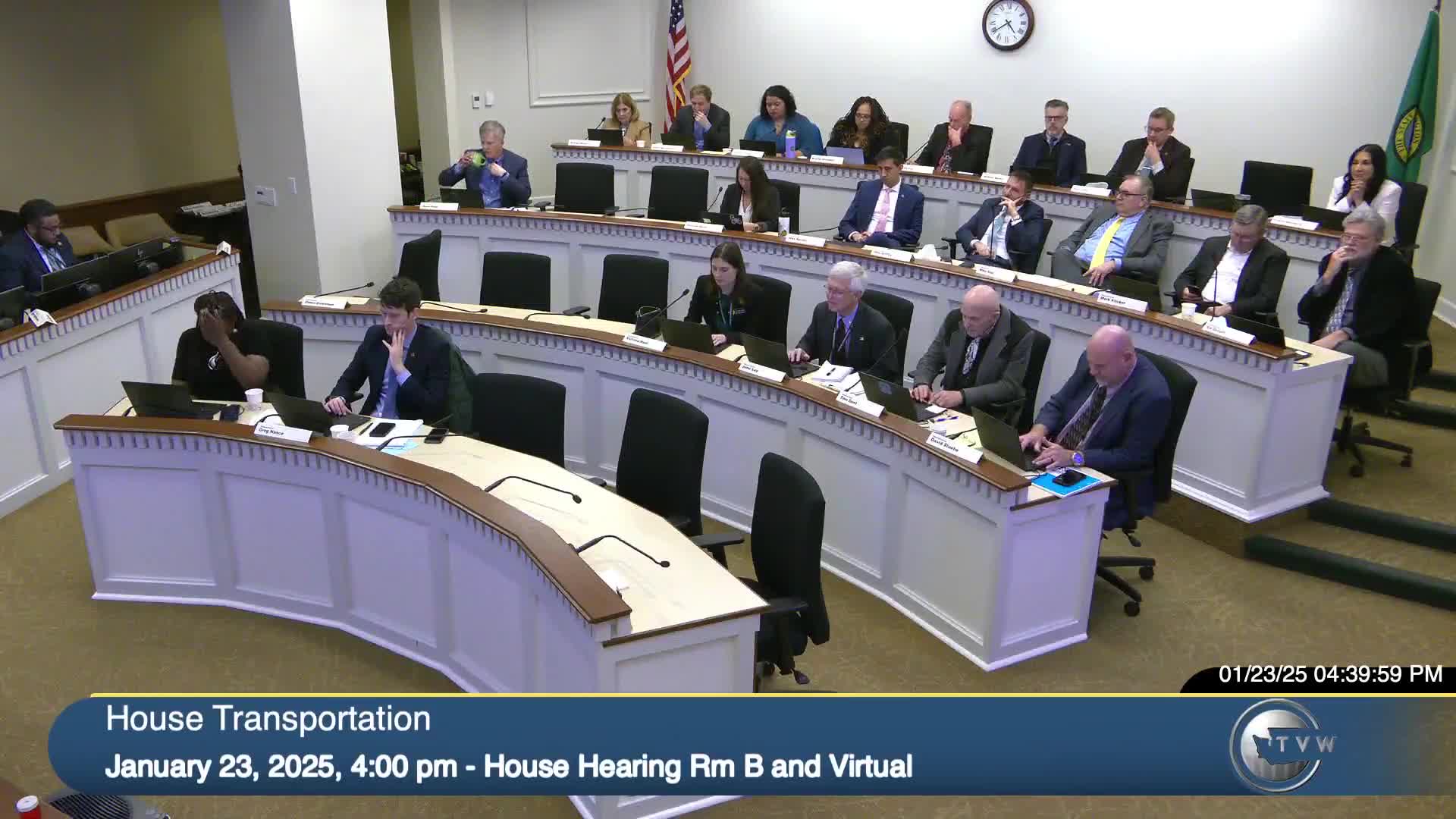
The House Transportation Committee held public testimony Jan. 23 on House Bill 1371, which would expand eligibility for special parking privileges to veterans who have a qualifying discharge, a 70% or higher disability rating from the U.S. Department of Veterans Affairs or the U.S. armed forces, and who use a service animal as defined under federal law.
Jennifer Harris, staff to the committee, described eligibility and documentation requirements: a disability must be determined by a licensed physician, licensed advanced registered nurse practitioner, or licensed physician’s assistant, and the health‑care practitioner must provide signed written authorization on tamper‑resistant paper or electronically. Harris said a technical amendment in the bill would clarify eligibility as “70% or higher” and move the effective date to Oct. 1, 2025. She also recited the bill’s requirement that disabled‑parking privileges be renewed at least every five years.
Sandy Meyer (Department of Licensing staff) briefed the committee on a fiscal estimate: the Department of Licensing expects about a 10% annual increase in applications and estimated 0.4 full‑time equivalent staff (about $47,000 ongoing) beginning in fiscal 2026, plus $19,000 in one‑time IT costs to modify licensing systems and small costs to update renewal reminder letters.
Veterans, nonprofit trainers and advocacy groups supported the bill in public testimony. Dan Regester, director and co‑founder of Canine Cavalry and an Air Force veteran, described practical risks: “In most cases, car doors do not open wide enough to facilitate safe entry or exit for a dog,” and tighter parking increases the chance of dogs falling, injuring themselves or being hit by vehicles. Xiomara Enriquez, an Army veteran and service‑dog trainer, said service dogs are vital medical supports and told the committee they “are not mere pets. They're also medical devices that assist us on an everyday basis.”
Multiple witnesses described near misses and injuries to service animals when vehicles park too close and testimony noted larger dogs or older animals require extra space or steps to enter vehicles safely. Toby Bollinger described a recent incident in which his service dog became briefly stuck while exiting a vehicle because another car was too close. Advocates said the bill’s accommodation would provide wider effective space for safe entry and exit in parking lots and reduce risks to handlers and animals.
Committee members asked whether the bill would bring additional people under the disabled‑parking program; Representative Orcutt and committee members said the change would allow some veterans who do not currently qualify for placards to receive them based on their service‑connected disability and use of a service animal. No committee vote was recorded at the hearing.
If adopted, the bill would define eligibility for disabled‑parking privileges for veterans meeting the stated discharge and disability‑rating criteria, require documentation from licensed health practitioners, and set an effective date of Oct. 1, 2025 (per the sponsor’s technical amendment). The Department of Licensing would incur modest administrative costs to process additional applications and update systems.