Get Full Government Meeting Transcripts, Videos, & Alerts Forever!
Get email alerts on the Document Recording Surcharge Homeless Housing topic
No spam. Unsubscribe anytime.
Hearing on HB 1260 focuses on how counties and cities split document-recording housing surcharge
Summary
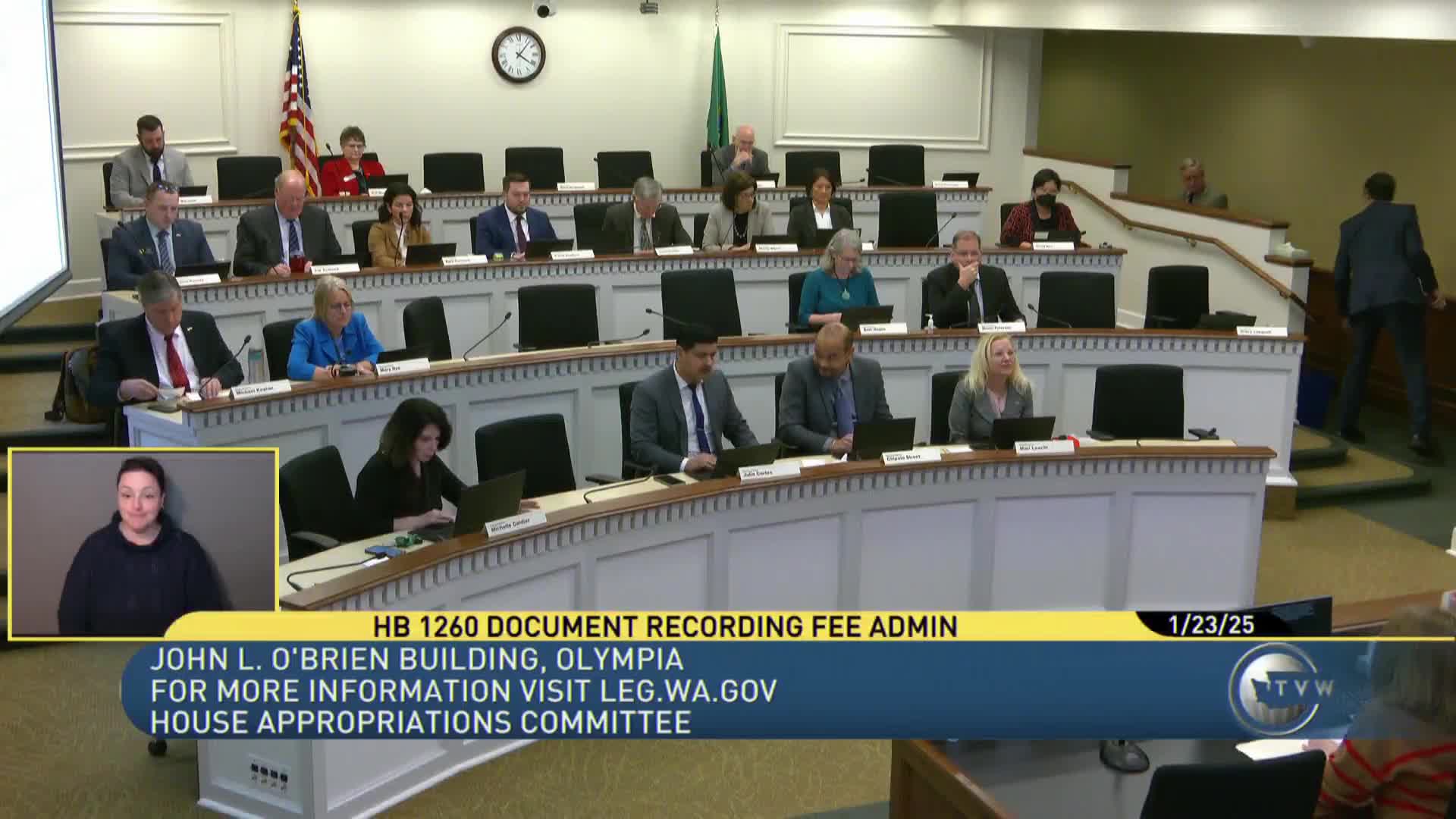
The Appropriations Committee held a public hearing on House Bill 1260, which would clarify how counties distribute the portion of the document-recording surcharge that funds local homeless housing programs when cities elect to run their own programs.
House Bill 1260 was the subject of a public hearing before the Appropriations Committee. The bill would amend how counties distribute the locally retained portion of the document-recording surcharge that funds homeless and affordable housing programs when one or more cities in the county elect to operate a separate local homeless housing program.
Jessica Van Horn, committee staff, summarized current law: a $183 document-recording surcharge is collected on certain recorded documents and the revenues are distributed among state and local homeless housing programs. Of the surcharge, 1% is retained by the county auditor for administrative costs, 30% is retained by the county to support local homeless housing programs, and 69% is distributed among state accounts. Under current law at least 15% of the county portion must serve extremely low and very low income households, at least 75% must implement the local homeless housing plan, and up to 10% may be used for administrative costs.
Several local officials and county auditors testified in support while seeking clearer language. Vicki Dalton, Spokane County auditor, on behalf of the Washington State Association of County Auditors, asked the committee to adopt substitute language she described as "simpler, more concise" and said the filed bill "creates a circular formula" that would be administratively difficult. Dalton said the association "takes no stand on the policy" and is seeking administrability.
City officials from Spokane Valley and Spokane said the change is needed to preserve the administrative fee intended for the city when a city exercises the option to run its own program. Ben Wicht, council member, described Spokane Valley's homeless outreach team and said the city opted into the statutory option to receive its share of the funding. Kelly Cochrane, city attorney for Spokane Valley, testified the 2023 streamlining (Senate Bill 5386) unintentionally created ambiguity that allowed counties to retain a 10% administrative charge "on the amount distributed to a city," which, if applied before distribution, could result in more than 10% of the 30% being used for administration rather than services. Nick Federici, representing the City of Spokane and the Washington Low Income Housing Alliance, said the bill "ensures that the funds generated by this fee for preventing and ameliorating homelessness goes to services rather than administration."
No committee vote was taken at the hearing. Testimony and substitute language were offered for the committee's consideration; committee staff said a ranking member had submitted substitute language to the electronic bill book. Committee staff scheduled HB 1260 for executive session Monday along with other bills.