Get Full Government Meeting Transcripts, Videos, & Alerts Forever!
Get email alerts on the Public Safety topic
No spam. Unsubscribe anytime.
Committee hears bill to exempt emergency vehicles, equipment from sales tax for rural fire districts
Summary
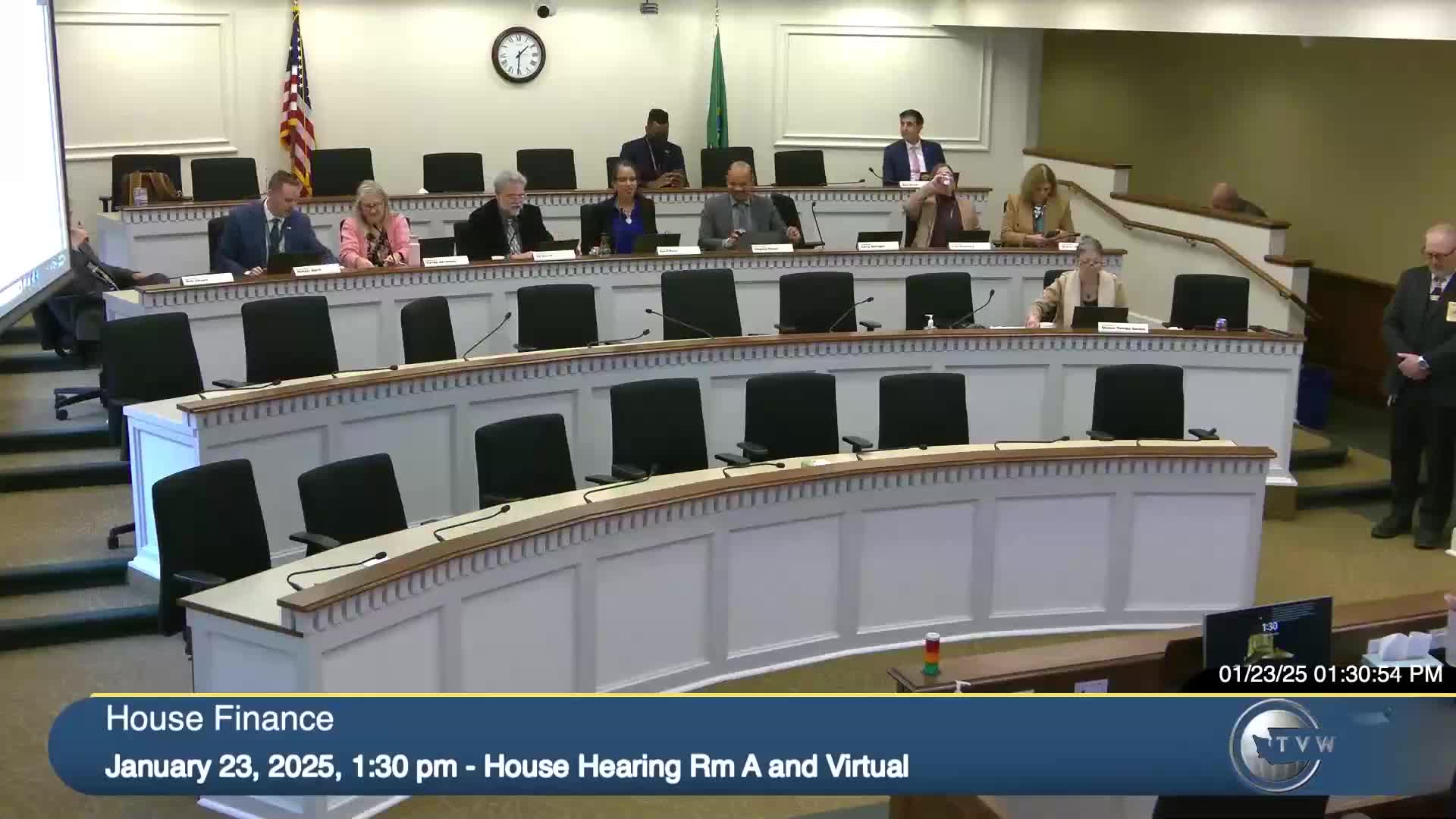
House Finance heard testimony Jan. 23 on House Bill 1047, which would exempt fire and emergency medical apparatus, vehicles, machinery and equipment purchased by certain rural fire districts from state and local sales and use taxes starting Oct. 1, 2025.
House Finance heard testimony Jan. 23 on House Bill 1047, which would exempt fire and emergency medical apparatus, vehicles, machinery and equipment purchased by certain rural fire districts from state and local sales and use taxes starting Oct. 1, 2025.
The bill, explained Christina King, staff to the committee, would cover purchases “necessary for the prevention and suppression of fires, the providing of emergency and medical services, and the protection of life and property” when made by a fire district located in a rural county and serving a population of 10,000 or fewer as estimated by the Office of Financial Management. King said the bill defines “rural county” as a county with fewer than 100 persons per square mile or smaller than 225 square miles, as determined by OFM.
King described the projected fiscal effects, citing a Department of Revenue analysis that the exemption would affect 221 fire districts. She said the state general fund revenue loss is estimated at about $700,000 for eight months of fiscal 2026 and $1 million in fiscal 2027 (the first full fiscal year), totaling about $1.7 million for the 2025–27 biennium and roughly $2 million per biennium thereafter. Local revenue losses were estimated at about $160,000 in fiscal 2026 and $280,000 per year beginning in fiscal 2027. King said DOR expects one-time implementation costs of about $80,000 in the 2025–27 biennium and ongoing annual costs near $10,000.
Ryan Spiller, representing the Washington Fire Commissioners Association, testified in support. “Our smallest districts … are mostly volunteer,” Spiller said. He described agencies that rely heavily on volunteer personnel and sparse tax bases, and said sales tax on equipment purchases reduces the number of safety items those districts can afford. “It would be super helpful for these small districts,” Spiller told the committee.
Sponsor Representative Tom Dent (R-13) said the exemption is intended to help small, mostly volunteer fire districts stretch limited tax revenues to keep equipment and personal protective gear up to date. “They do the best they can where they live and the taxes that the people pay. But it’s just, you know, I brought this forward … to help them stretch their tax dollars a little bit further,” Dent said.
Committee members asked about which counties or districts would be eligible and how the bill would treat nonrural counties. In response to Representative Jacobson, committee staff said the bill creates a new exemption and that nonrural counties would not receive the carve-out; districts in nonrural counties would continue to pay the regular sales tax.
No formal committee action on HB 1047 was recorded in the hearing transcript. The committee closed the public hearing on the bill after testimony and questions and moved on to other agenda items.