Get Full Government Meeting Transcripts, Videos, & Alerts Forever!
Get email alerts on the Utilities And Governance topic
No spam. Unsubscribe anytime.
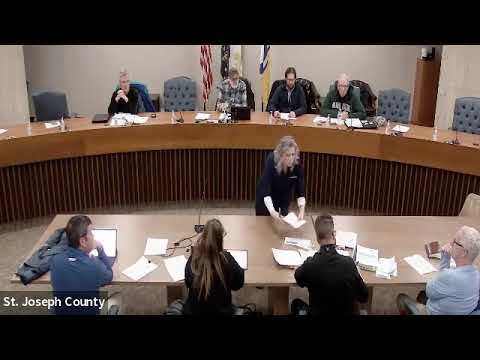
St. Joseph County utility trustees approve governance slate, authorize pumps and pause billing as members review 1,000‑acre utility study
Summary
The board of trustees for the St. Joseph County utility district met (date not specified) and approved the 2025 officer slate and district advisor appointments, adopted a bylaw amendment to allow ex‑officio utility representatives to fill absent utility appointee seats for quorum and voting, authorized the purchase of up to 10 E1 pumps, and paused billing for a homeowner while the district investigates an unpermitted septic installation.
The board of trustees for the St. Joseph County utility district met (date not specified) and approved the 2025 officer slate and district advisor appointments, adopted a bylaw amendment to allow ex‑officio utility representatives to fill absent utility appointee seats for quorum and voting, authorized the purchase of up to 10 E1 pumps, and paused billing for a homeowner while the district investigates an unpermitted septic installation.
The meeting’s longest discussion focused on a utilities study for a proposed 1,000‑acre industrial/commercial development. A consulting participant identified as Ken described water and sewer demand scenarios the district is modeling. He said the project and related users along planned mains could add roughly 250,000 gallons per day of demand to the district’s system and that, to meet fire‑protection requirements and peak use, the engineering work is sizing a water tower in the neighborhood of a 250,000‑gallon unit.
“...we're basing that on our typical approach as to what the demand for fire protection would be out there,” Ken said during the presentation, describing assumptions used to size mains and storage for both domestic and fire flows. He and other participants flagged that the modeled demand would ‘‘outpace’’ current production in some locations and that the tower and transmission work would be essential to reach southern portions of the study area.
Trustees and staff discussed sewer alternatives. The consultant said the district will need either to secure additional treatment capacity from the City of Elkhart (the conversation referenced an estimated available capacity figure of 135,000 gallons per day in prior materials) or to evaluate a local wastewater treatment plant and an outfall to the Saint Joseph River. The discussion noted environmental constraints and a pending anti‑degradation review; trustees said letters requested for that study were still outstanding from some parties and that those environmental limitations must be resolved before the district finalizes recommendations.
Board members also reported conversations with neighboring utilities. One trustee said Mishawaka has declined to serve properties outside city limits without annexation. Staff and consultants urged a development agreement to clarify infrastructure cost responsibility, and they warned private developers are pressing for timely commitments because other sites are competing for the same project.
On finances, staff reported account balances and a claims docket. The general account balance was reported at about $19,029; other reported balances included Wyatt (about $124,000 with a deposit in transit of $19,830), Granger ($464,889 with a deposit in transit of $48,885), Auton ($82,105 with $4,255 in transit) and Carriage Hills (about $149,936). The board approved the claims docket for January totaling $100,355.12.
Enforcement and operations items included authorization for district staff to inspect and dye‑test sewer lines at the Capri restaurant because grease and illicit connections have been reported, and a motion to pause billing for a homeowner whose property appears to have an unpermitted septic installation while the district pursues compliance and seeks information from the septic installer and the developer (the ‘‘flipper’’). The board instructed staff to send notices to the contractor/developer and to work with the health department and building officials to document permits.
Other governance actions: trustees reappointed Krohn Associates as financial advisor, JPR as engineer, Craig DeVault for legal services and Asbury as operator; they approved the 2025 meeting schedule; and they adopted a resolution amending the district bylaws to allow an ex‑officio utility representative to serve in place of an absent utility appointee for the purpose of quorum and voting. The board also agreed to formalize a previously negotiated settlement with a property owner identified as Hess and asked a trustee to sign the finalized agreement.
Votes at a glance: • Motion to keep the 2025 officer slate the same as 2024 (President Donald Bezard; Vice President Roger Donahue; Secretary [position name referenced]; Treasurer Jessica Clark) — approved. • Motion to retain district advisors (Krohn Associates, JPR, Craig DeVault, Asbury) — approved. • Motion to approve minutes from the Dec. 5 meeting — approved. • Motion to approve claims docket, $100,355.12 — approved. • Motion to authorize Dan to purchase up to 10 E1 pumps — approved. • Motion to pause billing for a homeowner pending investigation of an unpermitted septic installation — approved. • Motion to approve the 2025 meeting schedule — approved. • Resolution amending bylaws to permit ex‑officio utility representatives to serve and vote for absent appointees — adopted. • Instruction to staff to pursue dye‑testing and enforcement at the Capri restaurant — approved for action under the district ordinance. • Request to formalize the Hess settlement agreement and have a trustee sign the document — agreed.
What’s next: staff and consultants will finalize and circulate a draft utility study and spacing information for trustee review. Trustees said they may call a special meeting if more timely decisions are required for the prospective industrial developer. The board also asked staff to follow up with the City of Elkhart to confirm available sewer capacity and to provide the draft drinking‑water protection materials prepared by the county engineer and health department.
The meeting record and staff reports contain numeric account balances and engineering estimates cited to staff and the consultant; where the transcript gave rough or differing figures (for example, current production figures for some plants), staff told the board they would provide written confirmation at the next meeting.