Get Full Government Meeting Transcripts, Videos, & Alerts Forever!
Get email alerts on the Municipal Bonds topic
No spam. Unsubscribe anytime.
St. Joseph County Council approves $7.4 million in bonds to fund satellite highway garage
Summary
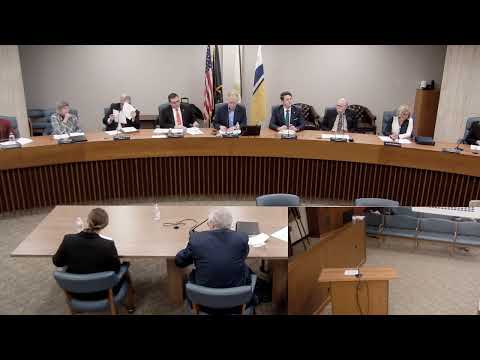
After a second statutorily required public hearing, the St. Joseph County Council voted 9-0 to approve ordinance 121-24 authorizing up to $7.4 million in general obligation bonds and ordinance 122-24 appropriating the proceeds for construction and site work for a satellite highway garage near Alexander Drive.
The St. Joseph County Council on Feb. 14 voted 9-0 to approve two linked ordinances: bill 121-24, authorizing up to $7,400,000 in general obligation bonds, and bill 122-24, appropriating the bond proceeds to build a satellite highway garage and related site work near Alexander Drive.
Bond counsel Catherine Fanello, of the Indianapolis law firm Dinsmore & Shohl, opened the required second public hearing and said the bond ordinance “did require 2 public hearings” and that the bonds are “in an amount not to exceed 7,400,000.” She told the council the maximum term would be seven years and that estimated interest rates were between 4.5% and 5.5%, with an estimated total interest cost of about $1,839,750. Fanello said the information in her presentation came from the county’s municipal advisor, Steve Dalton.
The bond counsel described the project the bonds would finance as including “the acquisition, construction, installation, and equipping of a vehicle storage building to serve as a satellite highway garage for the Saint Joseph County Highway Department,” plus land for parking and equipment storage, access road work, Alexander Road reconstruction, a prep bay and wash equipment, stormwater and site work, lighting, fire protection, asphalt and related engineering.
Resident Robert Bennett spoke during the public hearing to object to the planned competitive sale process, saying the public would be excluded from purchasing county bonds. “A competitive exclusive sale of these bonds is a kickback to these financial institutions,” Bennett said. Fanello replied that under current practice the bonds are typically sold competitively to banks and underwriters, that sales are book-entry through the Depository Trust Company and that federal tax rules require competitive bidding procedures to preserve tax-exempt status in many cases. She also said Indiana law has recently permitted negotiated sales in some cases but that the county’s municipal advisor would recommend the sale method that achieves the best interest rate.
After closing the public hearings, the council voted on motions to approve each ordinance. For bill 121-24, a motion to approve was made and seconded; the clerk recorded a roll-call vote and the measure passed by a vote of 9 to 0. The council then approved bill 122-24, the appropriation ordinance for the bond proceeds, by the same 9-0 tally.
Under Indiana Code Title 6, Article 1.1, Chapter 20, Section 3.1, Fanello explained, the bonds are subject to petition-remonstrance procedures; if the council adopts a preliminary determination following the second hearing, a notice will be published and registered voters or property owners within the county will have 30 days to file a petition requesting remonstrance.
Council members did not propose amendments to the ordinances during the meeting. The clerk’s records show each bill passed unanimously; the minutes list the passage as a recorded roll-call vote of 9 in favor and 0 opposed for both bills. The council packet included a debt-service table that the municipal advisor prepared projecting relatively level annual debt service and noting that payments on a 2022 highway GO bond are retiring, which mitigates an increase to future county debt-service levy rates.
The council’s action authorizes the county to proceed with bond issuance and appropriation; issuance and sale logistics, including final interest rates and sale method, are handled by the county’s municipal advisor and bond counsel and are subject to the statutory notice and petition period required by state law.