Get Full Government Meeting Transcripts, Videos, & Alerts Forever!
Get email alerts on the Dna Collection topic
No spam. Unsubscribe anytime.
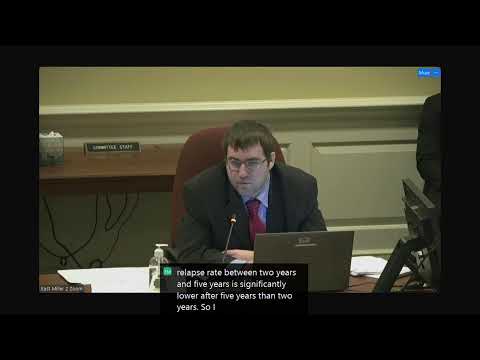
Committee holds DNA collection bill after lengthy discussion about backlog, testing and expungement
Summary
Senate Bill 202, which would change when DNA samples may be collected, tested or expunged and requires agencies to ensure collection before release from custody, drew extended committee scrutiny over penalties, backlog testing and ambiguous terms; the committee held the bill for further work.
Chair, Judicial Proceedings Committee, introduced Senate Bill 202 as a departmental bill from the Department of State Police (DSP) to alter when DNA samples must be collected, stored, tested or destroyed and to require releasing entities to ensure required samples are collected before release from custody. The bill also would prohibit refusal to provide a DNA sample and establish penalties for violations.
During extended discussion, members raised concerns about the severity of criminal penalties—one member contrasted the bill’s $10,000 penalty for refusing a DNA swab with driver-license sanctions for breath-test refusals and questioned whether the penalty was proportional. Committee members also discussed federal parity issues, the definition of “conviction” under federal law, and how the bill would let DSP address a longstanding backlog by clarifying when samples may be tested.
Committee members and staff discussed the bill’s expungement rules: under existing law DNA samples and records are destroyed or expunged automatically if certain conditions apply (no conviction, reversed conviction without retrial, or unconditional pardon). The bill would add a provision that untested DNA samples collected from individuals charged with certain crimes would be destroyed and expunged if at least two years have passed and the samples failed to meet testing requirements, with exceptions (for example, if a case is placed on certain dockets or remains pending). Members asked for clarification about how diversionary dockets or procedural categories (referred to in the transcript as “STED/STEP docket”) would interact with automatic destruction rules and whether some cases could remain indefinitely in limbo.
Senator James and other members said the bill’s primary selling point was clearing backlog samples that are statutorily untouchable under current law. DSP representatives acknowledged disagreements about whether arraignments occur in practice and said statutory changes are intended to provide clarity on procedural triggers for testing. After extended questioning, the committee agreed there was a sense to move the bill forward but held SB 202 to allow counsel and DSP to resolve drafting questions about expungement exceptions, penalty structure, and procedural triggers for testing.
No vote to advance the bill was recorded; the committee’s action was to hold SB 202 and request clarifying information and potential drafting adjustments.