Get Full Government Meeting Transcripts, Videos, & Alerts Forever!
Get email alerts on the Family Leave topic
No spam. Unsubscribe anytime.
Maryland outlines timeline for Family and Medical Leave Insurance; contributions to begin in 2025, benefits in 2026
Summary
The Maryland Department of Labor presented a timetable to lawmakers for implementing Family and Medical Leave Insurance: payroll deductions to begin July 2025, with benefits payable July 1, 2026 under the state trust fund or approved private plans.
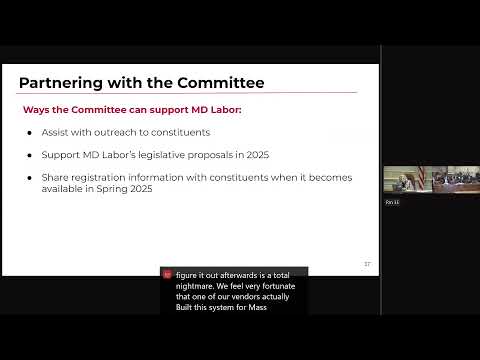
Maryland Department of Labor officials updated the Senate Finance Committee on Jan. 22 about the state’s Family and Medical Leave Insurance (FMLI) rollout, outlining the timeline, employer options and remaining implementation challenges.
Under the schedule presented, employers will begin payroll deductions in July 2025 and remit the first payments to the department in October 2025; workers and employers will be eligible to receive benefits from the trust fund or approved private plans starting July 1, 2026. Assistant Secretary Elliot Scherer said the department created two main paths for employers: participate in the state fund, or declare intent to provide an alternative (either a self‑insured plan or a private insurance plan regulated by the Maryland Insurance Administration). Employers will be able to declare intent to seek private coverage in May 2025; the department plans to open applications to self‑insure in January 2026 and allow private market plan confirmations in spring 2026.
Contributions and benefits: the statutory contribution rate is 0.9% of covered wages, split equally between employees and employers (0.45% each). The department said small employers (those with fewer than 15 employees) will not pay the employer share under the statutory structure. Benefits are paid on a progressive scale—lower‑wage workers receive higher replacement shares (up to 90% of wages), and the benefit is capped at $1,000 per week; the program provides up to 12 weeks of leave under the statute.
Administration and costs: the department said the program will be fully special‑funded: contributions and a small administrative assessment on private plans will finance benefits and administration. Staff estimated an administrative workforce of roughly 350–400 positions to build the digital systems, process claims, run customer service and manage fund accounting; those operating costs will be paid from program receipts rather than the general fund, the department said. Officials also said they have procured vendors with experience in other states, are building a modern self‑service portal and expect to deploy a “pizza‑tracker” style claims tracker to reduce call volumes.
Challenges and next steps: Secretary Wu and assistant secretaries noted procurement and IT complexity have delayed some implementation steps and said the department may use administrative flexibilities to stay on the statutory schedule. The department has engaged actuarial and accounting consultants and emphasized fraud and cybersecurity protections. Staff also said the state is proposing additional limited legislation to address self‑employed enrollment processes, an area the department described as administratively complex with low take‑up in other states.
Cost signals for individuals and employers: department staff provided ballpark examples during questioning—at median wages (roughly $70,000), the employee and employer shares each translate to about $2.70–$6.30 per week; a worker at about $90,000 in annual pay would see roughly $15 deducted biweekly and the employer would also contribute roughly $15 biweekly. The department said it will continue outreach—more than 80 events to date and a planned statewide marketing campaign—to educate the estimated 2.5 million covered workers and roughly 180,000 employers about enrollment options and compliance.
The department asked lawmakers for patience on implementation details and pledged to work with the Maryland Insurance Administration, the Department of Budget and Management and legislators to confirm employer choices for state coverage, self‑insurance or private plan alternatives.