Get Full Government Meeting Transcripts, Videos, & Alerts Forever!
Get email alerts on the Parking Standards Legislation topic
No spam. Unsubscribe anytime.
Sedro‑Woolley council votes to oppose state bills that would cut residential parking requirements
Summary
The City Council voted to send a letter opposing House Bill 1299 and Senate Bill 5184, which would sharply reduce local minimum parking standards; councilmembers cited public‑safety, ADA and local control concerns.
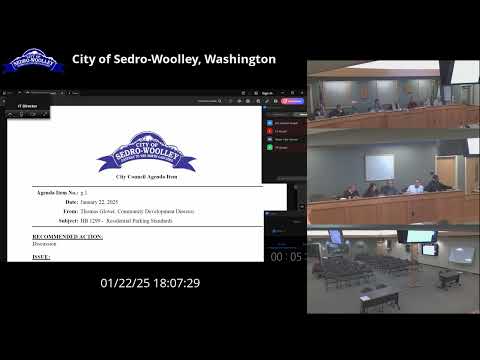
The Sedro‑Woolley City Council voted unanimously Jan. 22 to send a letter opposing House Bill 1299 and its companion Senate Bill 5184, a pair of measures that would limit local governments’ ability to require parking beyond a single space per dwelling unit and cut minimum parking rules for many commercial and residential projects.
City officials said the bills would override locally tailored parking standards the city and its Planning Commission have been revising. Tom Glover, Sedro‑Woolley’s community development director, told the council the bills would allow a code city “may not require more than 1 parking space per residential unit” and otherwise substantially reduce minimums for multiple building types. He said the legislation surfaced unexpectedly and has “significant support” at the legislature.
The council’s vote followed a lengthy discussion about public safety, accessibility and local planning authority. Council members said reduced parking could create overflow street parking that would impede emergency vehicle access and aggravate congested neighborhood streets. “If this were to pass and we then have developments based on parking with one spot per unit, you’re going to have so much overflow parking that you have no space for our first responders to respond,” a council member said. Councilman Henderson raised concerns about the bill’s treatment of housing for people with disabilities and whether the language would interact with legal accessibility requirements under the Americans with Disabilities Act.
Council members also framed the bills as a one‑size‑fits‑all approach that would apply in small towns with limited transit options. Several council members noted the city is still finalizing local parking code revisions and has a Planning Commission public hearing scheduled in February.
The council directed staff to prepare a letter opposing both House Bill 1299 and Senate Bill 5184 and to submit written comment before the committee hearing; members also said representatives attending the state’s City Action Days would deliver the council’s concerns in person.
Votes at a glance: Motion to send an opposition letter to the sponsor committees on House Bill 1299 and Senate Bill 5184 — mover: Councilman Burns; second: Councilman LaVaca; outcome: approved (aye by all present).