Get Full Government Meeting Transcripts, Videos, & Alerts Forever!
Ways and Means holds first 2025 bill hearings on elections, taxes, school voting and property assessments
Summary
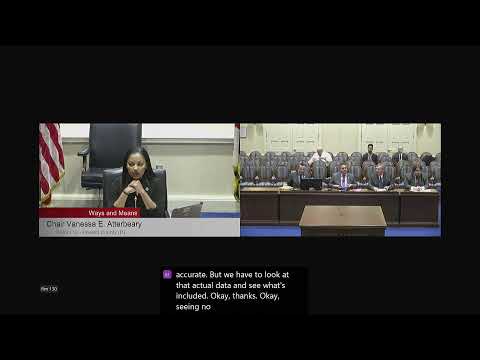
The Ways and Means Committee met Jan. 21 for the first bill hearings of the 2025 session and heard testimony on a dozen bills affecting elections, campaign finance, local tax deadlines, school-board voting and statewide property-assessment methods.
The Ways and Means Committee met Jan. 21 for the first bill hearings of the 2025 session and heard testimony on a dozen bills affecting elections, campaign finance, local tax deadlines, school-board voting and statewide property-assessment methods. Committee members and agency officials described proposed statutory changes, answered lawmakers’ questions and discussed possible amendments; the hearing did not record final committee votes.
Why it matters: the package would change procedures that affect voters, candidates, local governments, property owners and county budgets. Several bills seek administrative clarifications (petitions, ballot-mail notices, plan submittals), others change who may run or hold more than one office, and one — House Bill 6 — would expand the Department of Assessments and Taxation’s (SDAT) use of oblique aerial imagery statewide, with estimated fiscal and workload effects.
Most significant items
House Bill 6 (oblique aerial imagery for assessments): Delegate Chris Fair and SDAT Director Dan Phillips said HB6 would authorize SDAT to acquire oblique aerial photography and associated measurement tools statewide that are already used in nine counties. Phillips told the committee, “Oblique aerial photography uses top angle images taken by airplane to take accurate measurements of properties without the need for assessors to physically inspect that property.” The department and sponsors said the technology can measure building footprints more precisely than free online imagery, speed work (one hour of GIS work can replace several hours of in‑person inspection) and improve statewide assessment parity. Testimony cited an SDAT estimate that better imagery and measurement could identify about $1.25 billion in additional assessable base, producing roughly $14–15 million in annual revenue to local governments and the state. County representatives supported the policy but asked that implementation costs remain shared (the…
Already have an account? Log in
Subscribe to keep reading
Unlock the rest of this article — and every article on Citizen Portal.
- Unlimited articles
- AI-powered breakdowns of topics, speakers, decisions, and budgets
- Instant alerts when your location has a new meeting
- Follow topics and more locations
- 1,000 AI Insights / month, plus AI Chat