Get Full Government Meeting Transcripts, Videos, & Alerts Forever!
Get email alerts on the Committee Hearings Roundup topic
No spam. Unsubscribe anytime.
Ways and Means holds first 2025 bill hearings on elections, taxes, school voting and property assessments
Summary
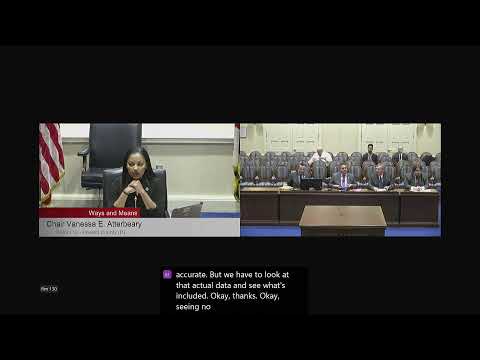
The Ways and Means Committee met Jan. 21 for the first bill hearings of the 2025 session and heard testimony on a dozen bills affecting elections, campaign finance, local tax deadlines, school-board voting and statewide property-assessment methods.
The Ways and Means Committee met Jan. 21 for the first bill hearings of the 2025 session and heard testimony on a dozen bills affecting elections, campaign finance, local tax deadlines, school-board voting and statewide property-assessment methods. Committee members and agency officials described proposed statutory changes, answered lawmakers’ questions and discussed possible amendments; the hearing did not record final committee votes.
Why it matters: the package would change procedures that affect voters, candidates, local governments, property owners and county budgets. Several bills seek administrative clarifications (petitions, ballot-mail notices, plan submittals), others change who may run or hold more than one office, and one — House Bill 6 — would expand the Department of Assessments and Taxation’s (SDAT) use of oblique aerial imagery statewide, with estimated fiscal and workload effects.
Most significant items
House Bill 6 (oblique aerial imagery for assessments): Delegate Chris Fair and SDAT Director Dan Phillips said HB6 would authorize SDAT to acquire oblique aerial photography and associated measurement tools statewide that are already used in nine counties. Phillips told the committee, “Oblique aerial photography uses top angle images taken by airplane to take accurate measurements of properties without the need for assessors to physically inspect that property.” The department and sponsors said the technology can measure building footprints more precisely than free online imagery, speed work (one hour of GIS work can replace several hours of in‑person inspection) and improve statewide assessment parity. Testimony cited an SDAT estimate that better imagery and measurement could identify about $1.25 billion in additional assessable base, producing roughly $14–15 million in annual revenue to local governments and the state. County representatives supported the policy but asked that implementation costs remain shared (the sponsor and county groups discussed a 50/50 split and asked not to shift 90% of costs to counties).
House Bill 101 and House Bill 133 (tax deadlines and constant‑yield calculation): SDAT Director Phillips testified that HB101 would move the deadline for local taxing authorities to set property tax rates from July 1 to June 1 to give the department extra time to calculate homeowners’ tax credits and reduce revised bills and service calls. Kevin Canale, speaking for municipal stakeholders, asked for a compromise date of June 20. HB133 would repeal the statutory requirement that SDAT calculate and notify each taxing authority of the constant‑yield tax rate; the department said it would continue to calculate the rate on request. Lawmakers pressed for a statutory backstop so counties requesting the constant‑yield calculation would reliably receive it (a suggested amendment was to require a request by Feb. 1).
Election‑administration, petition and plan changes (HB41, HB199, HB274, HB160, HB287): Jared DeMarinis, state administrator of elections, presented several departmental bills. He said HB41 would move the deadline to submit a new party petition to the first Monday in July and prohibit reuse of the same petition signatures in later efforts; DeMarinis described the change as a way to “alleviate” local board workload during the heavy August petition season. HB199 would clarify the timing for notices to voters on permanent mail‑in ballot status (establishing a clearer 120‑to‑90‑day window and adding additional contact methods if mailed notices are returned). HB274 would combine separate election plans (early voting, drop box, polling place) into a single election plan, move the submission deadline from six to seven months before the primary and tie certain polling‑place benchmarks to the first year of redistricting rather than a fixed year.
Delegate Kevin M. Harris introduced HB287, which would bar individuals from running for more than one office at the same time or from holding an elected public office while also serving in certain elected party posts (for example, a county central committee seat). Harris said the bill would take effect Oct. 1, 2025. Delegate Carden described HB160 as an effort to resolve a longstanding inconsistency in campaign‑contribution rules that arose after the State Constitution was amended for casino licensing; he described an anomaly that excludes some newer gaming license types and asked the committee to consider clarifying the campaign‑finance prohibition that applies to casino license holders.
Campaign finance and exploratory committees (HB111): Delegate Julie Plakovich Carr presented HB111 to increase transparency for exploratory committees. The bill would (1) require disclosure of contributions and expenditures by exploratory committees, (2) allow someone who has already filed for one office to form an exploratory committee to consider running for a different office, and (3) expand allowable expenditures and disposition options for leftover funds. Discussion included whether contributions to exploratory committees should count against candidate contribution limits if the exploratory committee later converts to a full campaign, and the sponsor indicated openness to tightening limits so transfers and earlier exploratory contributions do not effectively circumvent caps.
School‑board enfranchisement and appointments (HB52, HB237): Delegate Joe Vogel renewed an enabling measure, HB52, that would permit counties to give high‑school students a vote in local school‑board elections. It is enabling legislation; counties would choose whether and how to implement it. HB237, from Delegate Julie Plakovich Kerr, would standardize transparency and minimum procedures for party central committees and public participation when the Governor fills legislative vacancies by appointment; the sponsor framed it as a uniform, best‑practice set of requirements for central committees across the state.
Voter pre‑registration (HB153): Delegate Chris Fair proposed lowering the age for voter pre‑registration from 16 to 15 years, 9 months so those obtaining learner’s permits could pre‑register at the same time they receive driving credentials; the bill would also require a notification to newly eligible voters about when and where they can vote.
Committee process and next steps
Most presenters invited committee questions and were open to friendly amendments. Multiple lawmakers asked for specifics about fiscal impacts and implementation dates: county officials and stakeholders pressed for clarity on who pays for statewide imagery and on precise deadlines that affect county budgets and charter timelines. Several bills prompted requests for technical amendments (for example, an amendment to HB101 or HB133 to add a February 1 request deadline for constant‑yield calculations). The committee did not take recorded votes during the hearing; staff and sponsors said they would work with members on potential amendments before the next committee action.
Quotes from the hearing
“House bill 41 does two things. It clarifies the deadline to submit a new party petition to July, the first Monday in July,” said Jared DeMarinis, state administrator of elections.
“Oblique aerial photography uses top angle images taken by airplane to take accurate measurements of properties without the need for assessors to physically inspect that property,” said Dan Phillips, director of the Department of Assessments and Taxation.
“This bill ensures that individuals cannot run for more than one office at the same time,” said Delegate Kevin M. Harris about HB287.
Ending
The committee’s hearing concluded with staff and sponsors noting they will provide fiscal details and draft amendment language to lawmakers. No final committee votes were recorded on Jan. 21; bills will return to Ways and Means if and when members schedule votes or report language exchanges.