Get Full Government Meeting Transcripts, Videos, & Alerts Forever!
Get email alerts on the State Budget topic
No spam. Unsubscribe anytime.
DLS: Governor’s FY26 package narrows gap but relies on new taxes, cuts to education and local services
Summary
The governor’s fiscal 2026 budget narrows a projected shortfall but does not achieve the state’s spending-affordability target and depends on a mix of new revenues and spending reductions that will affect schools, local governments and health programs.
The governor’s fiscal 2026 budget narrows a projected shortfall but does not achieve the state’s spending-affordability target and depends on a mix of new revenues and spending reductions that will affect schools, local governments and health programs.
"The budget overall grows by about $800,000,000 to $67,000,000,000, a 1% growth," said David Romans, fiscal analyst with the Department of Legislative Services, during a Ways and Means Committee briefing on Jan. 21. "State general funds actually declined by $274,000,000 or 1% to $27,000,000,000. That decline in general funds reflects a lot of cost containment in the budget."
Why it matters: the Spending Affordability Committee set a structural-balance goal for fiscal 2026 — meaning ongoing revenues should cover ongoing costs — and the governor’s plan falls short by about $186 million. DLS said the governor’s package largely closes near-term gaps with $1.4 billion in revenue changes, roughly $1 billion in spending reductions and about $630 million in one-time transfers, but the mix increases medium-term pressure on the general fund.
Revenue and tax changes
The administration proposes major personal income tax changes as part of a budget reconciliation and financing act. Romans summarized the headline items: "The biggest chunk of actions is revenue adjustments, $1,300,000,000 of additional general fund revenues. $691,000,000 of that is from the personal income tax reform proposal." The plan flattens the lower brackets to a single 4.7% rate for the first four brackets while adding two higher brackets (6.25% and 6.5%) for top earners.
On capital gains, Romans said the governor would add a temporary 1% surcharge on capital gains for taxpayers with Maryland taxable income above $350,000; that surcharge is limited to four years and is estimated to generate about $128 million annually. "If your taxable income is over $350,000… you would pay the surcharge on your capital gains," Romans explained in response to a committee question.
The proposal would also double Maryland’s standard deduction, and eliminate the option to itemize on the state return — a change DLS said could shift tax burdens but for which the administration did not provide county-level or demographic breakdowns. "We do not" yet have a county-by-county or jurisdictional distribution of who would be affected, Romans said; DLS is beginning its own modeling.
Other revenue changes include raising the sports-wagering tax rate (temporarily directing the increased receipts to the general fund), higher cable gaming rates, a retail delivery fee of $0.75 per taxable order to help the transportation trust fund, and a plan to eliminate the state inheritance tax while lowering the estate exemption to offset lost revenue.
Spending cuts and program shifts
DLS identified roughly $1 billion in spending reductions in fiscal 2026. Major items include delaying or scaling back some Blueprint for Maryland’s Future investments: the behavioral-health element (the Consortium on Coordinated Community Supports) would be reduced from $130 million annually to about $40 million; the scheduled phase-in of funding for teacher collaborative time would be delayed by four years; and growth in the Concentration of Poverty grant would be paused for fiscal 2027–28.
"They would receive essentially the same level of funding as they are in the current year," Romans said of schools that now get Concentration of Poverty grants, but he added those schools "would not get the growth that under current law they would receive." Committee members pressed on the likely effects for community schools that use the grants for wraparound services.
The governor would also shift recurring costs to local governments. Romans said the plan moves about $144 million in costs to local governments in fiscal 2026, including a proposal requiring localities to cover half of the projected growth in the unfunded liability for K–12 teacher retirement — about $93 million annually under the governor’s plan.
Health, disability services and childcare
DLS flagged a large unfunded deficit in the Developmental Disabilities Administration’s community services program: "The deficit is about $450,000,000," Romans said, and the governor proposes cost containment of roughly $97 million in the current year and over $200 million in fiscal 2026.
The administration also proposes a $100 million permanent increase in the Medicaid hospital deficit assessment. Romans described the assessment as "essentially an extra charge on hospital rates in the state" that reduces general fund Medicaid costs because the assessment revenue supports Medicaid spending.
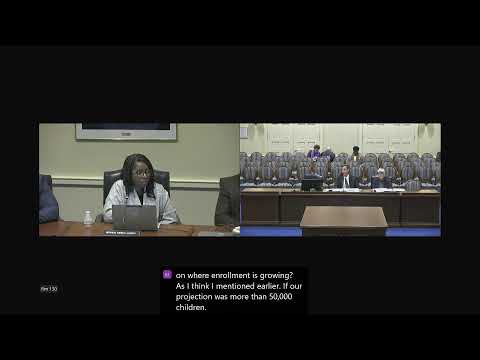
On childcare, DLS said program enrollment has grown rapidly — from roughly 22,000 children three years ago to a forecast that could have exceeded 50,000 in fiscal 2026 — and the administration proposes a cap that would limit participation to about 42,000 children in fiscal 2026.
Budget balance and medium‑term outlook
DLS presented a multi‑year picture showing that the governor’s package substantially improves the fiscal 2026 position but does not fully meet the Spending Affordability Committee’s structural-balance target. Romans said the governor’s plan "almost eliminat[es] the fiscal 26 deficit, but miss[es] the spending affordability goal. And then [it] makes significant progress in the out years," while warning substantial gaps reappear beginning in fiscal 2028, in part because Blueprint implementation outlays begin to outstrip the fund’s receipts.
Economic and federal risks
Theresa Cusinski, economist with DLS, briefed the panel on Maryland’s economic and revenue backdrop. "In Maryland, personal income in the first nine months of 2024 was up 5.8%. Wage income was up a little bit faster at 6.2%," Cusinski said, and she noted that inflows from the federal government (federal civilian payrolls, federal contracting, and pass-through federal funds) remain a material exposure for the state. DLS cautioned its revenue baseline makes no assumption about future federal workforce or federal spending reductions, and that uncertainty is a risk to the forecast.
Claims and contingent liabilities
DLS also reminded the committee of the Child Victims Act the General Assembly enacted in 2023, which eliminated certain statutes of limitation and capped state liability at $890,000 for an occurrence under statute. Romans said about 35,100 claims have been filed to date, primarily related to juvenile services, and that potential liabilities could be in the billions; he said the Attorney General’s Office has engaged outside counsel and that a settlement could surface before the end of session.
What happened next
Committee members pressed DLS for further modeling: county-level impacts of the personal income tax changes, distributional analysis of the elimination of itemized state deductions, and more detailed estimates of how the Blueprint and DDA changes would affect services. DLS said it would produce deeper, county-level estimates and fiscal notes when legislation is introduced.
DLS’s presentation and committee Q&A do not enact policy; they described the governor’s proposed package, identified fiscal exposures, and flagged areas where additional analysis and clarifying legislative language will be needed this session.
Taper: The Ways and Means Committee scheduled bill hearings for 1 p.m.; DLS said it will produce further county-level revenue analyses and fiscal notes as bills are filed.