Get Full Government Meeting Transcripts, Videos, & Alerts Forever!
Get email alerts on the Transit Mta topic
No spam. Unsubscribe anytime.
Maryland Transit Administration reports staffing gains, capital progress and higher ridership
Summary
Maryland Transit Administration Administrator Holly Arnold told the committee MTA has increased ridership and customer satisfaction, rebuilt hiring capacity for operators, is investing in state of good repair projects and is advancing the Purple Line and other capital priorities.
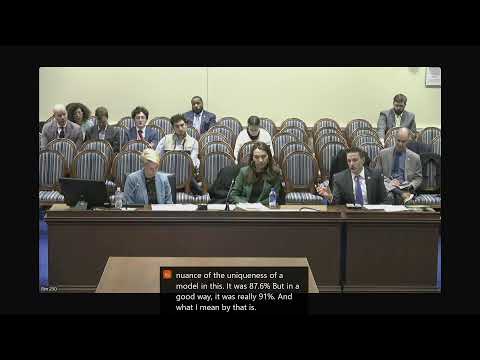
Holly Arnold, administrator of the Maryland Transit Administration, told the House Environment and Transportation Committee that MTA’s 2024 performance shows rising ridership, improved service reliability and progress in capital execution, and that the agency is focused on restoring and sustaining its system.
“We are in the planning process for the Red Line in Baltimore,” Arnold said, and she described the Purple Line in the D.C. region as “about 73% complete,” a figure she provided in response to a delegate question. Arnold told the committee MTA delivered more than 68 million rides in 2024 across its modes and said the agency is now fully staffed with operators, which she said improves service reliability.
Why it matters: MTA operates statewide modes including light rail, metro, commuter rail (MARC) and bus, and its budgets and capital plans directly affect service availability, state economic activity and projects such as the Baltimore Red Line and the Purple Line.
Staffing, operations and ridership
Arnold said MTA reduced hiring time by about 40% and is fully staffed for operators “for the first time in a really long time,” allowing the agency to run scheduled service more reliably. She listed daily beneficiaries of service as “over 150,000 commuters, 30,000 Baltimore City students and more than 1,000 people relying on the system for essential services” and said 30,000 students in Baltimore City depend on transit.
Capital progress and asset management
Arnold said MTA owns roughly $14 billion in capital assets and that the agency is investing to return systems to a state of good repair. She described FY25 operating and capital figures the agency presented: an FY25 operating base in the roughly $1.2 billion range and a capital program of about $5.7 billion in the capital‑planning period; MTA told the committee that FY24 capital expenditures exceeded $300 million and that the agency expended more than 80% of its capital budget for the first time in recent years.
Projects, supply chain and economic impact
Arnold described vehicle replacement and modernization efforts in Baltimore — including new heavy‑rail cars arriving and planned light‑rail investments — and said MTA procurement and capital spending support Maryland industry. She and committee members noted Hitachi’s Hagerstown plant and Knorr‑Bremse in Westminster as Maryland industrial partners. Arnold cited a Greater Washington Partnership report (to be released near the hearing) that estimated MTA investment creates substantial economic output for the state, which she summarized as roughly $2.7 billion in economic impact and supports roughly 10,000 jobs across Maryland.
Paratransit and mobility
Arnold said MTA has worked to restore paratransit and contracted Mobility service performance, reporting on‑time performance improvements and reduced wait times compared with recent years. She confirmed the Department of Justice recently notified MTA that it would not proceed with a pending complaint related to mobility services.
Funding and next steps
Arnold described MTA’s funding mix: operating dollars primarily from the Transportation Trust Fund with federal and fare revenue supplements, and a capital program roughly 42% federal. She emphasized the agency is building program management and asset‑management capacity to spend capital funds efficiently and minimize rider impacts during maintenance and construction work.
Ending
After her presentation, committee members asked follow‑up questions about paratransit, hospital access, transit‑oriented development in Baltimore and the Purple Line schedule. Arnold said MTA is open to further coordination with hospitals and local employers to align service with shift times and appointment needs.