Get Full Government Meeting Transcripts, Videos, & Alerts Forever!
Get email alerts on the Transit Wmata topic
No spam. Unsubscribe anytime.
WMATA reports ridership rebound, tighter fare enforcement and expanded bus network plans
Summary
WMATA leaders told the House Environment and Transportation Committee that ridership and customer satisfaction rose in 2024, crime and fare evasion have fallen after enforcement and infrastructure changes, and the agency is pursuing transit‑oriented development and a major bus network redesign that will affect Maryland riders.
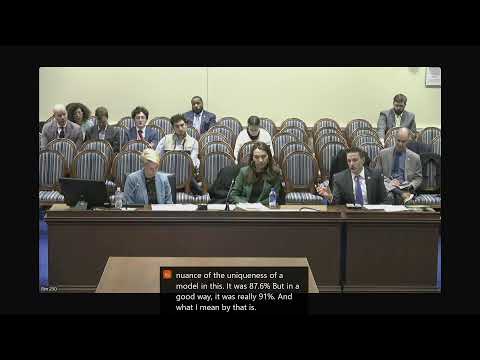
Valerie Santos, chair of the Washington Metropolitan Area Transit Authority Board of Directors, and Randy Clark, WMATA general manager and CEO, told the House Environment and Transportation Committee that the agency saw record ridership gains in 2024 and is pursuing a mix of cost containment, enforcement and service‑realignment measures to maintain momentum.
“2024 marked many milestones at Metro,” Santos said, noting the system had “45 consecutive months of ridership growth.” Clark added that both rail and bus ridership rose “roughly 12% relative to the prior year,” and customer satisfaction reached what he called the highest levels in WMATA history.
The officials described a package of operational and financial steps taken in 2024 to stabilize Metro’s finances. Clark and Santos said the agency implemented a 12.5% fare increase for customers, froze wage increases for employees for the year and enacted a hiring freeze and contractor reductions; those measures, agency leaders said, contributed to more than $500 million in identified savings. Clark said those changes and other cost‑efficiency efforts yielded “over $500,000,000 of cost efficiencies both on the operating and capital side.”
Why it matters: WMATA serves Maryland residents across multiple counties and is a major regional employer. Committee members pressed the agency on safety, fare compliance and how planned service changes will affect Maryland riders.
Enforcement, safety and fare policy
WMATA credited a mix of physical infrastructure and enforcement changes for recent reductions in crime and fare evasion. Clark said Metro installed higher fare gates at rail stations, expanded camera coverage, increased uniformed police visibility and established a community intervention team of crisis‑response social workers. Clark described the approach as “compassion, cops, and cameras.” He reported a roughly 40% year‑over‑year decline in crime in the most recent quarter and said fare evasion on rail had fallen about 82% after gate installation and other enforcement changes.
Clark and Santos also highlighted a new fare discount for low‑income riders. Metro Lift automatically enrolls riders who qualify for SNAP benefits and provides a 50% fare discount, Clark said.
Service changes and the Better Bus Network redesign
Officials described a major bus network redesign — which Clark called the largest in the country for the agency — intended to realign routes to current population and job centers. Clark said the board approved the redesign in the fall and that it takes effect June 29. He summarized projected Maryland impacts drawn from WMATA analysis: about 50,000 more Maryland residents would have access to a hospital within 30 minutes in morning peak, roughly 28,000 more would gain 30‑minute access to a college on weekdays, and weekend access would improve for tens of thousands of Maryland residents. The redesign emphasizes all‑day, seven‑day service in equity‑focused areas, Clark said.
Transit‑oriented development and local partnerships
WMATA officials described ongoing real‑estate partnerships in Maryland near stations including College Park, New Carrollton, Grosvenor and North Bethesda. Clark said about 1,000 apartment units were completed near Metro stations in 2024, and additional projects were planned in 2025. He also highlighted supplier and manufacturing investments that WMATA supports, naming Hitachi’s Hagerstown facility and Knorr‑Bremse’s expansion in Westminster as examples of transit‑related industrial investments that support Maryland jobs.
Budget, asset and capital context
Clark said WMATA operates roughly a $5 billion annual budget and is the second‑largest rail system and sixth‑largest bus system in the U.S. He stressed that predictable, long‑term capital funding is needed to maintain infrastructure and noted ongoing regional coordination efforts, including a joint WMATA–Council of Governments initiative called DMV Moves to align a regional transit funding vision.
Questions from committee members focused on the durability of crime and fare‑evasion gains, how fare enforcement is balanced against operator safety, and how transit‑oriented development incentives affect local housing markets. Clark said Metro is monitoring bus fare compliance data and expected more robust bus‑side results by late winter. He also told the committee the agency is pursuing rail service optimization to increase capacity where trains are crowded.
Ending
Committee members thanked the WMATA delegation and moved on to a separate briefing by the Maryland Transit Administration. No committee actions or votes were taken during the WMATA presentation.