Get Full Government Meeting Transcripts, Videos, & Alerts Forever!
Get email alerts on the Climate Policy topic
No spam. Unsubscribe anytime.
Sponsor seeks one‑time assessment on largest fossil‑fuel emitters to fund Maryland climate damages
Summary
Delegate Delia Frazier Hidalgo asked the House Economic Matters Committee to grant a favorable report on House Bill 128, a one‑time assessment on very large fossil‑fuel emitters intended to fund a Maryland mitigation and recovery fund for climate damages.
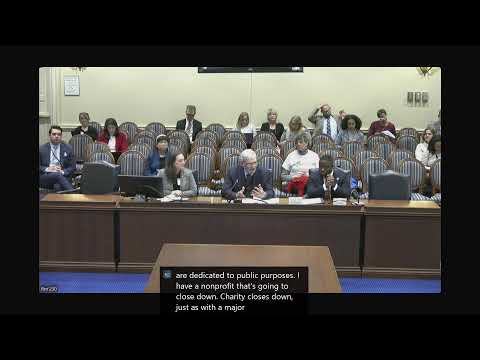
Delegate Delia Frazier Hidalgo, sponsor of House Bill 128, told the House Economic Matters Committee on Jan. 23 that the bill would create a fund to cover damage from extreme weather and other climate impacts by assessing the largest fossil‑fuel companies for historic emissions. “The fossil fuel industry has known for over 40 years…that burning fossil fuels is the leading cause of greenhouse gas emissions,” Hidalgo said, adding the bill would require companies that emitted more than 1,000,000,000 tons of greenhouse gases since 1994 to pay a one‑time assessment.
The bill would direct proceeds into a mitigation fund for purposes Hidalgo and witnesses listed — stormwater management, sea‑level rise protections and public‑health responses. Hidalgo said the measure would target multinational companies such as ExxonMobil and Shell and estimated the measure could generate about $9 billion in total, including roughly $900 million in an illustrative first calculation cited during testimony.
Brittney Baker, Maryland director of the Chesapeake Climate Action Network, said the bill applies a strict‑liability approach to the largest polluters and described the measure as a cost‑shifting mechanism: “The purpose of this bill is to cost shift these unavoidable costs off of Marylanders and onto the largest, most polluting fossil fuel companies,” Baker said. She told the committee the measure would not affect Maryland utilities or local fuel retailers and cited polling and attorney‑general support in submitted material.
William Pirmitay, testifying as an individual and identified as managing director of the environmental law program at the University of Maryland Carey School of Law, said the RENEW Act is modeled on the federal Superfund and similar state bills. Pirmitay told the committee he was confident Maryland’s police powers would justify a compensation‑based assessment and that recent litigation challenging Vermont’s law raises constitutional issues now being litigated elsewhere.
Several faith‑based, environmental‑justice and consumer groups also testified in favor, describing rising adaptation costs borne by local governments and households. Stacy Hartwell of the South County Environmental Justice Coalition cited county and municipal adaptation spending and urged the committee to prioritize low‑income and historically marginalized communities in any spending plan.
Committee members asked about legal exposure under dormant commerce‑clause and retroactivity arguments; witnesses replied the bill targets compensation for historic harms and that precedent exists in CERCLA‑style legislation. Hidalgo and witnesses said the bill would include a study in its first year to define collection and distribution mechanisms.
No committee action or formal vote on HB 128 was recorded during the hearing. The sponsor and proponents requested a favorable report to advance the bill for further consideration.