Get Full Government Meeting Transcripts, Videos, & Alerts Forever!
Get email alerts on the Critical Infrastructure Security topic
No spam. Unsubscribe anytime.
Bill tightened to target electronic components near Offutt and Panhandle missile fields; utilities and PRB disagree on scope
Summary
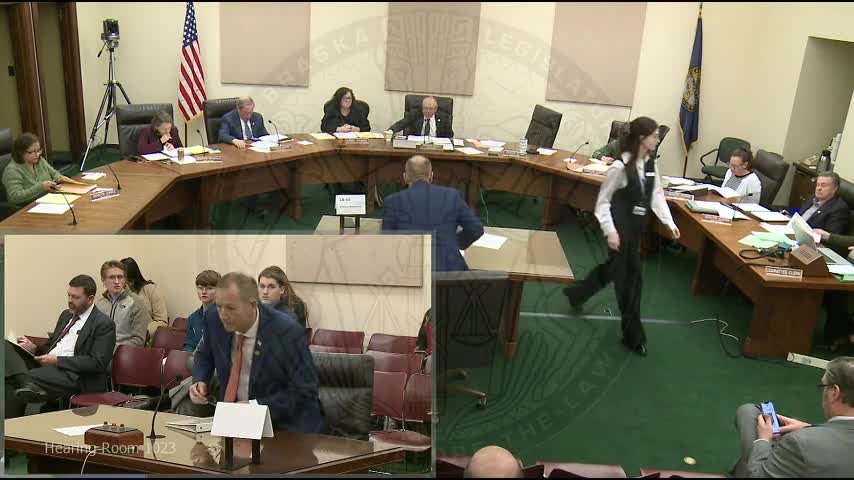
Senator Barry DeKay (R-District 40) presented LB 43 to clarify and narrow last year's law restricting foreign-adversary components near sensitive military installations, proposing to focus on electronic-related components and to define covered military sites.
Senator Barry DeKay (R-District 40) introduced LB 43 to amend provisions of last year's LB 1370, which requires electric suppliers to certify that equipment and components used within 10 miles of certain sensitive military installations are not manufactured by foreign adversaries listed by federal regulation.
DeKay said LB 43 narrows and clarifies the statute in several ways: it defines the covered military installations by citing applicable federal regulations, clarifies that the law applies only to electronic-related equipment and components (not general hardware such as nuts and bolts), updates the federal citation for the foreign-adversary list (moved to 15 C.F.R. § 791.4), and creates a process for electric suppliers to submit a one-time certification to the Nebraska Power Review Board (PRB) that their facilities meet the requirement.
"There were some concerns that LB 1370 applied to bolts, nuts, nails, and screws," DeKay said. "By limiting the bill to just electronics, it will be a lot easier for electric suppliers to work with their vendors and then to work with the Power Review Board to ensure compliance."
Supporters from the Nebraska Electric Association (NREA) and the Nebraska Power Review Board said LB 43 responds to implementation difficulties they encountered after LB 1370 became law. James Dukescher of NREA described examples in which non-electronic parts sourced through vendors could have blocked projects, and he said the bill's change to require electronic-related components only would avoid those outcomes. Tim Texel, executive director of the Power Review Board, said the bill clarifies which sites are covered — specifically Offutt Air Force Base and the missile-field area in Nebraska's Panhandle, defined by counties the U.S. government associates with the missile field — and provides a workable certification process that would not impede emergency repairs.
Opposition came from the Omaha Public Power District (OPPD). Seth Voyles, a registered lobbyist for OPPD, said the bill expands PRB oversight beyond the board's customary jurisdiction. OPPD noted the PRB historically reviews new construction and projects that cross utility service territories; OPPD argued extending oversight to routine maintenance, replacements, and upgrades would be a significant change and could impose operational burdens.
Texel, representing the PRB, said the original law's language and an ensuing attorney-general opinion had left utilities uncertain whether the statute covered more than the intended military assets and whether certifications were required for routine maintenance. LB 43 clarifies the covered geographic areas, narrows the rule to electronic components, and gives the PRB an administrative path to grant a limited exception if there is truly no acceptable alternative source for an emergency replacement part.
Committee members asked how often the certification requirement has affected work. Texel said the PRB receives notices sporadically — more frequently for utilities operating near the Panhandle missile field — and that staff review and respond to certification letters; the board meets monthly for matters that require board action. OPPD urged the committee to remove or narrow language that would require PRB involvement for maintenance and replacement of existing equipment, arguing the change would be an expansion of PRB authority.
Senator DeKay said he brought an amendment (AM 11) to clarify ambiguities and expressed willingness to work with utilities and the PRB to resolve concerns. The committee did not take a final vote during the hearing.