Get Full Government Meeting Transcripts, Videos, & Alerts Forever!
Get email alerts on the Child Protection topic
No spam. Unsubscribe anytime.
Senate committee advances bill defining child torture as first-degree felony with 10-year minimum
Summary
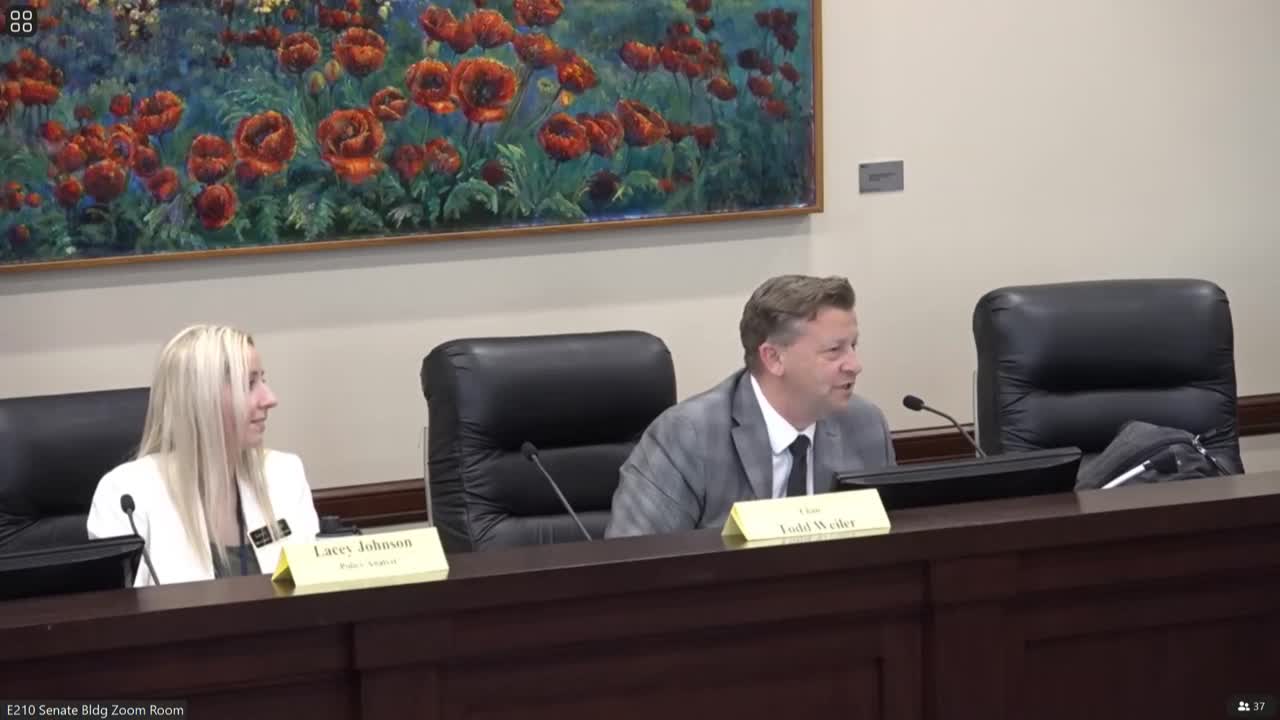
Senate Bill 24, the Child Abuse and Torture Amendments, was advanced out of the Senate Judiciary, Law Enforcement and Criminal Justice Standing Committee on a unanimous 4–0 vote after roughly an hour of testimony and questions.
Senate Bill 24, the Child Abuse and Torture Amendments, was advanced out of the Senate Judiciary, Law Enforcement and Criminal Justice Standing Committee on a unanimous 4–0 vote after roughly an hour of testimony and questions.
The bill’s sponsor, Senator Don Ibsen, introduced the measure and asked prosecutors and medical experts to describe the need for a separate criminal category. Eric Clark, Washington County attorney, said the measure would "define child torture, and make that a first-degree felony" and add a statutory definition of psychological injury. Dr. Antoinette Lasky, a child abuse pediatrician speaking for the Utah Children's Justice Centers, told the committee she and colleagues had evaluated cases of “severe torture” that included confinement, malnutrition, burning, electrocution and prolonged psychological abuse. "Survivors of child torture will have decades, if not their whole life, to work through the consequences of what happened to them," Lasky said.
Why it matters: Supporters said current statutes do not adequately address prolonged, intentionally cruel abuse when the child survives; they argued a separate offense and a mandatory minimum will better protect victims and give them time to recover before potential parole processes begin. "Giving a 10-year minimum mandatory gives them that runway into their healing process before they're even having to deal with any of those things," Clark said.
Opponents, including Mark Moffett of the Defense Lawyers Association and Steve Burton of the Defense Attorney Association, urged caution. Moffett said similar conduct already is prosecuted aggressively under aggravated child abuse statutes and argued the bill’s phrases — "exceptionally cruel," "exceptionally depraved," and "extreme physical or psychological pain" — are undefined and could give prosecutors excessive charging discretion. "These are standards without standards," Moffett said. Burton called mandatory minimums "problematic," saying they remove judicial discretion and risk disproportionate outcomes.
Prosecutors and victim advocates answered those concerns by citing multidisciplinary investigation practices and existing examples of long sentences in severe cases. Brett Robinson, with the Salt Lake County District Attorney's Office, pointed to other Utah statutes with mandatory minimums for the most serious crimes and said the proposal fits that pattern. Tom Ross, executive director of the Commission on Criminal and Juvenile Justice, testified the commission and the Victim Services Commission support the bill.
Committee deliberations: Committee members pressed witnesses on two recurring points: (1) whether existing statutes already allow lengthy incarceration and (2) whether the bill’s undefined aggravating-language could be grounded in case law or better-defined statutory phrasing. The chair asked prosecutors to provide case-law examples and for the attorney general’s appellate team to supply the precedents that informed the bill’s language. Senator Ibsen and witnesses said the phraseology was adapted from language used in aggravated murder case law and pledged to provide supporting citations to the committee.
Vote and next steps: A motion to favorably recommend SB 24 passed unanimously, 4–0, with the committee recording a caveat that the sponsor would continue working with stakeholders and committee members on possible floor amendments. The committee did not adopt statutory language changes at the hearing; senators said they expect additional drafting and data requests (including sentencing data) before the bill reaches the floor.
Ending note: Several witnesses emphasized the small number of cases but the high severity and lasting harm to victims; others warned against unintended prosecutorial overreach. The committee left the measure for continued refinement on the Senate floor.