Get Full Government Meeting Transcripts, Videos, & Alerts Forever!
Get email alerts on the Water And Sewer Rates topic
No spam. Unsubscribe anytime.
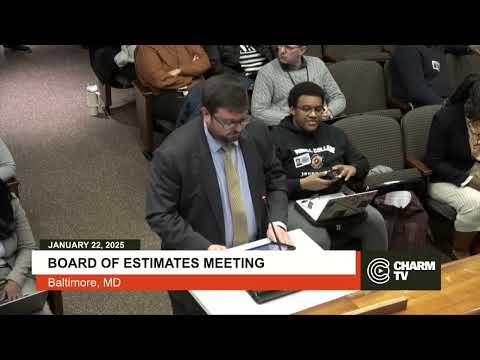
Baltimore Board of Estimates approves multi-year water, sewer and stormwater rate increases after public opposition
Summary
The Baltimore City Board of Estimates voted to approve Department of Public Works proposals to raise water, sewer and stormwater rates across fiscal years 2025–2027 after a public hearing that featured more than a dozen residents and advocates urging alternatives and expanded assistance programs.
The Baltimore City Board of Estimates on Jan. 22 approved Department of Public Works proposals to raise water and sewer rates for fiscal year 2025 and adopt multi-year increases for fiscal years 2026–27, with stormwater increases phased in during the latter two years. The board approved the measure with two votes in favor and one abstention.
The increases approved would raise water rates by 3% and sewer rates by 15% for the remainder of fiscal year 2025, effective Feb. 1, 2025, and would apply annual increases of 9% for water and sewer and 3% for stormwater in fiscal years 2026 and 2027, effective July 1 of 2025 and 2026. Department of Public Works interim deputy director Matthew Garbark said those FY25 increases would produce an average 9.66% increase on a customer bill and roughly an 8.45% average bill increase in FY26–27.
The measures follow multi-site public outreach by DPW and a public hearing at which nine in-person speakers and several organizations urged the board to reject the increases or seek alternative revenue sources. “We would not be requesting these increases were it not absolutely essential to operate and improve the systems that we have,” Matthew Garbark said during the department presentation.
Why it matters: DPW officials told the board the increases are driven by compliance costs tied to consent decrees, inflation, rising project and emergency repair costs, and higher contractor bids. Garbark said utilities expenses have risen nearly 38% in recent years and cited more than $230 million spent on improvements at the Back River and Patapsco wastewater treatment plants over the past two years. He described an emergency rehabilitation at Lake Montebello that is estimated to cost about $30 million — roughly 42% of the FY25 stormwater capital program total of $72 million.
Public testimony and alternatives: Dozens of residents, community advocates and union representatives argued the increases would hit low-income Baltimoreans hardest and urged alternatives including stronger collections from large commercial and tax-exempt institutions, expanding the city’s Water For All subsidy, and better enforcement of overdue commercial accounts. “Bottom line is, Baltimore City residents cannot afford even a $12 rate hike,” said Nika Namdi of the SOS Fund, who urged the board to reject the increase. Several speakers asked the city to press hospitals and universities for larger payments in lieu of taxes or to revisit pilot agreements that compensates the city for services those anchor institutions use.
City response and mitigation programs: Board members and administration officials countered that the water utility is an enterprise fund that must be self-sustaining and that property taxes cannot be used directly to stabilize utility operations. Mayor Scott emphasized that “the only money that goes in or out of it is what goes into the water system…Only when you pay your water bill,” explaining limits on shifting general revenues into the utility. The administration also described efforts to improve program outreach and enrollment in Water For All and other aid: Penny Lewis, manager of the Water For All program, said the program approved about 5,225 households in 2024 and that staff had enrolled roughly 313 families so far in January. DPW said roughly 12,000 households are now enrolled in Water For All overall.
Collections and unpaid accounts: DPW and administration officials described stepped-up collection activity, especially on commercial accounts. Director-level staff said the city has collected approximately $56.5 million from large commercial delinquent accounts in the past year, representing roughly 42% of the commercial outstanding balance targeted in recent collection efforts. The board and DPW said outstanding receivables across water, wastewater and stormwater total roughly $188 million (audit-year figure), with about 80% of the dollar value tied to commercial accounts and 80% of account counts on the residential side.
Workforce and contracting: DPW officials said part of recent cost increases resulted from external contracting used to meet permit and consent-decree requirements while the agency builds internal certification and staffing capacity. Aaron Moore, DPW chief financial officer, and other DPW staff described multiyear efforts to develop apprenticeships, partnerships with community colleges and programs (Be More Wise, YH2O) to build in-house operator capacity. DPW also identified ongoing contracts with Jacobs, ProStar and Hazen & Sawyer for support.
Board action: After questions and debate, a motion to approve the rate adjustments was moved and seconded. The board recorded two votes in favor and one abstention; the chair announced the motion carried. The board also instructed DPW to continue public outreach on assistance programs and to return with updates on collections and workforce development.
The vote and next steps: The rate adjustments take effect Feb. 1, 2025 for the FY25 increase and July 1, 2025 and July 1, 2026 for the FY26–27 adjustments. DPW and the mayor’s office said they will step up community outreach, accelerate Water For All enrollment, and continue commercial collection actions; board members requested periodic follow-up reporting on collections progress and program enrollment.
Ending note: The Board of Estimates reconvened said this action is intended to fund immediate compliance and capital needs; the administration said it will provide regular public updates on program enrollment, collections progress and capital spending to show how the revenue is directed.