Get Full Government Meeting Transcripts, Videos, & Alerts Forever!
Get email alerts on the Legal Ethics topic
No spam. Unsubscribe anytime.
State Bar board adopts ABA changes to RPC 1.16, stressing client vetting and withdrawal for suspected crime or fraud
Summary
The State Bar of Washington Board of Governors voted unanimously to adopt amendments aligning RPC 1.16 and its comments with recent American Bar Association guidance, emphasizing a lawyer's duty to "know the client," vet new matters and withdraw when a representation would further crime or fraud.
The State Bar of Washington Board of Governors voted unanimously to approve the Committee on Professional Ethics' recommendation to adopt the American Bar Association's amendments to Rule of Professional Conduct (RPC) 1.16 and two related comment changes.
The change adds a prefatory duty to "know the client" and assesses whether a lawyer has the time, competence and ethical ability to take a matter. It also adds a new subsection requiring withdrawal or seeking court permission to withdraw when a representation would assist a client in committing a crime or fraud, aligning the Washington rule and comments with the ABA's August 2023 amendments and accompanying ABA ethics opinion.
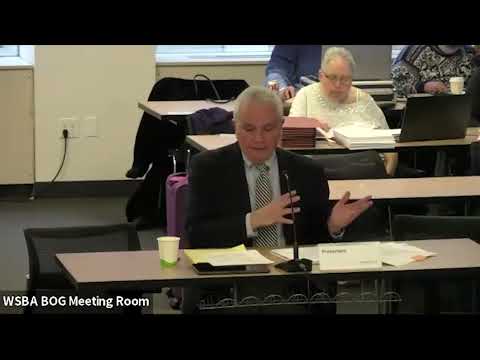
Mark Fusilli, subcommittee chair for the Committee on Professional Ethics, said the revision makes explicit duties that were previously implicit in the rules of competence and diligence. He summarized the core effect: the prefatory language "remind[s] lawyers" to ask whether a prospective matter is within their wheelhouse and whether the client's objectives are legitimate. Fusilli described the ABA's motivation as largely driven by concerns about money laundering and schemes that use lawyers' trust accounts to facilitate fraud. He told the board that the ABA also issued a comprehensive ethics opinion last summer explaining the amendment.
Chief Disciplinary Counsel Doug Ende framed the amendments inside the broader rules, saying, "1.16 prohibits a lawyer from representing or requires a lawyer to withdraw from representation if the representation will result in a violation of the rules of professional conduct." Ende added that related provisions such as RPC 1.1 (competence) and RPC 1.2(d) (limits on assisting clients in criminal or fraudulent conduct) support the change.
Several governors supported the recommendation during discussion. Governor Villeneuve described fast-moving intellectual-property matters and said he had observed "a lack of due diligence on the part of the attorneys" in some cases. Governor Ahern and others said the prefatory "shall inquire" language makes explicit an existing duty to investigate a prospective client and their objectives. Governor Fay moved to approve the committee recommendation; the motion was seconded and the board voted unanimously.
The materials provided to the board cited the ABA model-rule text and the ABA ethics opinion, and the committee's packet includes draft comment language (reflected in board materials at the cited pages). Committee members said the language is intended to be applied with a rule-of-reason approach: a long-time local client seeking routine work may not require the same level of scrutiny as a new, high-risk matter involving rapid transfers into a trust account.
The board did not adopt any Washington-specific expansion beyond the ABA's crime-or-fraud focus. Members discussed whether a broader civil standard should be included but concluded that existing duties of competence and court sanctions (e.g., rule 11 and discovery sanctions) already address some civil abuses. The board also discussed plans for education, including CLEs or a state ethics opinion, to explain how the amended rule should be applied in practice.
The action takes effect in the board's rules as adopted; no implementation date was specified in the meeting record. The Committee on Professional Ethics and State Bar staff indicated they will follow up with educational materials for members and may issue guidance clarifying how to apply the new prefatory inquiry in common practice situations.
Votes at a glance: motion to approve the Committee on Professional Ethics recommendation to adopt ABA amendments to RPC 1.16 and the associated comments — outcome: approved (unanimous).