Get Full Government Meeting Transcripts, Videos, & Alerts Forever!
Get email alerts on the Board Appointments topic
No spam. Unsubscribe anytime.
WSBA Board of Governors interviews six candidates for at-large vacancy; anonymous electronic ballot to decide winner
Summary
The Washington State Bar Association Board of Governors conducted interviews with six applicants to fill a vacant at-large governor seat. The board will use an anonymous electronic ballot; ballots will be tallied by the executive director and two designated reviewers. Runoff rules and balloting procedure were explained on the record.
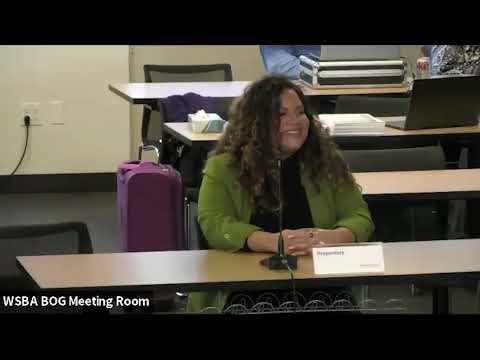
The Washington State Bar Association Board of Governors interviewed six candidates on the afternoon docket to fill the remaining term for a vacant at-large governor seat. Executive Director Nevitt told the board that each candidate would have 15 minutes—three minutes for an opening statement and 12 minutes for questions—and said the board will use an anonymous electronic ballot sent via SurveyMonkey to make the appointment.
The nut graf: The interviews featured repeated themes—mentorship for early-career lawyers, diversity/equity/inclusion work, outreach to immigrant communities and youth, and increased public-facing clinics and member engagement. Nevitt outlined the voting procedure and runoff rules for the selection, noting votes will be anonymous but the staff will be able to see whether a governor has cast a ballot and that the board will not disclose vote counts.
Board process and timeline
Executive Director Nevitt explained the mechanics of the appointment process and how voting will proceed. "Each candidate will have 15 minutes, 3 minutes to do an introduction, and then 12 minutes for you all to ask and for them to answer questions," Nevitt said. He also said: "If no candidate in the 1st round of voting receives a majority of the votes cast, then the 2 candidates that receive the highest number of votes will participate in a runoff." Nevitt added that the votes would be tallied by three people—the executive director plus Sara Nagowsky and Dan Clark—and that the board would announce the winner without releasing vote counts.
What the candidates emphasized
- Brooke Amster, a prosecutor who described herself as a "young lawyer," framed her pitch around mentorship and outreach. She said she would push for mentoring "between older attorneys and younger attorneys" and for community programs such as expungement drives and simple wills clinics. Amster also said she would pursue outreach to immigrant communities: "I think that maybe there should be some education on the rights of immigration, and migrants," she told governors.
- Christopher Bang highlighted civil-rights and DEI strategy work and said the board should develop "durable, realistic in scope, tangible in effect" DEI initiatives. Bang told governors he was prepared "to hit the ground running" and said he would seek invitations to internal committees where geographic diversity and DEI intersect.
- Minh (Minh) Kang emphasized outreach to youth, technology, and addressing burnout among lawyers. Kang said she wants to "reinvigorate" interest among young people in the legal field through scholarships, outreach and more visible programs.
- Nancy Hawkins described decades of service in family law and long-standing participation in Board of Governors meetings. Hawkins said she would like the board "to finish some of the projects that it starts, not get so overwhelmed with adding more projects that things get left behind," and stressed collegiality among members.
- Eileen Limerick, in-house counsel at McKinstry and a longtime volunteer with bar programs, said she would focus on member engagement, clarifying to members what the bar does and how they can participate. Limerick cited alternative licensing pathways and leader-development programs as areas to support.
- William (Bill) Trippett described a long legal and technical career and said he would apply an "equity filter" to board work and pursue inclusion initiatives, including tools for self-analysis of bias and steady implementation of the equity plan the bar has been developing.
Discussion versus formal action
The session consisted of candidate remarks and questions from governors; the board did not take a formal vote during the interviews. Nevitt instructed governors to watch for the emailed SurveyMonkey ballot and to check junk mail if they do not receive it. He reiterated the ballot rules: votes are anonymous but staff will know who has cast a ballot so they can follow up if necessary; results will be announced but vote tallies will not be released.
What to expect next
Nevitt explained runoff mechanics in detail: if no candidate receives a majority in the first round, the top two vote-getters will move to a runoff; if there is a tie for second place, the tied candidates and the top vote-getter will proceed. Nevitt said the board would carry out the tabulation, announce the winner, and would not publish the numerical vote count.
Ending
The interviews concluded after the sixth applicant presented. Governors asked follow-up questions on candidates' priorities, including access-to-justice clinics, mentoring, DEI strategy, outreach to immigrant communities and youth engagement. The board will decide the appointment by the electronic ballot process described on the record.