Get Full Government Meeting Transcripts, Videos, & Alerts Forever!
Get email alerts on the Board Governance Committee topic
No spam. Unsubscribe anytime.
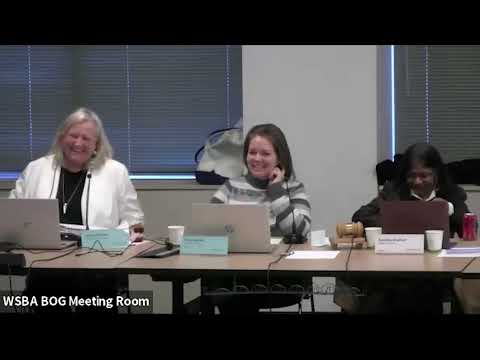
WSBA Board of Governors holds first reading of proposed governance committee; members debate scope, size and review authority
Summary
The Washington State Bar Association Board of Governors opened a first reading of a proposed governance committee charter Thursday, with debate over membership, scope and staff support.
The Washington State Bar Association Board of Governors opened a first reading of a proposed governance committee charter Thursday, inviting comments on committee membership, the committee’s scope to review bylaws and policies, and how the group would interact with WSBA sections and staff.
Board members said the proposal — included in meeting materials at page 484 with a draft charter at page 486 — is intended to create a standing committee to improve consistency across bylaws and board policies and to provide regular reviews of committees, sections and other entities created by the board. The board did not take a vote on the proposal during the first reading.
The proposal as circulated would create a multi-member committee with appointments made by the president. Discussion centered on three linked issues: how many members the committee should include and whether classes of governors should be represented; whether the president should serve as a nonvoting ex officio member; and whether the committee’s remit should include regular reviews of sections and the roughly 60 board policies posted on the WSBA website.
“That's what we should be doing with our section volunteers. I can't think of any easier way to drive away people than to do what's in the, the volunteer section here, which talks about when we get a volunteer, the first thing we do is teach them how to be a volunteer,” said Nancy Hawkins, an active section member who objected to what she characterized as an onerous oversight structure and urged the board to avoid imposing review requirements that would impede grassroots volunteer activity.
Former Governor Brent Williams Ruth disputed that view. “I disagree with everything that miss Hawkins just said,” he said, arguing the organization needs a body to pull together and clarify interrelated provisions across bylaws and policies and to create a navigable index and hyperlinks so members can see cross-references when reading the rules.
General Counsel Powers and Executive Director Navett both described the practical support staff would provide. Navett said, “my responsibility is to make sure that I am assigning appropriate staff resources,” adding that staff would provide subject-matter expertise and drafting support as the committee’s workload fluctuates. Powers noted that, beyond the bylaws, the WSBA currently has about 60 board policies on the website that also require review and indexing.
Board members debated membership rules in detail. Several governors suggested guaranteeing continuity by including at least one member from each governor “class” (first-, second- or third-year governors), while others urged flexibility so any governor willing to do the work could serve. One motion-style suggestion was a minimum committee size of five with an upper limit (a governor proposed five to 10 members) to balance continuity and manageability. Members also recommended keeping a running record of appointments to preserve institutional memory.
There was discussion about whether the president should be an ex officio, nonvoting member of the committee. A parliamentarian and several governors recommended explicitly clarifying that status in the charter; proponents said the president’s appointing authority and responsibility for committee appointments makes an ex officio role appropriate for continuity, even if the president does not vote.
The draft charter would designate General Counsel or a designee as the ongoing staff liaison. That proposal drew questions about how deep staffing support would be and how much drafting the general counsel’s office would perform; Navett and Powers said staff would vary their support by project and provide drafting and coordination to limit workload on volunteer members.
Several governors raised a terminology point: the draft used the term “triannual,” which some members noted can mean “three times a year”; several speakers recommended using “triennial” or explicitly saying “every three years” when describing periodic reviews.
No formal action or vote was taken; the item was presented for a first reading and board members asked staff to return with a revised draft that addresses the membership, scope language and the triannual/triennial wording. President Pacheco closed the discussion by encouraging interested governors to contact staff if they wished to be considered for appointment.
The matter will return to the Board of Governors for further consideration and possible subsequent readings or a formal vote.